
you’ve probably seen a smart bird feeder or know someone who has one. They’re recognizable with their clear housing, cameras, and solar panels, and perhaps a friend or family member has sent you a photo or video of a bright goldfinch or handsome woodpecker (guilty). The question at this point, then, is whether these feeders are really worth their $100-plus price tag. Are they actually durable? And what about the squirrel problem?
Lucky for you, I’ve been testing the most popular smart bird feeders, including Netvue’s original Birdfy Lite Feeder and Birdbuddy’s Pro, for almost two years—in rain, snow, and heat, and in a yard with persistent squirrels. I’ve explored the apps and notification settings, examined the photo and video quality, noted which features are hidden behind a subscription paywall, and used Cornell Lab’s All About Birds—as well as Google Lens and my own expertise—to verify the accuracy of AI identifications. The recommendations below are what I would buy with my own money, having tested dozens of brands and models for a minimum of four weeks each.
Updated April 2026: I’ve added the Birdfy Metal 2 4K, Birdfy Nest Duo, and CoolFly Aura smart feeders. I’ve also added a section on why most feeders run on 2.4-GHz Wi-Fi and have ensured up-to-date links and prices.
Featured in this article


Best Overall

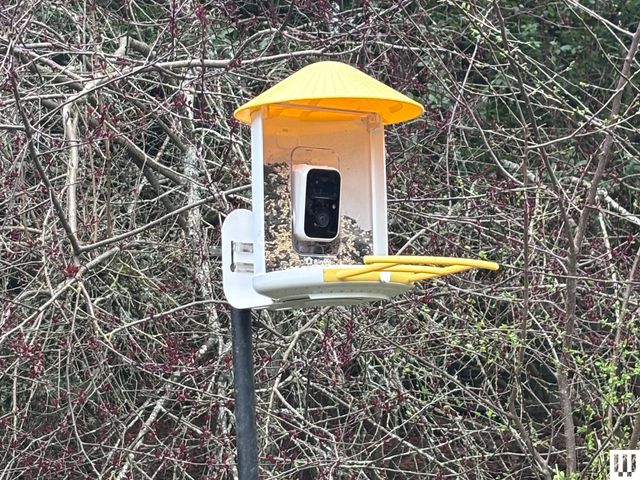
This cheery blue- or yellow-roofed feeder, from security company Netvue, is the first smart feeder WIRED tested, back in 2022. At that time, we gave it a 6/10 rating for its high price and wonky AI. Both metrics have improved dramatically since then—Birdfy’s app is now the second-most user-friendly on the market, behind only Birdbuddy, and this feeder is often on sale for $150 or less. If you pay $20 more, you get a lifetime subscription for AI identification, which is a solid deal, especially since the AI’s success rate is fairly decent. Without it, it’ll cost you $5 a month, but it’s not required to get plenty of enjoyment. As a bonus, this feeder is often discounted for Amazon Prime Day and other shopping holidays.
The 1080p camera isn’t the best quality you’ll find, but it does have one of the widest viewing angles of any smart feeder, at 155 degrees, so you’re more likely to get full bird shots, as opposed to just heads and butts. The IP65 plastic construction also makes this feeder durable and easier to clean, and the 50-ounce seed reservoir is super easy to fill with its convenient flip-up top. Not all bundles come with a solar panel, but you can buy it separately. Unlike with other feeders, the solar panel is not built in and needs to be mounted and connected separately with the included 9.8-foot charging cable. It’s not the fanciest feeder on the market, nor the one with the best camera, but the reliability and price point can’t be beat.
| Specs | |
|---|---|
| Camera(s) | 1080p photos, 2K video |
| Subscription? | No-subscription-needed model available, otherwise $49/year for AI ID |
| Solar? | Optional |
| Warranty | 2 years |
| Field of View | 155 degrees |
| Mounting options | Wall, pole, tree |
| Supported Wi-Fi networks | 2.4 GHz |
| How was test unit obtained? | Press sample from company |
| Where is it now? | Still in use rotation |
Best Upgrade
What would happen if Birdfy took all the winning elements other smart bird feeders—from its own line and from competitor products—and combined them? You’d have the Metal 2 4K. This IP66 feeder, the second generation of Birdfy’s original bright-green Metal 1, really does have it all: tool-free assembly, 4K ultrahigh-definition video, the ability to run on 2.4-GHz or 5.0-GHz Wi-Fi, a chew-proof metal body, and enhanced AI ID that is more accurate than the standard version and can even identify different sexes. In the Metal 2 update, Birdfy also did away with the brightly colored plastic in favor of tasteful green tones and a natural wood perch. This model comes with a metal grate that sits atop the seed tray for deterring squirrels, but as happened when I tested a similar setup from the brand CoolFly, small birds like chickadees struggled to access the seed with the grate in tact, so I ended up removing it. (I did like the grate design—it attaches to the tray with little metal bird feet that you can simply slide out of the way.)
Every detail of this feeder is dialed in, from the built-in solar roof down to the pole-mount sleeve with the Birdfy-logo thumb screw. I tested an early version that crashed after updating its firmware, so I’m not ready to make it the top pick just yet, but it is undoubtedly one of the more impressive new releases I’ve seen for 2026. It has done well in my month of testing, aside from the crash, but I will continue to update this review with my testing impressions throughout the year. Note that only the AI-included version is currently available; a subscription-only version (if you’d rather pay less and ID the birds yourself) will be available for a bit less around mid-May 2026.
| Specs | |
|---|---|
| Camera(s) | 4K (still images are captured from video) |
| Subscription? | No-subscription-needed model available, subscription price not yet known |
| Solar? | Built-in roof |
| Warranty | 2 years |
| Field of View | 120 degrees |
| Mounting options | Wall, pole, tree |
| Supported Wi-Fi networks | 2.4 GHz, 5 GHz |
| How was test unit obtained? | Press sample from company |
| Where is it now? | Still in testing |
Highest-Resolution Photos
Camojojo’s original Hibird feeder has long been a reliable model in my testing stable, unique for its ability to run on both 2.4-GHz and 5-GHz Wi-Fi bands—almost all smart feeders are 2.4-GHz only (learn why below) and last year saw the debut of an upgraded model, the Hibird Pro. The update has built-in solar panels; an option for pole mounting; and supposedly improved AI identification, though it still frequently misidentifies even common birds in my West Coast backyard as East Coast species. The app is not as streamlined or user-friendly as Birdfy’s or Birdbuddy’s, but it’s still easy enough to navigate, with options for changing video length (default is 10 seconds) or viewing in slo-mo. Video is the default media type it saves, though this is 4K Ultra HD. Without a subscription, you can’t search past videos by bird, and cloud storage is capped at 5 GB over 60 days, though the feeder does come with a 128-GB SD card. You’ll also get “smarter” chats with the app’s AI Q&A function, “Dr. Bird,” and the ability to share across two devices ($45 year/$4 month).
I appreciate the generous 1.5-liter seed hopper, though this, combined with the solar panel and battery, makes it one heavy feeder. When filled, it tips the scales at 5 pounds, so if you do pole mount, you will need to use both included hose clamps and wrench them tight. I also wouldn’t attempt to mount it on anything unstable. Other Hibird features transferred to the Pro are the assembly screws having little handles on them, so you won’t need a screwdriver, and a chunky IP66 plastic body. It was subjected to a little bit of squirrel chewing during my test, but still held up well.
| Specs | |
|---|---|
| Camera(s) | 32 MP photos, 4K video |
| Subscription? | Usable without, otherwise $45/year for increased storage and added features |
| Solar? | Yes |
| Warranty | 1 year |
| Field of View | 130 degrees |
| Mounting options | Wall, pole, tree, tripod |
| Supported Wi-Fi networks | 2.4 GHz, 5 GHz |
| How was test unit obtained? | Press sample from company |
| Where is it now? | Office storage |
Another Seed Feeder I Like

The Kiwibit Bird Feeder 2 is one of the most thoughtfully designed feeders on the market. The 1.5-liter dual-hopper plastic seed reservoir is removable from the body, so you don’t have to take down the whole feeder when refilling; the 8-megapixel photos and 4K HD video have much better quality than you’ll find from most competitors; and the components come apart for easy cleaning. I also tested the original version, which features a separate solar panel, and my only complaint was that the panel stopped charging the camera after about six weeks. This version features a built-in solar roof, which has done an excellent job keeping the feeder charged during its six-week-long test, even on cloudy days. The IP65 plastic body is extremely thick and sturdy, and unlike lighter-weight models, it’s designed to hold up in more extreme weather.
The app is easy to navigate, and the whole setup is fully functional without a Kiwibit Plus subscription ($4/month or $47/year, purchasable through the Kiwibit app)—it even includes AI identification as a base feature, which functions pretty decently. However, Kiwibit Plus is necessary to access the extended 60-day storage and the ability to record up to three minutes of video if a bird is doing something interesting—a unique feature among smart feeders, and one I discovered I love. (Nothing more frustrating than having a video cut off right as a bird is about to do something funny.) This smart feeder costs a bit more for what it is—and it’s almost never on sale—but if you know you like having a smart feeder, I think it’s worth the investment. Note, however, that it only works on 2.4-GHz Wi-Fi, and the warranty is half the length you get from many competitors.
| Specs | |
|---|---|
| Camera(s) | 8 MP photo, 4K HD video |
| Subscription? | Usable without, otherwise $47/year for extended storage and longer videos |
| Solar? | Optional |
| Warranty | 1 year |
| Field of View | 130 degrees |
| Mounting options | Wall, pole, tree |
| Supported Wi-Fi networks | 2.4 GHz |
| How was test unit obtained? | Press sample from company |
| Where is it now? | Still in use rotation |
Best Smart Hummingbird Feeder


Birdbuddy is known for its user-friendliness and thoughtful app—its Pro Smart Hummingbird Feeder is no exception. The feeder is intuitive and easy to use, and you don’t need a subscription to access fun features like AI identification, 5 MP photos, and 2K HD video with slo-mo. A subscription will unlock features like family sharing and a higher bit rate, but the feeder is perfectly functional without those. There’s also no auxiliary solar panel to worry about, as the panel is built into the feeder’s roof. Pairing with your phone is a cinch, integrating it into the Birdbuddy app with other feeders is a snap, and even refilling it is no problem. Unlike other hummingbird feeders that have weirdly cavernous capacities and/or need to be filled upside down, the Birdbuddy’s bottom screws off and holds a reasonable 1.75 cups of liquid. This is more important than you might think, as Cornell Lab of Ornithology points out that the easier it is to clean a hummingbird feeder, the more likely you are to do it often and well.
This feeder also comes with extra plastic flowers and a little brush for scrubbing them, and the app sends reminders when it’s time to clean. You’ll also find fun, seasonal touches in the app, like the ability to send digital bird holiday cards with the photos your feeder captures, and a tool that superimposes hats, clothes, and various accessories on the birds, which is actually funnier than it sounds. However, as with the Birdbuddy Pro seed feeder, below, the big downside is that the feeder’s sensor doesn’t always pick up every bird that visits, which can definitely be a bummer when you see something interesting out the window but it doesn’t show up in the app.
| Specs | |
|---|---|
| Camera(s) | 5 MP photos, 2K video |
| Subscription? | Usable without, $70/year for 2K Ultra HD video and added features |
| Solar? | Yes |
| Warranty | 2 years |
| Field of View | 122 degrees |
| Mounting options | Hang |
| Supported Wi-Fi networks | 2.4 GHz |
| How was test unit obtained? | Press sample from company |
| Where is it now? | Still in use rotation |
Best Smart Birdhouse

- Two cameras show two action views
- Pole-mountable solar panel was reliable in my testing
- Different hole sizes can be mounted for different species
- Wood requires upkeep
- Birds didn’t like mesh floor (it is removable)
After experiencing another round of connection issues with the Birdfy Polygon (see below), I swapped it out for the newer Birdfy Duo and have had no issues whatsoever. The sleek, contemporary Duo is a fir box fitted with two cameras—one facing the hole and one tucked away discreetly inside the feeder, so you can get a full-spectrum view of what’s going on. Both cameras have night vision (the internal one is infrared). Like the Polygon, the Duo sports a remote for rebooting and recharging the camera (though the separate solar panel, which can be pole-mounted, has kept the cameras reliably charged), as well as different-size holes for different species, each with its own chew-proof predator guard. There’s a metal grate with drainage holes that you can slot into grooves in the lower third of the Nest to make the cavity larger or smaller. The interested chickadees of my yard seemed very put off by the grate, so I covered it with a layer of moss. The Birdfy app will collect images and string them together in a shareable “story,” but I haven’t had any avian takers, so all my images are in the “Nesting” category. So far, the Duo has been rained on a bunch and survived a mild heat wave, but I can tell the wood will need refinishing after this season.
| Specs | |
|---|---|
| Camera(s) | 1080p photos, 2K video for both |
| Subscription? | None needed |
| Solar? | Yes |
| Warranty | 2 years |
| Field of View | 110 degrees diagonal, 92 degrees horizontal, 57 degrees vertical |
| Mounting options | Hang (it weighs 7.9 pounds), tree, pole |
| Supported Wi-Fi networks | 2.4 GHz only |
| How was test unit obtained? | Press sample |
| Where is it now? | Still in seasonal testing |
Smart Bird Feeder With the Best App


Birdbuddy’s Pro model sports a snazzy new HDR camera that can also shoot 2K video with slow-motion capability. In addition to having a visibly larger and more advanced lens, the camera’s now got a larger focus range, 122-degree field of view, and high-fidelity microphone. (A subscription to Birdbuddy Premium for $70 a year unlocks 2K Ultra with a higher video bit rate, allowing for richer colors, sharper images, and less background noise—plus the ability to set alerts for sick or injured birds, among other things—but it’s perfectly usable without this. )
The photos aren’t nearly as impressive as those by competitors like the Birdfy Pro Duo, Camojojo Hibird, or Kiwibit, and the camera, frustratingly, only captures a small portion of the birds that actually visit. However, Birdbuddy’s app is a consistent standout, with a user-friendly design and plenty of helpful alerts, like if a cat is detected nearby, or if it’s time to clean the feeder.
It also serves you insights gathered over time, like what time certain species seem to prefer to visit. (Finches apparently like to visit my yard at 10 am daily.) The Birdbuddy also “sleeps” at night and does not seem to emphasize capturing photos of people, so it wouldn’t make a good choice to double as a security camera, and there are also unique seasonal features like the ability to send holiday cards or “dress up” visiting birds with hats, glasses, and sweaters. (It is funnier than it sounds, really!) Both Birdbuddys work with 2.4-GHz Wi-Fi only.
Another Birdbuddy downside is the infuriatingly small, hinged opening for filling the 4 cups’ worth of seed. The feeder comes with its own spouted cup, but I have yet to fill the feeder without making an enormous mess. I also tested the 3-in-1 Nutrition Set ($39), which includes a screw-on tray that can variably become a water fountain, jelly dish, or fruit stake for fruit-loving species like orioles. I’ve used it as a jelly dish and water fountain and found that it blocks enough of the perch area that birds tend to shift out of camera view to avoid it. However, this feeder is still worth it for those who like a more streamlined app experience or want to take advantage of some of its unique sharing features, especially Premium’s ability to share your feeder livestream with others.
| Specs | |
|---|---|
| Camera(s) | 5 MP photos, 2K video |
| Subscription? | Usable without, $70/year for 2K Ultra HD video and added features |
| Solar? | Built into roof |
| Warranty | 2 years |
| Field of View | 122 degrees |
| Mounting options | Hang, pole mount |
| Supported Wi-Fi networks | 2.4 GHz |
| How was test unit obtained? | Press sample from company |
| Where is it now? | Office storage |
Disclaimer : This story is auto aggregated by a computer programme and has not been created or edited by DOWNTHENEWS. Publisher: wired.com



