Sports fans aren’t just being priced out of the arena anymore — they’re being priced out of the bar. A new Intuit Credit Karma survey of 1,747 fans, conducted by The Harris Poll, found that one in five say rising costs have pushed them out of watch parties and sports bars entirely. Not the $67,000 World Cup final ticket. Not the $279,804 courtside Knicks seat. The $12 beer.
So it’s not all that surprising to see sports fans tightening their belts and spending less money not only on tickets, but also going out to bars—or the opposite end of the spectrum, where sports fans are more willing to take on credit card debt to see their favorite team in action. According to a new Intuit Credit Karma survey of 1,747 sports fans conducted by The Harris Poll, the uptick in ticket prices is forcing a large split in the sports world: people are either eating the increased cost to go see a game in person, or they’re skipping out on the consolation prize of a sports bar entirely.
“Obviously it’s much cheaper to go to a bar and have a couple of beers than go to Madison Square Garden,” Courtney Alev, Consumer Financial Advocate at Intuit Credit Karma, told Fortune. “But even that has gotten really expensive for a lot of people—even those are becoming hard to overcome for a lot of consumers, even if they are fans.”
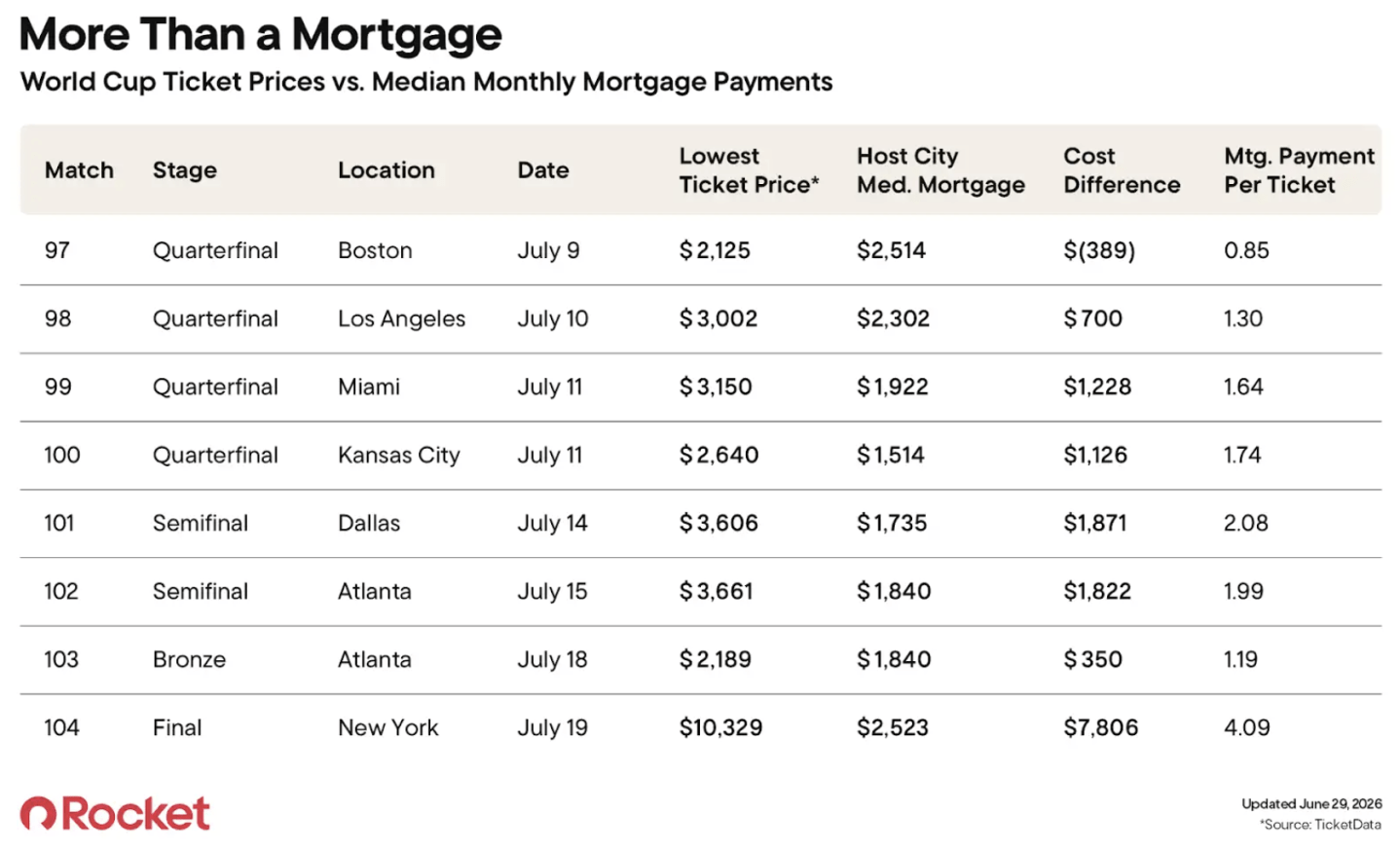
This is the split defining sports fandom in 2026: record ticket prices at the top, and a vanishing floor at the bottom. The cheapest seat to the World Cup Final in New York on July 19 costs $10,329—more than four times the city’s median monthly mortgage payment of $2,523, according to a Rocket Mortgage analysis of resale prices from TicketData.
Rocket
The Harris Poll, conducted between June 17–22, paints a picture of a fandom economy splitting in two. At one end: nearly half of sports fans (47%) say they’d attend a championship involving their team “no matter the cost,” with one in five saying they’d take on credit card debt to make it happen. Among fans ages 18 to 34, the same share said they’d dip into emergency savings. At the other end: 16% say they can no longer afford to attend any live events at all, even if they previously could afford to do so.
That means the middle is hollowing out. Among fans who say rising costs have changed how they engage with their fandom—57% of respondents—the cutbacks are across the board: 31% are buying less merchandise, 29% are attending fewer games, and 20% have cut streaming subscriptions.
Twenty-one percent say they’re going to fewer watch parties, bars, or restaurants, which Alev calls the most “eye-opening” stat in the study. “We know the cost of dining out is much higher,” she said. “But even that is becoming hard to overcome for a lot of people.”
Willing to take on debt to see their team win
New York Knicks tickets setting the record for the most expensive NBA Finals game (Game 3 tickets went for an average of $5,137; two courtside tickets sold for a record $279,804). The Knicks’ playoff run generated $380 million in economic activity for New York City, with each Finals home game worth roughly $90 million. World Cup tickets are determined for the first time ever by dynamic pricing, leading to record highs on both ends of the spectrum: the cheapest group stage ticket is priced at $167 and the most expensive final ticket is priced at $67,000. World Cup ticket prices, meanwhile, have drawn an AG investigation, a congressional inquiry, and even a public admission from President Trump, who said he “wouldn’t pay it either” for prices that had gone too far. For basketball, his advice to fans priced out of the NBA Finals was to “watch it on television.” That now seems to be what everyone’s doing.
The Rocket Mortgage data shows just how disparate the premium has become: In Miami, the cheapest quarterfinal ticket runs $3,150—$1,228 more than the city’s median monthly mortgage. In Dallas, a semifinal floor of $3,606 is more than double the local median payment of $1,735. Boston is the lone exception, where the quarterfinal floor of $2,125 comes in just below the local median mortgage of $2,514.
FIFA’s dynamic pricing model—deployed at a World Cup for the first time—has taken face values that started at $120 and sent them into the five figures, with the Final at MetLife touching $33,000 on the resale market. As Fortune has reported, economists have called the strategy less price discovery than a wealth filter, with the predictable result: superfans who’ve attended multiple World Cups are staying home.
For fans who do open their wallets, the motivation runs deeper than the game. The top driver of major sports spending, per the Credit Karma survey, is creating memories with friends and family (38%), followed by loyalty to a team or player (36%) and the in-person atmosphere (32%). Among 18-to-34-year-olds, social media—both what fans see and the desire to post—drives 33% of spending decisions.
“Consumers aren’t always evaluating meaningful experiences the same way they’re evaluating everyday purchases,” Alev said. “For a lot of fans, a championship game, a playoff run, a bucket-list event is something they’ve imagined doing for years—which can change how they think about the cost, to the extent that they don’t even think about the cost.”
There’s a generational edge to that emotional pull, Alev noted, saying the data consistently shows younger fans are especially willing to spend on experiences, and are especially likely to be influenced by what they see on social media. “It’s not just capturing the moment,” she said. “It’s I’m seeing people go, I want to be part of that.”
But being part of it has real financial implications. “We are seeing that especially for sports fans, these experiences are still worth prioritizing,” Alev said. “And that comes at a cost. We saw about one out of five say they were willing to make trade-offs like going into credit card debt, and for young folks, even dipping into emergency savings. This has real financial implications.”
“There clearly is a demand and a desire to attend these events to be a fan,” she said, “and I’m not surprised to see leagues continue to capitalize on that.” The NFL tops the league-by-league willingness-to-splurge rankings at 45%, followed by the NBA at 30% and MLB at 24%.
Her advice to fans tempted to splurge in a summer that has stacked the Knicks title run, the World Cup, and F1’s expanding U.S. calendar all at once: pause before swiping. “The scariest place to be,” she said, “is: I just put down $5,000 on this ticket, I make $40,000 a year, I’m going to be paying that off for years. Emotion or no, the moment to pause and reflect is what I’d encourage everyone to do.”
For fans who’ve already decided the answer is nothing , then start saving now. “If you know you’re a YOLO fan—any time my team’s in the championship, I want to go—put away $20, $50 a month,” she said. “Even if the Mets are out of the World Series for another five years, you’ve got a nice fund.”
Disclaimer : This story is auto aggregated by a computer programme and has not been created or edited by DOWNTHENEWS. Publisher: fortune.com