This article has been published in partnership with Forest Stewardship Council (FSC India).
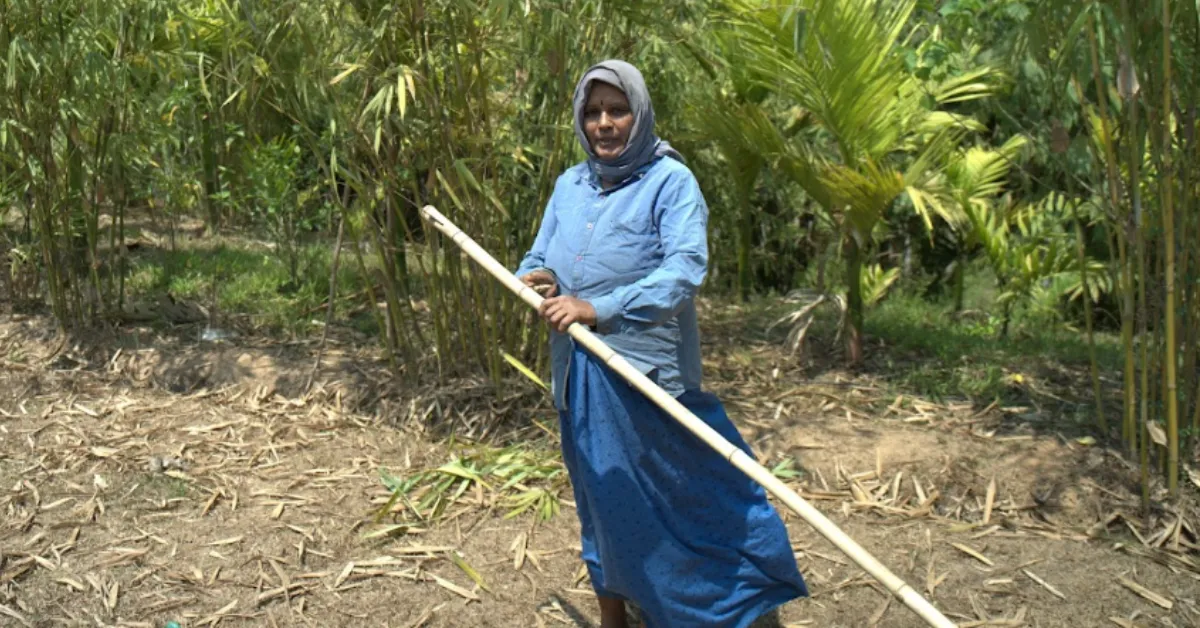
At first light, the bamboo leaves are still wet with the night’s moisture when Leelamani H.G. steps onto a small patch of land in Karnataka’s Shivamogga district. It is only 0.37 acres, but the land was once a degraded patch that gave her little reason to return.
Hundreds of kilometres away, in the rubber country of Kanyakumari, the light is barely in when K.M. Thomas walks into his plantation and begins the day’s work among the trees. Here, the first cut of the day is part of a routine he has known since childhood.
Bamboo and rubber may have little in common beyond coming from trees.
Yet for Leelamani and Thomas, the plantations are small pieces of land being managed as livelihoods, assets and long-term investments, and also as part of a system that asks a more demanding question of the people who grow forest-based products: can responsible forestry work at the scale of a small farm?
For decades, certification has seemed like a system designed for larger forest estates and organised producers. Yet much of India’s forest-based landscape is managed in smaller units like family plantations, home gardens, farms, community forests, and scattered plots.
Many smallholders have long followed practices shaped by experience and local knowledge, but have had limited access to markets or the systems needed to demonstrate how their land is managed.
That is where the Forest Stewardship Council (FSC) enters the picture.
FSC is an international non-profit organisation dedicated to promoting responsible forest management worldwide. Its certification framework is intended to ensure that forests are managed in environmentally appropriate, socially beneficial and economically viable ways.
In India, it works with forest owners, smallholders, businesses and communities to encourage sustainable forestry practices, protect biodiversity and strengthen rural livelihoods.
But a certification logo on a product begins much earlier than the point of sale. It begins on the land.
From a small patch to a new livelihood
For 55-year-old Leelamani H.G., the starting point was one acre of agricultural land in H Kallukoppa village under Purappemane Gram Panchayat in Hosanagara taluk, Shivamogga district, Karnataka.
She and her husband grew areca nut, but the income was seasonal. To supplement it, she also took up local catering work.
“Managing a small piece of agricultural land and depending mainly on areca nut meant that our income was limited and depended on the agricultural cycle. We had only one acre, so there was not much scope to increase our earnings from the existing land. That is why I was also doing catering work. I was looking for another opportunity that could give us an additional and more sustainable source of income.”, Leelamani tells The Better India.
The constraint was not the size of the farm. It was what that size allowed her to earn from it.
An opportunity arrived in 2022, when the Industree team came to her village to speak to farmers about bamboo cultivation.
She had a 0.37-acre patch of degraded land that was not productive. Instead of leaving it unused, she decided to plant bamboo.
“With a small farm, you cannot always depend on agriculture, but I wanted to see whether we could make better use of the land we had. When I heard about the bamboo plantation opportunity, I felt it could give us another source of income in the future.
She decided to take up the plantation on that patch.
The change, she says, was also psychological.
“Taking up bamboo cultivation gave me the confidence to make that decision and try something different on our land.”
Today, around 60 healthy bamboo clumps stand on that patch.
“I feel more confident about making decisions regarding the land. When I started, it was a small patch that was not giving us any productive return. Today, there are around 60 healthy bamboo clumps growing there. Seeing that transformation has given me confidence that even a small farmer can make use of underutilised land and create another livelihood opportunity.”
In 2025, Leelamani became part of the FSC-FM Group Certification. Her journey shows how a global standard can travel all the way down to a smallholding, giving farmers like her the tools to turn modest parcels of land into recognised, productive and more sustainable sources of livelihood.
Making a global standard work locally
A certificate may carry a global standard, but meeting that standard happens on the ground.
To understand how certification can work for India’s smallholders, The Better India spoke to Dr Suresh Gairola, India Country Director of the Forest Stewardship Council (FSC).
A former Indian Forest Service officer, Dr Gairola has more than four decades of experience in forest management. He has served as Director General of the Indian Council of Forestry Research and Education and Additional Director General of Forests (Wildlife), among other roles.
“Global standards with local relevance” is what Dr Gairola says India needs.
/filters:format(webp)/english-betterindia/media/media_files/2026/09/30/fsc-9-2026-09-30-17-34-38.png)
FSC’s framework has 10 Principles and 70 Criteria covering areas such as legal compliance, workers’ rights, communities, biodiversity and forest monitoring. But applying these requirements to thousands of small farms is different from applying them to a large plantation.
This is where group certification helps.
Several small farms can be covered under one FSC certificate. Farmers continue to own and manage their land, while a Group Entity handles common systems for training, monitoring, documentation and compliance.
This means smallholders do not have to manage the entire certification process on their own. They get support while continuing to make decisions about their own land.
For India, Dr Gairola says, the system also needs to reflect the size of its farms. “India’s situation is unique because here average land holding is 1-2 hectares and in other countries smallholders could have 200-300 hectares. So we have to understand naturally the requirements of large numbers of small holders.”
That difference in scale is central to making certification accessible. In India, responsible forestry has to work across thousands of smaller plots, with systems that can support farmers rather than treating them like large plantation owners. “India has a dedicated FSC certification standard for smallholder plantations less than 20 hectares. This is a much simplified version with ease of understanding, compliance and audit” he informs.
A plantation that follows the supply chain
In Kerala and neighbouring Kanyakumari district, the crop is rubber.
For 71-year-old K M Thomas, rubber cultivation began in childhood. His parents owned a small rubber estate, and the experience stayed with him even through two decades of professional work in Saudi Arabia.
/filters:format(webp)/english-betterindia/media/media_files/2026/09/30/fsc-2-2026-09-30-15-39-11.png)
“From childhood, I knew about rubber and plantations and how they were working with them,” he tells The Better India.
After retiring, Thomas returned to India and began looking at investment possibilities around Kanyakumari.
“I realised that if I invested in land and a rubber plantation, it would be safe for my retirement time,” he says.
Today, Thomas manages about 15 acres of mature rubber plantation at Bethel Estate in Manali, Kanyakumari district. The latex is supplied to New Ambadi Estate under an agreement. He also has about 30 acres at Green Land/Green Valley Estate in Kannan Kuzhi, planted in 2021 with around 5,000 rubber plants.
He expects those trees to be ready for tapping in 2028.
For Thomas, plantation management has become a long-term exercise in record-keeping and oversight.
“In the beginning of the rubber plantation, until we start tapping, we have to take care of the trees,” he explains. “After that, only manuring the trees and taking care of the estate is needed, and we can have an income for a long time.”
He regularly visits the plantation, checks the work and follows plantation activities.
“All the proper records are maintained, labour records, harvesting logs, pesticide usage, managing corrective action, and the CIP, the Continuous Improvement Process,” he says.
For Thomas, even the planting material is part of that decision-making process.
“I strongly believe that sampling from Ambadi is more healthy,” he says, referring to the nursery’s selection of seeds, monitoring of plant growth and removal of plants when problems are detected.
When trees become part of the farm
Further west, in Vaghnera village of Ukai taluka, Tapi district, Mohanbhai Sambhai Gamit has taken a different approach.
His farm combines eucalyptus with paddy. He manages about five acres of eucalyptus plantations spread across different locations while continuing normal agricultural cultivation. He also sells milk to a local dairy and makes and sells organic fertiliser.
“I have planted eucalyptus along with normal farming. I have merged the two,” he tells The Better India.
/filters:format(webp)/english-betterindia/media/media_files/2026/09/30/fsc-4-2026-09-30-15-47-39.png)
The approach means the trees are not simply replacing food crops. They form one part of a wider agricultural and livelihood system.
“I also use organic fertilizer on my farm, and I make it and sell it in the open market,” he says.
FSC certification, he says, gave him a clearer understanding of what happens beyond the farm.
“After FSC certification, there is a supply chain, and we have understood more about how that supply chain works,” he says.
For Mohanbhai, the intervention has also translated into an improvement in income.
“There has been almost a 30–40% jump,” he says.
His experience shows why certification does not by itself create a livelihood, but the systems around it can help farmers understand production practices, supply chains and the requirements associated with reaching responsible markets.
The people behind the certificate
Across Karnataka, Kerala and Gujarat, the crops are different. So are the circumstances in which these farmers entered forestry.
Leelamani began with a degraded patch of land. Thomas returned to rubber after retirement. Mohanbhai incorporated trees into an existing farming system.
Yet their experiences point to the same shift.
Certification can turn the day-to-day decisions made by people managing small parcels of land into something that can be documented, monitored and recognised within a larger market system.
The impact, therefore, is not only the certificate itself. It is the knowledge and systems that smallholders build around it.
A bigger forest story
Dr Gairola sees the issue against a larger environmental crisis.
“Urban and industrial emissions are one of the key reasons behind the problem of increasing greenhouse gases and climate change . Trees remain one of the best options because as they grow, they absorb carbon. Even when a tree is cut, the carbon remains locked in the wood for years. Trees also act like sponges and help improve the groundwater table. So we have to keep talking about the nitty-gritties, but explain them in an easy way. What we need to aim for is a global standard with local relevance and mainstreaming sustainability as a way of life.”
That final phrase captures the challenge.
India has a large number of small and marginal landholders. Bringing them into responsible forest-management systems cannot rely on the same approach used for a large plantation with a single owner.
And that is where the importance of certification lies.
For Leelamani, it meant looking at a degraded 0.37-acre patch differently. For Thomas, it meant following plantation work and latex beyond the trees themselves. For Mohanbhai, it meant understanding how his eucalyptus and paddy farm fitted into a larger supply chain.
The impact of responsible forestry is therefore measured not only in hectares certified, but in whether the people working those hectares have the tools, knowledge and market access to manage them for the long term.
The stamp matters. It is ultimately about creating value at both ends: plantation owners adopt more sustainable practices, while manufacturers reward responsible production with stronger market opportunities and additional financial benefits.
To know more about FSC certification in India, visit https://asiapacific.fsc.org/fsc-india or write to [email protected].
All pictures: FSC
Disclaimer : This story is auto aggregated by a computer programme and has not been created or edited by DOWNTHENEWS. Publisher: thebetterindia.com