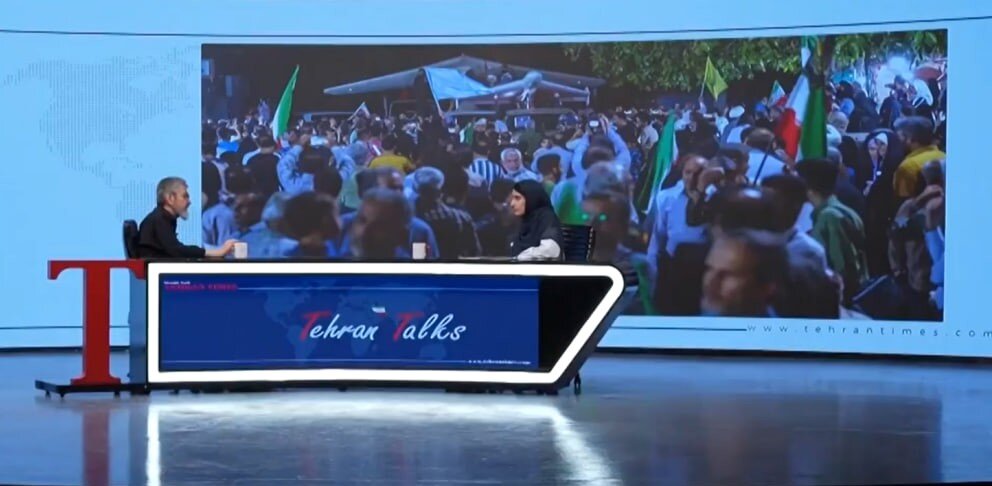
TEHRAN – In the weeks following the U.S.–Israeli invasion of Iran, an unexpected social phenomenon began to take shape across the country. Night after night, in cities large and small, people gathered in streets and public squares. What began as spontaneous assemblies gradually turned into vigils that continued for more than one hundred consecutive nights despite security risks, air‑raid warnings, and even occasional attacks.
These gatherings brought together people from a wide range of social backgrounds. Participants sang, mourned, talked, and simply stood together. For many observers, the persistence and diversity of these nightly gatherings raised important questions about collective identity, social cohesion, and the ways societies respond to external threats.
To better understand this phenomenon, the Tehran Times spoke with Kurosh Alyani, an Iranian cultural expert and author known for his work on narrative and collective memory.
Below is the full text of the interview:
Since the beginning of the war, people have come out into the streets and squares in both large and small cities. In some cases, the enemy even attacked these gatherings. Yet even then people did not leave the streets, and for more than a hundred nights they continued without interruption. In your view, where does this energy and motivation come from?
I think there is something fundamentally shared among all human beings and that’s the desire to survive. In fact, it’s not only humans; every living creature has a drive for survival. In different cultures this drive manifests in different ways, sometimes individually and sometimes collectively.
Because we have a long civilizational and cultural history, we possess many accumulated experiences, and these experiences help us better understand the value of collective survival. In other words, we understand that survival cannot be achieved alone; we survive together.
These gatherings were essentially a declaration that we want to survive together. To survive together means to live together, to shout together, to laugh together, to cry together, to sing together, to mourn together. The gatherings were an expression of collective life.
But they were not only about collective life; they were also about reclaiming space. We reclaimed the city and the streets from institutions. There was a time when if you gathered in the street, people would ask, “What are you doing here?” Now everyone knows what people are doing there. Everyone knows the street belongs to the people.
This process of reclaiming public space intersected with that collective instinct for survival. I remember that on the very first night there were announcements saying that people should evacuate large cities because there was danger. But people didn’t listen; instead, they poured into the streets.
A couple of times I personally witnessed situations where there was real physical danger. Air defenses were operating, and from the other side things were coming in. Sometimes the defenses intercepted them, sometimes explosions were heard—and the crowd only grew larger. Once, while I was returning home from a gathering, one of these incidents happened. I noticed that almost the entire street was moving in the opposite direction from me—toward the gathering. People who had been at home heard the explosions and came out into the streets instead of hiding.
To me it was the convergence of three things: a kind of collective awareness, a desire for collective life, and this movement to reclaim public space.
These gatherings seemed to include a wide range of social groups—different types of people, likely with different beliefs and opinions. What did you observe, and how do you analyze this diversity?
The desire for survival, and the awareness that survival can only be preserved collectively, created this situation. People know that others around them are different. They know there are many disagreements between them, issues that ideally should be resolved, or at least managed so they don’t turn into conflict. But at this moment there is a shared national objective.
This collective national goal has been understood clearly enough that it prevents disagreements from turning into confrontations. Differences are visible. People might discuss them calmly with one another. But they do not escalate into clashes. What struck me was that, despite the enormous diversity present at these gatherings, there were almost no reports of conflicts among participants.
One notable feature of these gatherings seems to be the strong presence of women and girls. What were your observations and thoughts about this?
This again connects to the movement of reclaiming the street. For a long time, there was a common attitude: if someone asked, “Why are you in the street?” a man could say, “I’m working,” but a woman was often expected to stay at home. People would simply say, “Stay home.”
Contrary to what many people assumed, this expectation was not necessarily based on ideology or religion. Even families that were not ideological often behaved this way in everyday life. At some point women demonstrated that if they want to be present, they can be. Until now perhaps they didn’t want confrontation or unnecessary arguments. But now they are there.
At midnight, on an ordinary night, you see women in the streets with an active presence—often even more active than the men. And they come from extremely diverse backgrounds: from the most religious groups to the most secular, from the most traditional to the most modern. Everyone is present together. No group is marginal in terms of presence.
At a time when many people believed there was some powerful force of repression, whether tradition or ideology, preventing such participation, these gatherings showed something else, and that was that either such a force does not really exist, or if it does exist, it is incapable of stopping people.
Do we see anything similar to this social phenomenon in the contemporary history of other countries?
People gathering together for social reasons—especially in response to threats—is not unusual. But I think what we saw here had a particular beauty to it. I’m not saying that simply because I’m Iranian and want to praise Iranians; I genuinely think it was beautiful.
I remember the gatherings of two different political groups in Beirut’s Martyrs’ Square—the supporters of Saad Hariri and the supporters of Hezbollah. For weeks and months, they lived in tents in the streets to make their voices heard by their fellow citizens and by the world. So, this kind of phenomenon is not unprecedented. In the 1960s and 1970s it was even more common, though it took different forms.
In recent decades the world seemed to accept the dominance of individualism. But now it feels as if collective action is suddenly re-emerging from beneath that surface.
You could see something similar after the events of October 7. Around the world people gathered to protest the massacre carried out by Israel. Those demonstrations were themselves very diverse. We have had Christians, Jews, and Muslims standing together, alongside leftists who are strongly antireligious.
Logically and practically, these gatherings cannot continue forever and will eventually end. In your view, how can this social capacity be sustained and used constructively?
When strange historical events occur—like when the Pope crowned a German ruler as the Holy Roman Emperor—many people at the time probably thought the situation would last forever. And in some sense, it did continue.
So perhaps these gatherings will continue longer than we expect. We don’t know.
But regarding the social capacity you mentioned, what has emerged is a network. We now have a network with its own nodes and connections. Relationships have formed neighborhood by neighborhood. This network could become a powerful resource for improving collective life. Even in simple ways, people can help one another. Someone might say, “Does your child need help with school? I’m a teacher.” Another says, “I’m a doctor.” Someone else says, “I’m a plumber,” or “I’m a baker.”
People can support each other. Some may be good at navigating bureaucratic processes. If someone in their neighborhood has a problem with the municipality, the water authority, or the electricity office, they can help follow up. So, these networks could be directed toward improving everyday life.
They could also become networks of awareness. Right now, these gatherings are largely centered around mourning. The main theme is that we have been struck by shameless blows, and we are mourning those losses. In English, if I’m not mistaken, this kind of gathering is sometimes called a vigil.
Our awareness at the moment is largely intuitive rather than analytical. These gatherings could gradually become circles of awareness—spaces where people exchange, correct, and distribute knowledge.
People can discuss questions such as: Why does the United States behave so brutally? What allows them to act this way? Does it relate to the history of colonialism? Is it related to the Middle East—or should we call it West Asia? Does that terminology actually affect how conflicts unfold, or is it merely an obsessive sensitivity?
These and many other issues could be explored through such circles of awareness.
The United States and Israel claim they have significant influence inside Iran, and some evidence—such as sabotage or assassinations—may support part of that claim. We know that their main plan was to connect airstrikes with street unrest and eventually push the situation toward regime change. But the opposite seemed to happen, and social unity actually increased. How do you analyze the gap between their claimed influence and this apparent miscalculation about Iranian society?
We, as Iranians, have roughly seven thousand years of civilizational history. That means we have accumulated a great deal of experience.
When the Mongols came and besieged Nishapur, people resisted and refused to open the gates. Eventually some people concluded that resistance could not continue forever. They decided to negotiate in order to save themselves—essentially sacrificing the city so that they and a few associates could preserve their own position and prosperity. According to the widely held popular narrative, they secretly agreed to open the gates of the city to the Mongols. When the Mongols entered, however, the first people they executed were those very collaborators. Their reasoning was that anyone who betrays their own country will eventually betray us as well. Better to eliminate them immediately.
Whether or not every historical detail is perfectly accurate is not the point. What matters is that this story has remained in the Iranian collective imagination. It reinforces the idea that survival is collective, especially when there is an external threat.
When those powers assumed they could attack Iran, threaten it, and create internal division, they failed to estimate how Iranians react to external threats. They did not properly assess how Iranian responses differ from those of Americans, Spaniards, Norwegians, or others.
When you lack such an assessment, mistakes are inevitable. It is not mysterious. Miscalculations happen because they lacked a proper understanding.
We live in a world that ultimately runs on calculations. You cannot calculate based on guesses—especially guesses about another culture. If you are guessing the density of iron, you might get close. But human societies are not like that. Cultures do not all behave with the same “specific gravity.”
You have studied narrative and even written a book about it. I’d like you to analyze this from a narrative perspective as well. What is the significance of the story of these nightly gatherings, and how should it be told to nonIranian audiences?
If I answer this question carelessly, I could say that anyone can tell the story however they want. But if I answer it carefully, the issue becomes more complicated.
In the strict sense, narrative is often something that forms unconsciously in the human mind. We do not fully control it. We can express or transmit narratives, but we do not completely create them. So perhaps the decision is not entirely ours.
There is a story in Rumi’s Masnavi: a man dreams that a spiritual figure tells him to go to a hill the next day, shoot an arrow, and wherever the arrow lands he will find a treasure. The next day he goes to the hill, draws his bow, and then realizes the figure never said which direction to shoot. He shoots north, digs—nothing. He shoots south, digs—nothing. He tries every direction, digging everywhere, but finds no treasure.
The king sees him digging holes everywhere and assumes he must be searching for treasure. The man is arrested and tortured so he will reveal where the treasure is hidden. Eventually he insists that he knows nothing; he only followed a dream. The king concludes he is simply a fool and releases him.
Afterward the man dreams again of the same spiritual figure and complains that the dream ruined his life. The figure replies: I gave you a precise instruction. I told you to release the arrow. I did not tell you to draw the bow first. If you had simply released it, it would have fallen at your feet—and the treasure was right there.
Often, we feel compelled to pull the bow—to force things toward perfection. But sometimes what is needed is simply to let the arrow fall. Perhaps we should resist the urge to manipulate events for the sake of a perfect narrative. Instead, we should simply convey what exists.
Life does not require our artistic direction. What matters is that we transmit what is happening without distorting it.
Disclaimer : This story is auto aggregated by a computer programme and has not been created or edited by DOWNTHENEWS. Publisher: tehrantimes.com