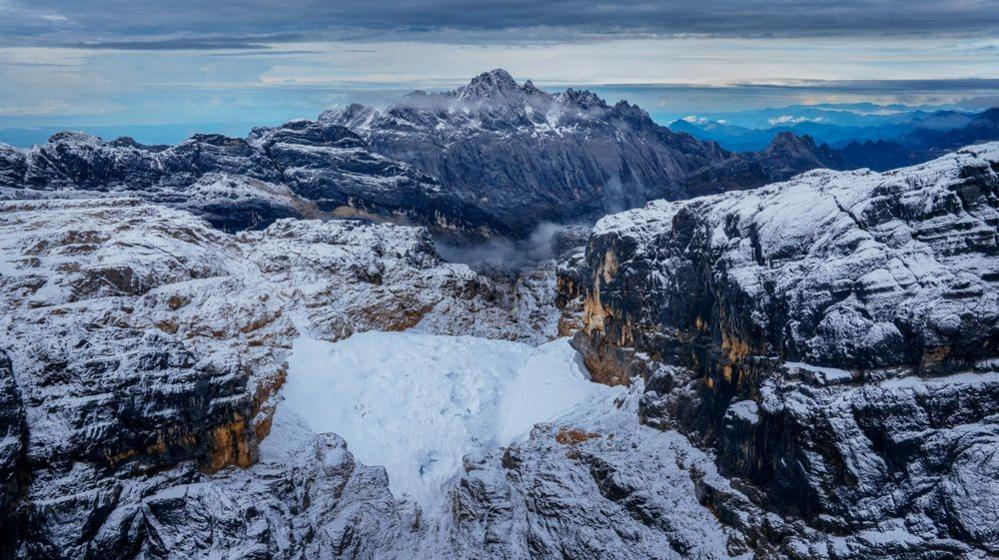
The treasured ‘eternal snow’ on this tropical island is about to disappear forever
-
Published
The mountains of Papua are not far from the equator, but they’ve been topped with “eternal snow” for centuries.
The peaks in this Indonesian region on the world’s second-largest island, just north of Australia, have offered scientists countless insights into the Earth’s climate history.
They’re also the epicentre of the spiritual universe for many Papuans – a Mecca or a Vatican, as one activist puts it.
But now, nearly all the snow is gone.
A century ago, the 300km (190-mile) stretch of the Sudirman Range had snow and permanent ice on all four of its major peaks.
But now there are only small areas around Puncak Jaya, also known as Carstensz Pyramid, with any snow at all. These are expected to entirely disappear in a year or two.
Glacier cover around the peak has shrunk from nearly 1,900 hectares (4,700 acres) in the 19th Century to about 16 hectares (40 acres) today. Almost entire glaciers have vanished within a human lifetime.

“There is a profound unfairness in this,” says Marie Šabacká, a Czech glacier ecologist who travelled to Puncak Jaya last March in a bid to be among the last scientists to study Papua’s “eternal snow”.
She says the tropical glaciers in Papua are unique because they are separated from other glacier systems by thousands of kilometres. Papua is home to the “last remaining tropical ice” between the Andes and Himalayas.
Ice cores taken from the slopes of Puncak Jaya preserve a record of climate history.
Scientists can use them to obtain information about atmospheric conditions in the region and understand changes in the planet’s warmest ocean waters that surround the island – the tropical Pacific and Western Pacific Warm pool.
But this archive is disappearing before scientists have had time to fully study it.

Proof of a warming planet
The retreat of Papua’s glaciers is driven by the same forces affecting ice around the world, Šabacká notes, a warming atmosphere caused by human activity, including the burning of fossil fuels like coal, oil and gas.
As temperatures rise, the freezing point moves higher up mountains, so more precipitation falls as rain instead of snow, even in places that once saw regular snowfall.
El Niño events can accelerate this process, while local factors such as cloud cover, snowfall and mountain topography influence its pace.
The mountains in Papua are just 450km (280 miles) south of the equator, where “permanent ice can survive only at very high altitudes and within a narrow range of climatic conditions”, Šabacká says.
A small increase in temperature, a higher freezing point or shift from snowfall to rainfall can determine whether a glacier survives at all, she adds.
The glaciers’ retreat is evidence the Earth has been warming over a long period – and their disappearance “removes both a biological habitat and part of a culturally significant landscape”.
 Image source, Marie Šabacká
A spiritual anchor
At least five groups of Indigenous people have had strong spiritual ties to Puncak Jaya for generations.
The Moni people refer to it as Mbainggela, and believe their ancestors watch over the mountain. To the Amungme people, the range is known as Nemangkawi, or the “White Arrow”.
“Parents and grandparents prayed their children would have hearts like the White Arrow, never straying from the proper path,” says Elfrida Natkime, a young Amungme woman. “It symbolises honesty, purity and moral integrity.”
According to traditional Amungme beliefs, Nemangkawi symbolises how people should live.
Amungme environmental activist Adolfina Kum stresses how important the peak is to her people – and how traditions and cultural foundations risk being shattered as the ice melts.
“How would Muslims feel if Mecca were destroyed? How would Catholics feel if Rome or the Vatican were destroyed?” she asks. “For the Amungme people, that is what it feels like when Nemangkawi is destroyed.”

For many Indigenous Papuans, the disappearance of the glacier is not an isolated event.
The discovery of vast copper and gold deposits transformed the region during the 20th Century, and the development of extractive industrial projects have reshaped parts of the landscape.
Entire mountain faces have been excavated and roads, industrial infrastructure and settlements have transformed surrounding valleys.
Papuans say the development has brought jobs, roads, education and economic opportunities, but also environmental degradation and decades of social conflict. Some have lost access to their ancestral lands as mining expanded.
The BBC has approached Freeport, which operates Papua’s Grasberg mine, one of the world’s largest gold and copper operations, for comment.
“Every time I see the mountains, I feel amazed, but I also feel sadness,” says Elfrida Natkime. “Since the company came, I have seen the exploitation. But the development has also provided a livelihood for many people.”
 Image source, Project Pressure/Klaus Tymann
As local communities watch their sacred landscapes change, scientists and explorers are racing to document what is left.
Using drones and three-dimensional mapping techniques, Danish researcher Klaus Thymann and his team have created a detailed model of what remains.
From the early 2000s to 2025, the glaciated area has receded by 95%, he says. “There’s almost no ice left. Those are the facts.”
Thymann says glaciers are “incredibly powerful” as indicators of climate change.
“When people hear that something described as ‘eternal’ is disappearing, it triggers a reaction,” he explains.
Adolfina Kum believes communities “lose an important source of strength” when sacred mountains, forests or ancestral places are disturbed.
“I often describe it as pulling out the roots of a tree. Once the roots are removed, the tree loses its foundation.”
-
-
Published11 June
-
-
-
Published17 September

-
-
-
Published12 September

-
Disclaimer : This story is auto aggregated by a computer programme and has not been created or edited by DOWNTHENEWS. Publisher: newsrss.bbc.co.uk