In New York, the United Nations General Assembly is gearing up for its big annual session, starting on Tuesday. Which foreign leader will the United States prevent from attending (last time it was Mahmoud Abbas of the Palestinian Authority) along with the judges it has blacklisted from the UN’s International Criminal Court?
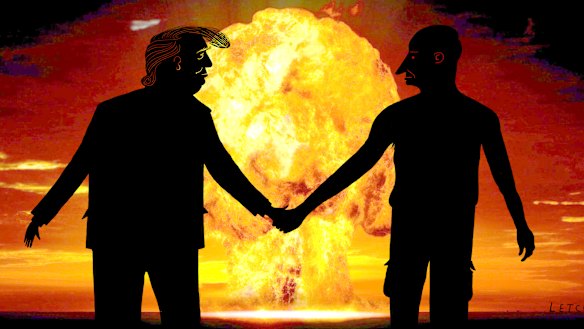
Benjamin Netanyahu is always made welcome, but this year might he be arrested by order of the city’s new Muslim mayor, Zohran Mamdani? Will Vladimir Putin, the truly evil emperor responsible for over half a million deaths, have the effrontery to attend an organisation with a UN Charter purpose to “end the scourge of war”? At a Chatham House seminar last week on the subject “what is the UN good for?”, the most agreed answer was to run the Universal Postal Union.
Of course, there are a number of well-run UN agencies, mostly headquartered in Geneva and Vienna and Nairobi. They are necessary – indeed indispensable – for international co-operation on climate, health and nuclear proliferation. But the primary purpose of this organisation is world peace. In this regard, it is an abject failure as its Security Council watches passively while hundreds of thousands of civilians are killed by bombs, drones and bullets in the 56 armed conflicts (involving fighting by 92 UN member states) currently being waged across the world.
The reason for its failure is no secret. The design of the international order, which dates back to 1945, leaves the General Assembly as not much more than a talking shop with actual power reserved to the Security Council and, in reality, to its five permanent members which can veto any action that it should take. The council is now, and for the foreseeable future, pole-axed: Russia vetoes any resolution for a ceasefire in Ukraine, just as China will veto any attempt to stop a possible invasion of Taiwan; and the US, on behalf of Israel, has vetoed various actions in relation to Gaza (although, at Trump’s insistence, it has rubber-stamped his “Board of Peace”, notwithstanding the unlikelihood of it ever living up to its name).
For other deadly conflicts where the identity of the aggressor is clear – Myanmar, Sudan, the Congo and so on – the Security Council does nothing.
Scholars and diplomats have for years urged reform: limiting or abolishing the veto, expanding the number of non-permanent members, strengthening the role of the General Assembly – but to no avail. The “Big Five” – Russia, the US, China, the United Kingdom and France – will never surrender their veto power voluntarily and will use it to stop any reform that might undermine it. Many nations favour at least one change – to stop the veto being used to prevent action in relation to atrocities – but this has been rejected by the “Big Three”, the US China and Russia.
The other blind spot is that the UN, and the international law that it supports, does nothing to protect democracy. The very word is not mentioned in its charter and the two authoritarian permanent members will keep it that way, so the UN can do nothing when democratic governments are invaded or overthrown. There has been talk, ever since former US secretary of state Madeleine Albright started it, of a “coalition of democracies” – 40 European countries plus 56 from the Commonwealth and Brazil, Japan and others.
But the weak link is the Commonwealth, which has had no effective presence in the world since it led the fight against apartheid in the 1960s. The agenda for the Commonwealth Heads of Government Meeting, in Antigua this November, is full of happy-clappy talk about the virtues of cricket and “investment for a prosperous Commonwealth”, but not for taking any political action for peace.
So the UN remains the best we can do for this purpose. It will need a new leader. The dogged but defeated Antonio Guterres retires in December. The UN lacks any proper system for appointing its leader, who is decided in secret by the Security Council and rubber-stamped by the General Assembly. If an inspirational leader was sought, most nations would probably vote to bring back Barack Obama, but he is excluded on many grounds, not least because of the general agreement that the next secretary-general should at long last be a woman.
A job for Julia Gillard? No, because of an agreement that it is the “turn” of someone from Latin America. The likelihood is that it will come down to a lowest-common-denominator choice of a diplomat from that continent unlikely to ruffle the feathers of any of the Big Three.
There is a looming practical difficulty caused by the Trump administration’s tendency to deny visas to leaders they do not like, such as Abbas, and judges and lawyers of the ICC who need to enter America to report to the UN. The organisation cannot function properly if its officials are banned from access to its iconic building beside the Hudson River on land donated to it by Nelson Rockefeller (which the UN could sell – perhaps to Trump himself – for more than its unpaid US contributions).
Many countries are asking whether now is the time for it to find a new headquarters. Emmanuel Macron will make his swansong at the General Assembly this year, and may well offer a palace in Paris, where the UN began and had its most memorable moments (such as on December 10, 1948, when Eleanor Roosevelt presented the Universal Declaration of Human Rights to the president of the General Assembly, Dr H V Evatt, who would become Australia’s Labor opposition leader).
Nations in favour of moving the UN headquarters away from New York have been clear that its new location should be in the Global South. Could we offer Melbourne? It may not have an opera house – a requirement for any city that takes itself seriously – but it would inject some tourists and cosmopolitan life to the nation’s biggest metropolis. The UN would be safe with a federal government and a people who support its values – in ways that the American government certainly does not.
Geoffrey Robertson, KC, is a human rights lawyer and former UN war crimes judge. He is the author of World of War Crimes: Eyeless in Gaza … and Beyond.
Get a weekly wrap of views that will challenge, champion and inform your own. Sign up for our Opinion newsletter.
 Geoffrey Robertson KC is a London-based Australian human rights barrister and founding head of Doughty Street Chambers. He is the author of Rather His Own Man: In Court with Tyrants, Tarts and Troublemakers.
From our partners
Disclaimer : This story is auto aggregated by a computer programme and has not been created or edited by DOWNTHENEWS. Publisher: www.smh.com.au