
When the Wallabies crashed to a record loss to England in their first game of the spring tour, the statistics made for ugly reading, in both defence and attack.
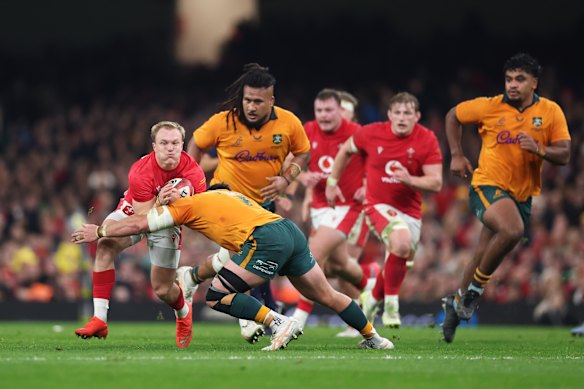
But over the next two weeks Australia turned their game around so much that they posted one of the best performances of all the Nations Championship teams – based on the same stats – in their win over Wales; particularly when defending their own line.
Ahead of a return to Twickenham for the fifth-place playoff against Ireland on Friday, however, the ill-discipline that forced the Wallabies to tackle so much in their red zone is a flaw that will prove fatal against the world No.2 side, unless fixed.
The Wallabies’ defence – and morale – was ripped apart by England in a 45-22 thumping at the start of the month, when they conceded 621 carry metres (4.93m per carry) and ten clean breaks. It continued a disturbing pattern seen in both Bledisloe Cup losses, and raised questions about the Wallabies’ new defensive system under Les Kiss and Scott McLeod.
The defence responded strongly in a wet-weather clash against Scotland the following week, cutting the conceded carry metres by more than half to 305m (2.03m per carry) and allowing just one linebreak. Even in a more open clash against Wales at the weekend, the Wallabies held their rivals to 394 carry metres (3.23m per carry) and four clean breaks.
The Wallabies’ strength in the collisions was clearly better, with five dominant tackles against England rising to 11 against Scotland and 10 against Wales.
Where the Wallabies really shone against Wales, though, was in defending their own tryline – and they had to do plenty of it. The Welsh had 20 entries into the Wallabies’ quarter but only scored 26 points, at a rate of 1.3 points per entry.
That was the lowest figure of games involving top ten sides at the weekend (Scotland’s 1 point per entry in a 67-5 win over Japan was the only one lower).
The Wallabies held Wales up three times over the line, with Welsh captain Dewi Lake saying post-game that the Aussies had pulled the “Uno reverse card” on them – doing exactly what the Welsh had done against the All Blacks a week earlier, when they held them to 1.8 points per entry, from 16 entries.
“Our defence, when we do it well, it’s a real point of difference for us,” Wallabies captain Harry Wilson said afterwards. “When we bring the line speed, we put teams under pressure, and I thought our D-zone (own quarter) defence was unbelievable. We probably took a bit from what Wales did last week against the All Blacks. It’s just people really working hard for each other.”
Helped by a dramatic reduction in turnovers (from 19 against England to eight against Wales), a tour-high five wins on contestable kicks and a big improvement in gainline carries (50 per cent), the Wallabies’ effort at the other end of the field was just as effective. With far less possession and territory, the Wallabies struck with 2.9 points per entry on nine visits to the Welsh red zone. Again, excluding Scotland’s big win over Japan, that was the highest of all the Nations Championship teams at the weekend.
The progress bodes well for the Wallabies as they seek to finish the year on a strong note against Ireland, who they almost beat in the opening Nations Championship game back in July.
But one troubling stat column will be jumping off the page for Kiss: discipline.
The Wallabies conceded a season-high 14 penalties against Wales, and 11 were given away in their own half. It provided the Welsh with multiple corner lineouts, and though Australia mostly defended the maul well, they also conceded three maul tries. Banking on a strong maul defence to stop a key weapon of Ireland won’t be a winning strategy for Saturday morning (AEDT).
Meanwhile, reserve halfback Kalani Thomas talked up the importance of always staying ready after an impressive performance from the bench in the second half against Wales.
The 24-year debuted against France on the spring tour last year, and also played against New Zealand and Argentina this year. But for a youngster who has been unused for 16 Tests, and had just 34 minutes of experience in Test rugby before the weekend, Thomas’ assured 22-minute stint was impressive.
“It’s always challenging not getting game time,” Thomas said. “It’s sort of a cut-throat sport, but my job each week is just to either prep the boys that are playing, or if I do get a chance, then Kissy’s big on owning your readiness.
“So that’s one thing that the boys that haven’t played, we really pride ourselves on is knowing our knowledge and knowing that it’s a next-man-up mentality. Kissie’s really onto that.”
Waratahs halfback Teddy Wilson was initially selected as the squad’s third halfback, allowing Thomas to join the Australia A tour of the USA to get game time. With Tate McDermott expecting a child back home, Thomas was originally due to join the tour last week, but he ended up flying from the US to do the full tour.
News, results and expert analysis from the week in sport sent every Friday. Sign up for our Sport newsletter.
 Iain Payten is a senior sports reporter for The Sydney Morning Herald.Connect via X or email.
From our partners
Disclaimer : This story is auto aggregated by a computer programme and has not been created or edited by DOWNTHENEWS. Publisher: www.smh.com.au