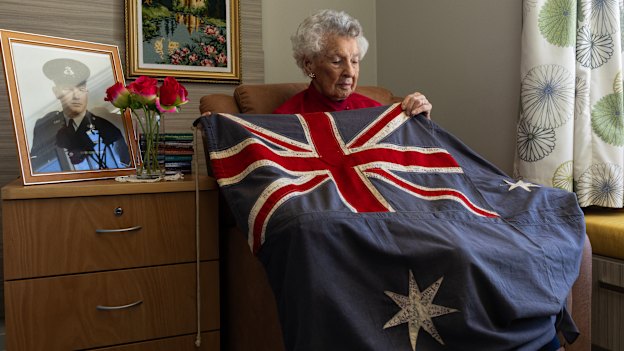
This is not just a flag – and not just any distinguished-looking older lady.
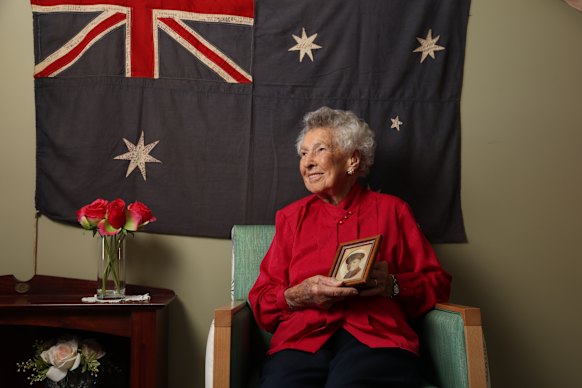
Since the death of her husband nearly two decades ago, Hazel Donaldson – nudging towards 106, and living in a retirement home in Forster, NSW – has been the keeper of the flag, and the prime teller of its extraordinary story.
No less than 84 years ago, see, her man, Private Alan James “Jimmy” Donaldson from up Urunga way, was a member of the Australian 8th Division, as they fought for their very lives against Japanese forces storming the shores of Singapore with three divisions of armed troops. In those terrible days of February 1942, the Australian 8th Divvie took the brunt of the fighting, and though only forming 14 per cent of the defending Allied soldiers, suffered nearly three-quarters of the casualties. By the time British commander General Arthur Percival walked forward with the white flag of unconditional surrender, no fewer than 1789 Australians had been killed, 1306 wounded and 15,395 taken prisoner.
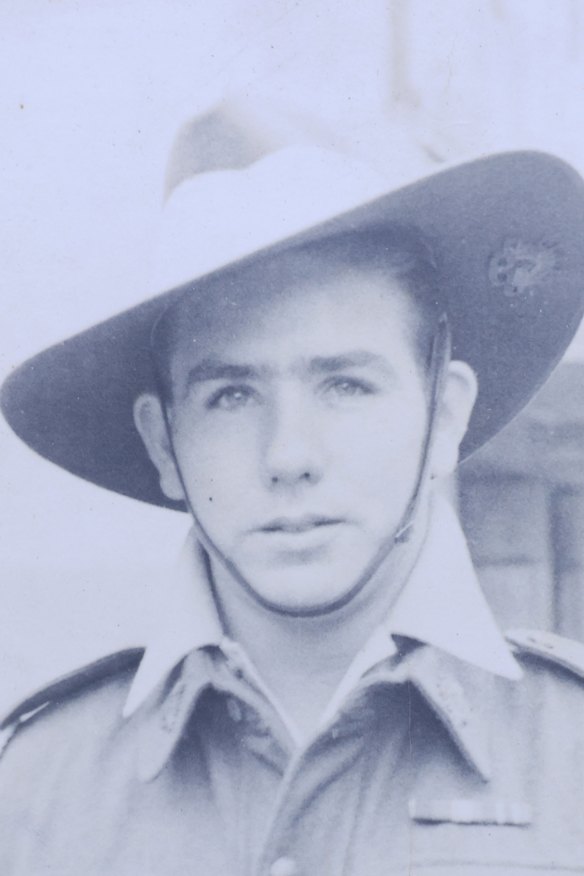
“But my Jim,” Hazel says softly, “was one of the survivors.”
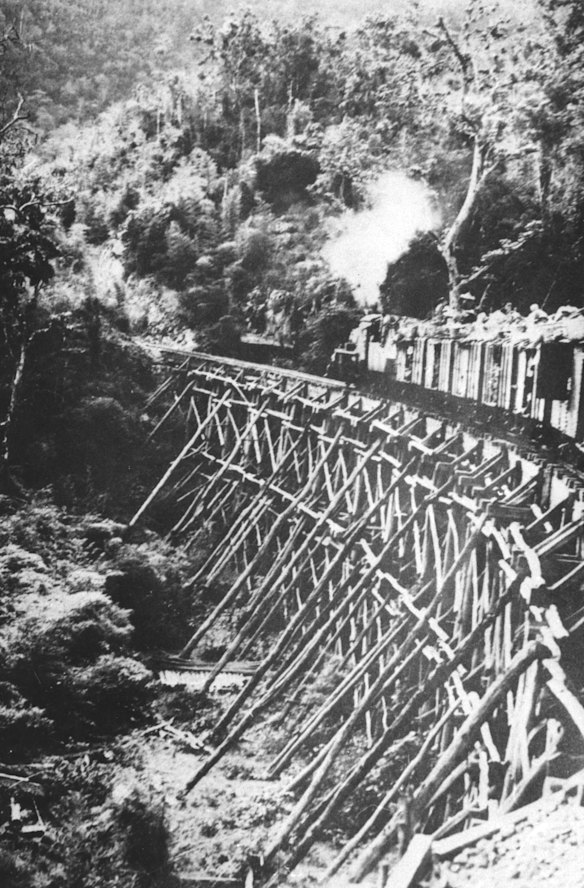
So far, anyway. For after spending three months in Changi Prison, Jim Donaldson found himself working as one of many thousands of other Australians on the infamous Thai-Burma Railway, that long streak of misery that runs through the jungles and mountains of Thailand and Burma – built at the behest of the Japanese to serve as a possible supply route for an attack on the jewel of the British Empire, India. On starvation rations, the working days of men like Jim began at dawn, and went into the night by the light of bamboo torches, digging such cuttings as Hellfire Pass and Hintok. Dozens of Jim’s close mates went to their grisly deaths as victims of starvation, malaria, cholera and Japanese brutality. At night, they’d fall asleep with the acrid smoke in their nostrils of their fellow Australians being turned to ashes in the cremation pits.
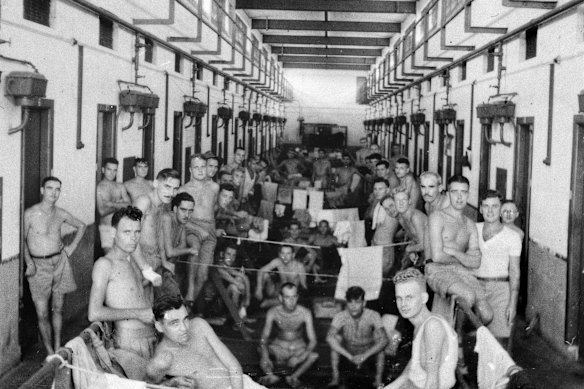
Finally, unable to bear it, Jim made a break for it in the company of an American POW, Otto Carl Schwarz, intending to fight with Chinese guerillas in Malaya. They managed to get 480 kilometres through the jungle before being recaptured. After being beaten savagely by their Japanese captors, the two POWs had their wrists bound by wire and looped around a tree, and were left there for three blistering hot days and dark nights without food or water. The only way they were able to keep alive was by their mates risking their lives in the wee hours to crawl out to give them sustenance – at first with water-soaked handkerchiefs to rub on their parched, cracked lips; then with canteens; and finally hard biscuits and small portions of rice saved from their own starvation rations.

Eventually, as the war sputtered to an end in the days after the bombs were dropped on Hiroshima and Nagasaki, Jim Donaldson found himself in a POW camp in Saigon, with 68 Australians, 200 Americans and a smattering of a scattering of other Allied POWs judged too sick to be sent to the slave labour camps in Japan.
The only thing that had kept him alive to that point, he later told Hazel, was the hope he could last long enough to see her again.
At last, the great day comes. Something has changed. American bombers are flying overhead, unchallenged. The Japanese officers are observed whispering to each other, some tearful.
“The war is over?” one of Jim’s mates hazards to a Japanese guard.
“Yes,” the guard replies. “We now friends.”
“Like hell we are.”
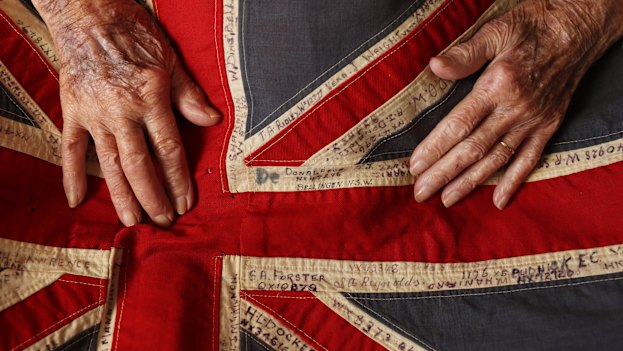
In short order the Japanese flag that had fluttered over the camp is torn down, and one of the Australian POWs from Melbourne, gunner Tich Hudson of Box Hill, gets to work with scissors and an ancient sewing machine. To begin, he carves enough red strips and white strips from the dismembered flag of the rising sun to form the Union Jack. In the same fashion he carefully cuts out the shape of the different-sized stars to form the Southern Cross and the Federation Star. For the base of the flag he uses the blue bordering material of some Japanese mosquito nets, and sews the strips and stars onto the blue. For a halyard, he uses cord from a parachute.
When the flag is finished, to universal acclaim, every one of the 68 Australian POWs in the camp signs it, and it is hauled up the pole where the Japanese flag used to be – believed to be the first Allied flag raised in a liberated POW camp in Asia.
Weeks later, they are, at last, heading home, home to Australia.
The one-time Hazel Pryor takes up the story from a more intimate point of view.
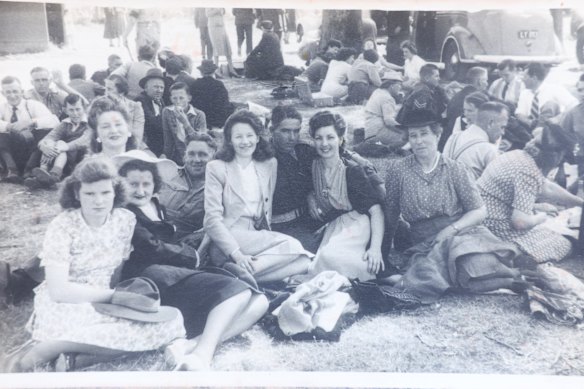
When “my Jim” came down the gangplank of the Highland Chieftain troopship after it pulled into the finger wharf of Sydney Harbour on a shining morning of October 11, 1945, she was waiting for him, having come down all the way from Tamworth. No, they weren’t engaged or anything, but they knew they loved each other, and she had burst into tears when she’d received a message that Jim was alive.
But which one is Jim?
The man she had farewelled from Tamworth five years earlier had been a robust son of the Southern Cross. This ghostly scarecrow giving her a wan death’s head grin is no more than six stone (38 kilograms), about half the weight he had been. But it’s him all right: Jim!
“I gave him a cuddle,” she says, “and never really let him go after that.”
Emptying his kit on the afternoon of his arrival, he shows her the flag all his mates had told him to look after, and told her its story. After she has nursed him to be healthy enough to stand before the altar, they are married ere a year had gone by.
Through their various households over the seven decades of their marriage – including a long stint in Cootamundra where Jim was a police sergeant – the flag would be proudly brought out for special occasions, and taken to regular reunions of the other signatories, men, Jim told Hazel, “closer to me than brothers”.
Those brothers in arms are all gone now, every man Jack of them, with Jim being one of the last to go, back in 2009.
Of course, he left the flag to Hazel, and asked that when she goes, its only slightly moth-eaten form be bequeathed to the Australian War Memorial.
Advised of the flag’s story, and its final destination, Australian War Memorial director Matt Anderson said on Monday: “The Australian War Memorial would be honoured to receive the Australian National Flag into our collection, should that be Hazel’s wish. Here it will tell the story of Jimmy and his mates, their resilience, mateship and courage, to generations to come. And we are more than happy to wait a decade or longer.”
“And that is what I will do,” Hazel says softly, “when my time comes.”
Not that, mercifully, there’s any sign of that yet. She doesn’t think she’ll make 120, but reports “I still feel strong.”
(And for the record, she looks and sounds strong, too.)
Long may she go on.
Start the day with a summary of the day’s most important and interesting stories, analysis and insights. Sign up for our Morning Edition newsletter.
Disclaimer : This story is auto aggregated by a computer programme and has not been created or edited by DOWNTHENEWS. Publisher: www.smh.com.au