
Fashion
The editorial world of jewellery tends to move in a fairly predictable vocabulary, one built around carats and clarity and the shine of a stone under studio lighting. But none of it has a word for what Pippa Small actually does. Her materials sound almost too plain to belong in a jewellery feature at all – hand panned gold, glass blown by a single craftsman outside Ramallah, silver cast straight from an olive leaf plucked off a tree in Bethlehem. And yet somewhere between the workshop and the wrist they gather a kind of luxury mainstream fine jewellery houses simply do not know how to articulate, because putting on one of her pieces feels less like wearing metal or glass and more like donning decades of someone else’s family history. “There’s a human being here,” Small reflects. “There’s a story behind this, and I think that just makes it more meaningful.”
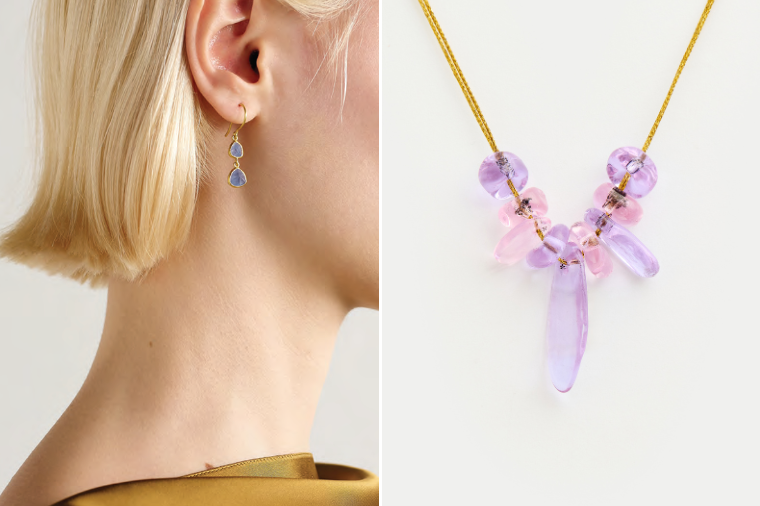
Azaz, Small’s hand-blown glass collection, was created in partnership with Palestinian glassblower Mohammed Twam, whom she met in Jaba’ in spring 2025 through her longstanding relationship with the charity Turquoise Mountain. He’s a collaborator she speaks about with something close to awe. Twam has been working with glass for more than 40 years, and Small describes him as someone whose craft is his whole world, a man who might wake at two in the morning with an idea and go down to his workshop in the dark, losing track of time until he looks up and it is seven. “He’s someone who really lives and breathes his craft,” she shares, describing his workshop tucked inside his own home, his grandchildren wandering in and out, food cooking somewhere close by, a scene she called intimate and luxurious in a way no showroom could ever manufacture. During one of their early meetings, he dropped a piece of his work onto the concrete floor and it bounced without a crack, dismantling every reservation Small had about bringing something so seemingly delicate to be worn as jewellery, and Azaz, meaning glass in the local Palestinian dialect, was born from those quiet conversations.

Bethlehem Garden, the other of Small’s two Palestinian collections, began with the Golden Zaytouna workshop, run by father and son Tawfeeq and Samer Qattan alongside Nadira Alaraj, a former economics professor who fell for the craft and never left. Their signature technique casts silver or gold around an actual olive leaf, which burns away in the firing and leaves behind its imprint. “It’s such a hugely symbolic thing,” Small says. “It contains something across all faiths, across the region.” From there came acorns, almonds, baby figs, lemons and baby pomegranates, a walk through a Palestinian garden in early spring, when everything is still tiny and shaped by the season. “A seed, no matter what, just represents everything to me,” Small shares. “It’s this tiny container that holds life, and it will grow into something bigger than us.” Alaraj, an avid bird watcher, once walked her out to one of the oldest olive trees in the Middle East, an afternoon Small credits with grounding the whole collection in something larger than a workbench.

For Azaz, Small brought a bag of ancient beads to one of her first meetings with Twam. “I’m a bit obsessed with ancient beads,” she confesses, and together they worked out how to blow glass solid enough for daily wear while keeping the worn, uneven feel she loves, the strength coming from repeated firing in the kiln. The palette – teal, amber, a wild translucent pink, a soft lavender – was new territory for a designer who tends to favour materials pulled straight from the earth. “It feels like a little amulet,” she said. “Finding joy in challenging times, that’s how I see them.”

The silver Bethlehem Garden pieces launched only a week before our conversation, while the gold creations had been released gradually over the past few years as the collection found its footing, roughly five years after her inaugural trip to Palestine set it all in motion. The first Azaz collection launched around October last year, while a second, built around shells, seed pods and twisted glass coils, was recently revealed. What threads both collections together is a conviction Small has carried through her career, that a piece of adornment can hold the same weight as a story passed down at a kitchen table. She trained in anthropology at SOAS before working in grassroots human rights across Borneo and the Philippines, and that instinct for listening before designing has carried her through not just Palestine, but Colombia, Myanmar, Jordan, Afghanistan and Bolivia. “When we know where we’re getting our materials, and we’re buying directly from miners, we can’t be happier,” she says, recalling a goldsmith in Myanmar who will not touch his tools if he is in a bad mood, in case it absorbs into the gold. Small’s own mother, a committed socialist, once told her that making jewellery for wealthy people was not something to be proud of, and the jewellery has spent decades proving there is another way, built on transparency and relationships that outlast a single order.

Looking ahead, Small is drawn to olive wood carving around Bethlehem and a possible collaboration in Syria, where the absence of local gemstones has pushed her towards chains inspired by Damascus ironwork instead. “I have so many books now on Syrian craft and heritage,” she admits. Even through a screen, it’s impossible not to sense how much of herself Small has folded into this work. She laughs at the observation. For her, the connection is instinctive – something deeply felt rather than consciously sought out. Because ultimately, these pieces are not simply about what can be made but what deserves to be remembered.
October’s—The Discovery Issue—Download now
– For more on luxury lifestyle, news, fashion, and beauty, follow Emirates Woman on Facebook and Instagram.
Images: Supplied
Disclaimer : This story is auto aggregated by a computer programme and has not been created or edited by DOWNTHENEWS. Publisher: emirateswoman.com




