
Christopher Beanland
All around the world there are dozens of abandoned airports. Some have been repurposed in interesting ways while others have been left as odd memorials, attracting hardened urban explorers who film YouTube videos in the dusty shells of these once-grand terminals.
Longhua Airport, Shanghai, China
Longhua’s claim to fame was that it housed the young JG Ballard and his family after the Japanese broke the colonial peace in Shanghai during the Second World War. Ballard remembers his parents going from casual G&Ts by the pool to being interned on the fringes of Longhua’s runways in his book Empire of the Sun. In Steven Spielberg’s film adaptation, Christian Bale plays young “Jim”, obsessing over the Japanese planes and pilots while watching adults have slow breakdowns. The film famously paid for a new Ford Granada for Ballard.
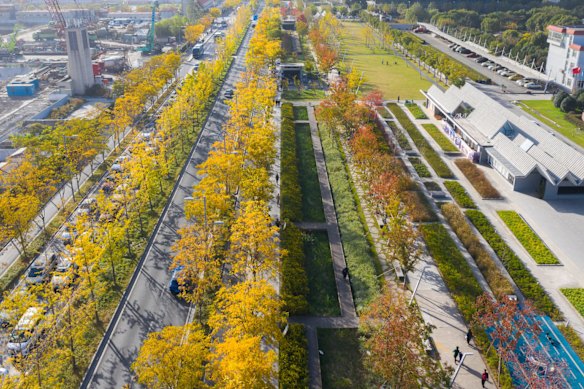
Longhua was Shanghai’s main airport for decades, but since 2020, it has been re-imagined as a sustainable urban park named Xuhui Runway Park, with linear paths remembering the lines of the runways.
Ellinikon Airport, Athens, Greece
Sign up for the Traveller Deals newsletter
Get exclusive travel deals delivered straight to your inbox. Sign up now.
It seems almost inconceivable that such prime real estate so close to the centre of a major European capital city (and next to the sea) could have stayed unused for so long, but somehow the grounds of Ellinikon held out for a quarter of a century after its 2001 closure. Athens built a new, larger airport further away from the city for the 2004 Summer Olympics and actually used some of the Ellinikon grounds as venues for the games. Yet the dilapidated terminals sat empty, enticing urban explorers.
Today, however, a major redevelopment plan is in full swing, with a predictable pack of high-end apartments, a 1000-bed Hard Rock Hotel & Casino, shopping centre, yacht marina, offices and sports facilities coming.
Tegel, Schönefeld and Brand-Briesen airports, Berlin, Germany
Berlin is the world capital of abandoned airports. Its two main Cold War airports were Schönefeld (East) and Tegel (West). Schönefeld (SXF) lies forgotten at the fringes of the city’s fully functioning Berlin Brandenburg Airport (BER), which cannibalised the SXF runways and was itself a ghost airport for years until completion in 2020. For a time, it served as BER’s “Terminal 5″ but has not been used since the main new BER terminal finally opened.
Elsewhere, Tegel – a brutalist, hexagonal beast – will welcome tech incubators and new housing over the coming years, while nearby Brand-Briesen, the former airship hangar at the old Brand-Briesen Airfield is the centre of Tropical Islands, a giant indoor resort.
Sheffield City and Doncaster-Sheffield airports, UK
Aviation in South Yorkshire has not been wholly successful. Sheffield fancied a new airport in the 1990s and built itself one – but with a very short runway. This worked at London City (just), but thrifty Yorkshire folk were keener on cheaper flights and the 737s and A320s of low-cost airlines could not land there. It lasted from 1997-2008 and managed to attract KLM flights to Amsterdam and Sabena to Brussels, along with domestic choices. It’s now a business park, but much infrastructure remains.
Elsewhere, the old RAF Finningley became Robin Hood Airport from 2005, before changing its name to Doncaster-Sheffield and closing again in 2022. Though it is hoped it will re-open there is now argument over the complex financing, so it’s not a done deal.
Nicosia International Airport, Cyprus
This abandoned airport is likely to stay abandoned for the foreseeable future. When the Turkish-Greek conflict of 1974 turned into open warfare, Nicosia was caught in the crossfire. It is now stuck bang in the Green Zone between Cyprus and the self-declared Turkish Republic of Northern Cyprus (TRNC).
The UN’s main peacekeeping force on the divided island is based at the fringes of the airport, and no one can visit. Cyprus replaced it with Larnaca and Paphos airports, while the TRNC built Ercan.
Tempelhof Airport, Berlin, Germany
Berlin’s most daring airport transformation is at Tempelhof. It opened in the Weimar years, but it’s better known for its Nazi associations, as Hitler greatly expanded the huge, curved building. It was used in the Berlin Airlift and has housed asylum seekers in more recent times.
Having closed in 2008, it is now a sprawling park that attracts thousands of locals and tourists (and dogs) every weekend. The runways and taxiways have been preserved with old airliners dotted about, making it a hub for aviation enthusiasts.
Kai Tak Airport, Kowloon, Hong Kong
Hong Kong’s main airport from 1925-1998 was iconic, and those seat-of-the-pants landings, skimming the Kowloon rooftops, were legendary. The city’s new airport is much larger and Kai Tak continues to evolve, with waterside housing, a park and a sports campus opening last year.
The best part is the restoration of the famous Checker Board Hill that pilots would aim at before their hard-right bank to land. It has been repainted and the paths restored, so you can hike it and remember the Kai Tak legend.
Ciudad Real Airport, Spain
Initially (and aptly) named after Don Quixote – a literary joker who bounced between fantasy, idealism, madness and abject failure – was Ciudad Real ever a real airport? Or was it an elaborate hoax played on taxpayers and shareholders?
“South Madrid Airport” (another former moniker) was built a whopping 338 kilometres from the capital, with no proper transport links and a scale far beyond what budget-airline flights needed. Closed in 2012 after just three years, the site was bought for €10,000 ($16,400) and became a symbol of Spain’s spendthrift silliness – the equivalent of logging on to Temu drunk at 2am. Old planes are now stored there.
Stapleton International Airport, Denver, US
Denver’s main airport was Stapleton until the city’s enormous new facility opened in 1995. The new one is more like a megacity, with runways larger than the entire inner city of Paris. Indeed, the new DEN’s staggering size, odd runway layout and even odder artworks have made it a favourite with conspiracy theorists.
Stapleton has since been redeveloped as a Central Park district, consisting mostly of housing, with the original control tower preserved as a historic monument. It is now home to a craft beer outlet called FlyteCo Tower, which also offers mini-golf and axe-throwing experiences.
Mirabel Airport, Montreal, Canada
Montreal in the 1960s had high ambitions. At the time, it was Canada’s leading city and hosted a seminal Expo in 1967. Mirabel Airport was built in 1975, in time to serve the 1976 Olympics, and planned to be the world’s largest. An eye-watering amount of land was bought up for the six-terminal plan, but only one opened – and that quickly went south. In the end, Toronto stole Montreal’s thunder – plus the distance from the city and lack of rail links put passengers off.
Rival airport Dorval continued to operate while Mirabel went under in 2004. In 2016, its abandoned, smoked-glass terminal fell to demolition men, leaving only the kitsch Chateau Hotel – once treasured by modernism fans – standing but derelict.
The Telegraph, London
Traveller Guides
From our partners
Disclaimer : This story is auto aggregated by a computer programme and has not been created or edited by DOWNTHENEWS. Publisher: www.smh.com.au


