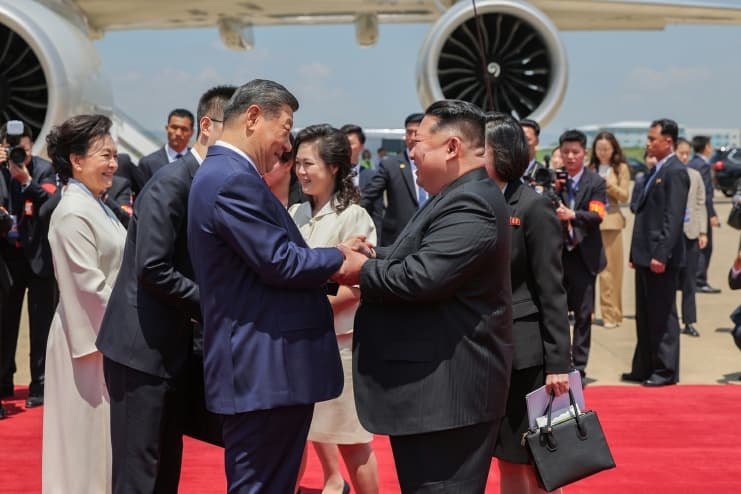
When Chinese President Xi Jinping visited North Korea on June 8 and 9, 2026, for a summit with North Korean leader Kim Jong Un, the pageantry on display — welcome ceremonies, state banquets, elaborate artistic performances — appeared carefully staged to send a message of Sino–North Korean solidarity to South Korea, the United States, and Japan. But a close comparison of how each country’s state media covered the visit tells a more complicated story, one that reveals a meaningful gap in expectations and interests on both sides. It also raises a question that may prove pivotal in the months ahead: whether a North Korea–U.S. summit will happen at all.
North Korea’s Korean Central News Agency (KCNA), the country’s official state news service, distributed photos of Xi watching a performance in Pyongyang on June 9. In those photos, Xi was wearing glasses. Chinese state media chose not to highlight the image. A China specialist in Japan told this writer it was the first time they had ever seen Xi wearing glasses in public, and suggested Beijing may have quietly suppressed coverage of the moment to avoid fueling speculation about Xi’s health. A former Workers’ Party of Korea (WPK) official who defected said North Korea would have been aware of China’s sensitivity on the issue. He recalled that in the 1980s, a Chinese Communist Party official had confronted North Korean counterparts over photos of Kim Jong Il appearing in glasses, arguing it contradicted Pyongyang’s claims of its leader’s supreme dignity. The Chinese official had noted that Beijing had never allowed images of Mao Zedong or Deng Xiaoping wearing glasses to circulate. That North Korea published the photos of Xi in glasses anyway may reflect something more than an editorial oversight. It may suggest that prior coordination between the two sides on protocol and media coverage was less thorough than the summit’s warm optics implied.
What Pyongyang left out
A former North Korean diplomat told this writer that Pyongyang tends to manage its diplomatic contacts with Beijing carefully, deliberately avoiding any appearance of being drawn too far into China’s orbit. That instinct appears to have shaped what North Korea’s state media chose to report about the summit’s substance. Among the items omitted from North Korean coverage was Xi’s proposal of “four measures for developing China–North Korea relations,” which China’s People’s Daily reported in detail. According to Chinese state media, Xi called for strengthened exchanges in diplomacy, law enforcement, and military affairs, as well as the full reopening of the border and the resumption of civilian air routes and international passenger rail services as a basis for expanding people-to-people ties.
The proposal closely resembles a framework China applied to Vietnam in a “3+3 dialogue” held in Hanoi on March 16, 2026, in which ministerial-level officials from the two countries’ foreign affairs, public security, and defense portfolios met together. Beijing appears to want to institutionalize a similar strategic communications channel with Pyongyang. North Korea’s silence on the proposal in its own reporting suggests it has little interest in agreeing to that arrangement. A former WPK official said North Korea has historically kept military exchanges with China under tight control. He recounted an episode in which Chinese military officers who had once trained North Korean soldiers requested to meet with their former pupils during a visit to Pyongyang. The North Korean side refused. “North Korea is extremely wary of military secrets leaking to the Chinese military,” the official said. China’s push for a trilateral security dialogue framework appears motivated partly by a desire for greater transparency into North Korean military activity and a reduction in the risk of accidental clashes with South Korean, U.S., or Japanese forces. Pyongyang’s decision not to report on the proposal points to its continued resistance to any arrangement that might expand China’s influence over its security posture.
The question of expanded people-to-people ties is similarly sensitive for Pyongyang. Xi’s reference to reopening tourism cuts to the heart of a longstanding North Korean dilemma. Chinese tourists once visited North Korea in numbers exceeding 300,000 per year at peak. The foreign currency that kind of tourism generates is clearly attractive. But when regular air and rail services between the two countries resumed this past spring, North Korean officials were not observed formally welcoming Chinese visitors. The regime’s concern is not purely economic. What North Korean authorities refer to as “yellow culture” — Western cultural influences that can travel through Chinese tourists in the form of social media posts, YouTube videos, and conversations — is seen as a potential vector for both cultural contamination and the leakage of information about conditions inside the country.
The nuclear question looms over Pyongyang
Notably absent from Chinese state media coverage of the summit was any mention of “denuclearization of the Korean Peninsula,” a phrase that appeared prominently in coverage of Xi’s previous visit to Pyongyang seven years ago. Yet the nuclear issue is unlikely to have been absent from the room. Strategic messaging between Washington and Pyongyang on the subject of North Korea’s nuclear weapons has intensified in recent weeks. A White House fact sheet from a U.S.–China summit in May stated that the two sides shared “the goal of denuclearization of North Korea.” China did not publicly object. A former Japanese government official who spent years working on North Korea policy told this writer that Xi may have quietly played a mediating role, signaling to Kim that a North Korea–U.S. summit was achievable while urging flexibility on nuclear talks.
Pyongyang moved to preempt that framing ahead of Xi’s visit. Kim conducted a high-profile inspection of nuclear facilities shortly before Xi’s arrival, and WPK Vice Director Kim Yo Jong released a statement dismissing the White House fact sheet as false. The moves appeared designed to pressure both Beijing and Washington to keep denuclearization off the summit agenda. Washington, however, did not blink. The G7 summit communiqué issued in Évian, France, between June 15 and 17 included language calling for the “complete denuclearization” of North Korea, with U.S. agreement. Kim Yo Jong responded on June 18 with a statement calling the pursuit of complete denuclearization a “catastrophic choice.” That same day, David Wilezo, the U.S. deputy assistant secretary of state for Korea, Japan, and Mongolia, reaffirmed North Korean denuclearization as a U.S. objective at a symposium in Washington.
Even so, the fact that a Xi–Kim summit took place at all carries strategic weight. As was the case during the first Trump administration, North Korea appears to be using coordination with Beijing as a stepping stone to engagement with Washington. On June 13, President Trump posted on social media a photo of himself walking with Kim Jong Un at their historic June 2018 Singapore summit, without any accompanying caption. A former Japanese government official suggested that Trump, facing political headwinds over his administration’s decision to strike Iran and with U.S. midterm elections approaching in November, may have reason to pursue a Kim summit as a diplomatic headline. The same official noted the possibility that a peace treaty formally ending the Korean War could emerge as a talking point. Whatever the outcome, the positioning on both sides suggests the opening moves of a negotiating dynamic are already underway.
The views expressed in this column are the author’s own and do not necessarily reflect the editorial position of Daily NK.
Disclaimer : This story is auto aggregated by a computer programme and has not been created or edited by DOWNTHENEWS. Publisher: dailynk.com