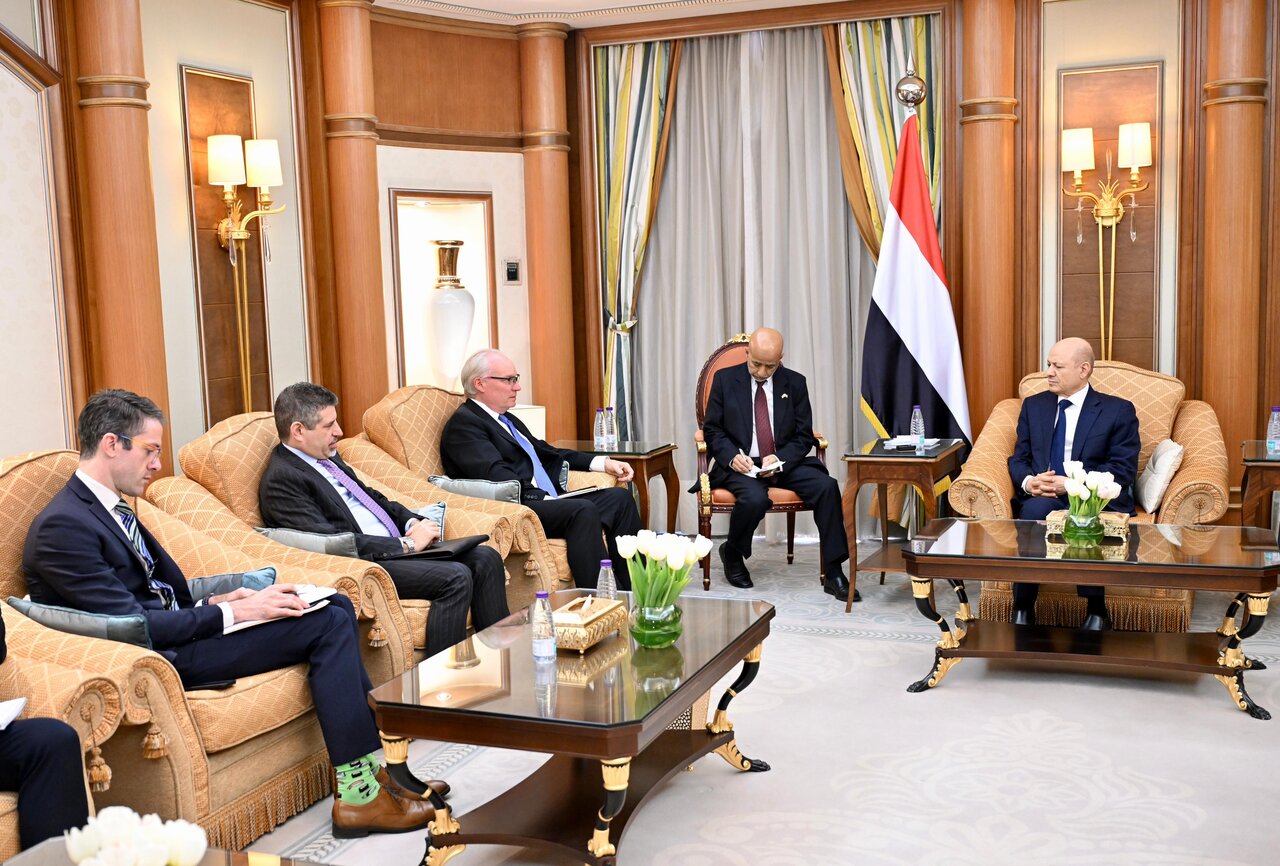
TEHRAN – Yemen’s “recognized” government has international backing but was not elected, has no money of its own, and no control over its own forces.
The so-called internationally recognized government, nominally based in Aden, is led by the Presidential Leadership Council (PLC). It is an eight-member body formed in April 2022, when Abdrabbuh Mansur Hadi handed power to it from Riyadh. On what basis does it hold authority?
No one voted for it. Yemen’s last parliamentary elections were in April 2003. Its last competitive presidential election was in September 2006. The 2012 vote that brought Hadi to power had only one candidate, under an Initiative by several Arab countries. It was meant to be temporary, with elections within two years. They never came.
By 2022, Hadi was handing over powers that had already run past their term.
Critics also highlight how the transfer went beyond the constitution at the time. The text lets a president hand certain powers to a vice president. On this reading, it does not let him dissolve the constitutional order and give power to a body of his own choosing. The declaration, issued from Riyadh, canceled any provisions that conflicted with it. Whether or not one accepts the legal argument, the political point stands: the PLC inherited an exemption from a mandate, not a mandate.
Yemenis call the administration the “government of the hotels.” Many ministers and council members live in Cairo, Jeddah, and Riyadh. They draw salaries in hard currency while teachers and public workers supposedly under its control in Yemen go unpaid for months.
The problem is not only money. Officials who live outside Yemen do not face the power cuts, the salary crisis, or the collapse of services in Aden. When Yemenis protest, they protest against leaders who govern from hotel lobbies far from the warzone.
The PLC was split from the start between camps loyal to Saudi Arabia and the United Arab Emirates. One bloc, around chairman Rashad al-Alimi, is based in Riyadh and backs the Saudi-led coalition. The other, led by the UAE-backed Southern Transitional Council, is based inside Yemen and takes a different line on foreign intervention.
The so-called legitimate government is itself a coalition of non-state actors, or more plainly, an alliance of militias. None of these factions possesses unquestionable legitimacy in its own right, and combining several illegitimate actors does not somehow produce a legitimate authority.
The military setup shows the same dependency. The Supreme Military Committee created by al-Alimi was placed under Saudi-led coalition command, not Yemeni command. A government that cannot command its own army is not running a war. It is being carried by one.
Saudi grants have been essential to paying civil servant salaries and covering the budget deficit. Riyadh is now the main outside funder of non-Ansarullah areas.
That dependency has a diplomatic cost. Riyadh has held direct talks with Ansarallah through UN mediation, while the body it sponsors has played no meaningful role in those talks. The sponsor is negotiating the fate of a country whose recognized government it built, and that government has no seat in the room. If recognition meant what it claims to mean, the recognized government would be at the table. It is not.
The United States, Britain, and their partners recognize the PLC and call it Yemen’s legitimate government. But the actual diplomatic track on the war runs through Riyadh, not Aden. The capitals that grant recognition are not the capitals where the war is being discussed. Recognition, in practice, has become a statement about which side a government is on, not about whether it governs.
Ansarallah grew out of the tribal and religious life of northern Yemen and can mobilize through local structures. Its resistance against foreign intervention has widened that support base. The PLC has no such roots. It controls no capital it can call its own and commands no independent force.
That is an observation about what legitimacy looks like when it is measured by consent rather than by diplomatic statements.
In contrast to the Saudi-backed administration, the government in Sanaa has grown more popular over time. Its heroic military stance in support of the Palestinians amid the U.S.-backed Zionist genocide in Gaza earned it the respect of the region let alone Yemen.
The mass weekly Friday street mobilizations by the Yemeni people in support of Ansarallah and the Sanaa government again underscores that popular public support.
Recognition of the PLC as currently practiced is unconditional and open-ended. It was given to a body with no electoral mandate, no money of its own and no unified command, and it is tied to no benchmark requiring it to gain them.
A government that has never asked the Yemeni people for their consent and cannot work without a foreign patron is a diplomatic placeholder. It is useful to the outside world precisely because it is too weak to say no.
What room does this government have to make independent decisions? And with what credibility can its leaders speak of state-building, the rule of law, a state monopoly on weapons, and the authority to decide matters of war and peace?
Their own social and political bases are increasingly losing patience with them, with their lavish lifestyles, complacency, and apparent preference for comfortable exile over the difficult prospect of returning home, even to the areas supposedly captured from Ansarallah.
Is recognition by a handful of influential Arab and regional capitals sufficient to transform one faction into a legitimate government while stripping its compatriots and political rivals of that same status?
The guiding principle for assessing both Ansarallah and its adversaries can be summarized in one sentence:
If Yemen cannot be governed by Ansarullah, it will never be governed without them.
Disclaimer : This story is auto aggregated by a computer programme and has not been created or edited by DOWNTHENEWS. Publisher: tehrantimes.com