
Mark Zuckerberg, Elon Musk, Sam Altman: the faces of big tech in 2026 are, decidedly, male.
But beyond the “broligarchy” of Silicon Valley, a radically different set of faces are emerging: they’re punk, personal and paving the way for a new set of technologists.
Cyberdecks – custom-made, portable computers – are garnering a loyal following from hobbyists online, particularly young women, looking to wrest back control from major tech companies and experiment beyond the algorithm.
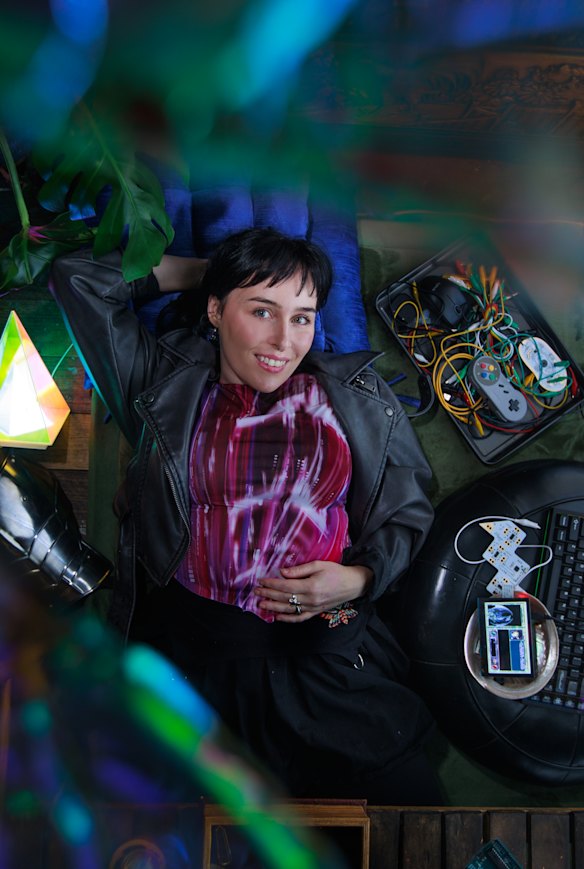
Laura Alice Bracken, a Geelong-based artist, started building her own cyberdeck as an extension of her creative practice, in which she was experimenting with MIDI controllers that take biofrequencies from plants and transform them into soundwaves.
But Bracken, 39, wanted something she could take out into nature and, after falling down a rabbit hole online, her mind started to widen to the world of cyberdecks.
The device she is making – housed inside a vintage abalone shell – will also double as an e-reader.
“I just found out my Kindle is about to be made redundant,” she says (Amazon recently announced they would no longer support e-readers made before 2012).
“It is a perfectly good Kindle … so why is it suddenly going to be trash? It’s because they want to sell new ones.”
This is the spirit of cyberdecks, where the sky (or one’s imagination) is really the limit in terms of what’s possible. They can be as simple as a screen and speaker or more complicated, like Bracken’s.
Online hobbyists have found homes for their Frankenstein-esque computers in just about anything, from vintage handbags and make-up compacts to lolly tins and briefcases.
“The renaissance of women, femmes and queer people getting into it are so creative, stylish and have this fashionista side,” says Bracken.
“All of us have enormous amounts of technology in our lives. If you’re a creative person, it can be frustrating how prescribed everything is.”
But cyberdecks are nothing new.
Dr Daniel Binns, a senior media lecturer at the Royal Melbourne Institute of Technology, says the hardware draws inspiration from science-fiction, like William Gibson’s 1984 novel Neuromancer (from which cyberdecks derive their name) and the cyberpunk movement, exemplified in Y2K classics such as Sneakers (1992), Hackers (1995) and The Matrix (1999).
In Silicone Valley, Steve Jobs and Steve Wozniak sold a kind of cyberdeck at UC Berkeley before founding Apple.
Binns thinks the cyberdeck movement is an expression of growing frustration with the inefficiency of apps such as Uber and Airbnb (often referred to as part of “The Platform Economy”), as well as resistance to “tech bro culture where everything’s inevitable, everything’s smooth”.
“There’s this concept of technological determinism, which is what we’re seeing with AI and this attitude of, ‘Get on board, or get out of the way,’ ” he says.
“This is versus the reality, which is that humans are in control of how we use and deploy and adopt or reject technology.”
He adds many are also looking to plug into “off-grid” networks, maintain control over their own data and empower themselves by learning through community, particularly young women typically excluded from the male-dominated world of tech.
Bracken has no formal training, and has been teaching herself everything through trial and error and by engaging with other social media creators on platforms like Reddit and TikTok.
“Learning is such a joy. And when you’re tinkering and playing with things that are new to you, it can be a really fun space to be in,” she says.
“We want to learn how to fix things, how to repurpose things, we want to keep things going for longer periods of time. We don’t want to have to be buying a new phone every year.”
Bracken says she’s been learning about some of the pioneering women – such as mathematician Ada Lovelace – behind early computer models, often erased from history.
Like Bracken, “Summer” Sunkyoung Roh has been swept up in the cyberdeck craze, and is building a Tamagotchi (a digital pet toy hailing from Japan) inside an old “brick” phone.
As a ’90s kid, Roh was an early adopter of the internet, becoming obsessed with video games and teaching herself skills such as coding and graphic design.
Roh studied software engineering in Australia and has now returned to South Korea, where she works full-time as a content creator.
She’s replaced the phone’s keypad with her own custom keyboard (she loves the “tactility” of the buttons), and put in a new screen. The idea is that her digital pet will mirror her own daily life.
“I programmed it, so I can record my own activities, like if I work out, then it reflects to the Tamagotchi, so it gets healthier too.”
Indeed, like Roh, Binns points out many cyberdeck enthusiasts are repurposing old materials, and finding nostalgia in the pop culture of technology from the ’80s and ’90s (like the Tamagotchi).
“The glorification of hacker culture is this subversive anarchic practice, and people are looking around at things like e-waste and thinking, ‘What can we do with it?’ ” he says.
“They’re looking into the history of computing, hacker culture, and they’re seeing cyberdecks and saying that seems like a really fun thing to do.”
Eventually, this Tamagotchi cyberdeck will sync up with the companion robot Roh has built from scratch, inspired by the cat “Jiji” in Studio Ghibli’s Kiki’s Delivery Service.
“That data will be shared with my robot so, when I talk to it, it can gently remind me that, ‘Hey, your Tamagotchi [and you] forgot to go to the gym last week.’ ”
Despite her technical knowledge, Roh says the project has been a challenge, but she’s been buoyed by the online community around her and availability of open-source projects that have helped her learn.
“When you build a cyberdeck, you get to decide the aesthetics and functionalities just for you,” says Roh.
“I love that it encourages people to be on the creative rather than a pure consumer side.”
Make the most of your health, relationships, fitness and nutrition with our Live Well newsletter. Get it in your inbox every Monday.
From our partners
Disclaimer : This story is auto aggregated by a computer programme and has not been created or edited by DOWNTHENEWS. Publisher: www.smh.com.au