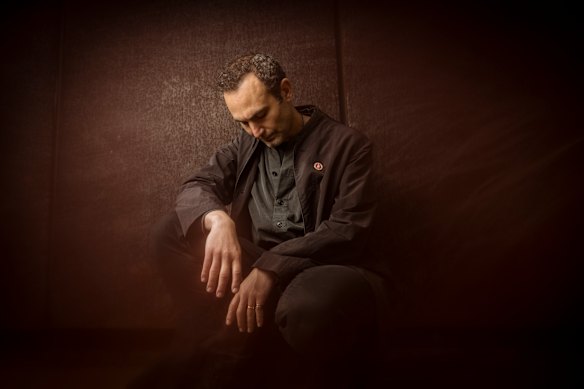

When Khalid Abdalla was in Australia for the Sydney Festival in January, there were calls to drop his one-man show Nowhere from the program.
It was, the Scottish-born Anglo-Egyptian actor and Palestinian rights activist admits, “a very charged time, just weeks after Bondi” – the attack in December on a Jewish gathering at Sydney’s famed beach, which left 15people dead, along with one of the two gunmen.
The calls also came amid a furore over the decision to ditch Palestinian-Australian author Randa Abdel-Fattah from Adelaide Writers’ Week. It was, says Abdalla, “the only time in my career so far there were attempts to de-platform or cancel me”.
The Sydney Festival held its nerve, and Abdalla, best known for playing Dodi Fayed in season six of The Crown, got to perform the intensely personal and political work he now brings to Melbourne for Rising.
Nowhere is a complex piece that melds voice, movement and video to probe the notion of Arab identity, of belonging and of statelessness, in the modern world. A linchpin in the show is the observation of former British prime minister Theresa May, that “if you believe you’re a citizen of the world, you’re a citizen of nowhere”.
Colonialism is squarely in the spotlight here: while the Middle East is often seen as the great risk to global stability, Nowhere insists the post-World War I carve-up of the Ottoman Empire by Britain and France is a root cause.
Abdalla says performing the show in Australia is “special” because while we’re not out of the woods in terms of reckoning with our messy past, here we are at least engaging with it.
“There is an attempt to reconcile with colonial histories, and that creates a very resonant ground for the show that is unlike anywhere else, really,” he says.
“Here, I literally walk on stage following a Welcome to Country, and it’s Reconciliation Week, and you walk into the theatre to a sign that talks about unceded territory. That’s a very different frequency to the idea of what ‘normal’ means [in the UK].”
Nowhere is an evolving work, as Abdalla continually tweaks it in response to developments in the real world. But he says the version he’s performing in Melbourne is much the same as the one he did in Sydney at the start of the year.
“[Lebanon] is there without me having to say it, as is Iran,” he says. “It’s always shifting with the circumstances. Here I’m performing in the context of the royal commission [into antisemitism], I’m performing in the context of what just happened with the flotilla [of activists detained and allegedly abused by Israel]. In rewriting it, I’ve always understood it has to have some rage in it, which then settles in a more hopeful space.”
Abdalla doesn’t consider himself as a citizen of nowhere, but rather as a product of two identities, Egyptian and British, albeit never settled in either. “It’s definitely not easy to feel not welcome in a full way in a British context, and in an Egyptian context to be threatened with prison,” he says.
As an actor, he says he has spent much of his career being othered. “It was 17 or 18 years until I was asked to perform in my actual voice, which is kind of painful. It was always either an Arab accent or an American accent.”
Playing Dodi was an important milestone, he says, both personally and for the way it shifted the representation of Arabs on Western screens.
“Dodi was the first Arab character in the history of film [in the West] who you get to know and love, not fear, and so when he dies, you mourn him – and that’s the crucial bit,” Abdalla says. “The grievability of the Arab body in fiction barely exists, and that feeds how the culture responds during a moment of genocide,” he says, in reference to the ongoing conflict in Gaza.
The real Dodi was a fixture in tabloids and glossy magazines thanks to his romance with Diana, he says, “but nobody really knew anything about him before The Crown. How can you mourn someone if you don’t know them?”
In a sense, Nowhere is an attempt to translate the Dodi effect to the Arab world at large. Is that too much to ask of an artwork, no matter how passionately performed?
“I think the role of the arts is to create the crack through which the light enters,” Abdalla says. “It gives you an embodied experience that this is possible, but it doesn’t exist yet. Of course, you have to go through the process of structural change and political change, which takes time, but you have to feel the certainty of its possibility. And I think art, culture and theatre is able to do that.”
Nowhere is at Malthouse Theatre until Sunday, June 6 as part of Rising. Details: 2026.rising.melbourne
From our partners
Disclaimer : This story is auto aggregated by a computer programme and has not been created or edited by DOWNTHENEWS. Publisher: www.smh.com.au