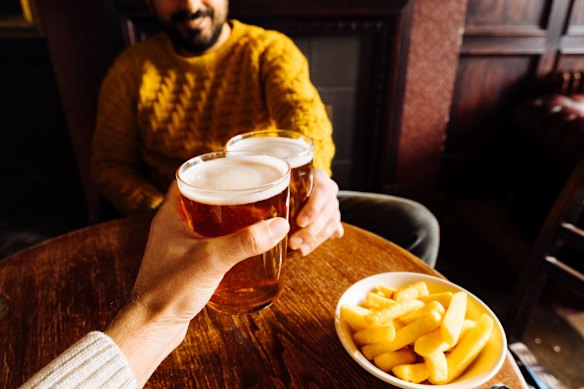

Ever wondered why a cheese plate and a glass of chardonnay pair so perfectly or why people crave salty fries or pizza with their beer? It’s called the aperitif effect.
Refined as the aperitif effect sounds, the system driving it is even more sophisticated.
Our bodies have a hankering for protein foods when we drink because the enzymes found in protein help them process the alcohol.
Our bodies associate salty, umami-flavoured foods as protein-rich. But, in the modern food environment, where these flavours can be added to ultra-processed foods (UPFs), our mouths are getting what they crave, but our bodies are not, so we are driven to keep eating as our bodies seek the protein hit they need.
This is the finding of a fascinating new paper, published in Obesity Reviews. Along with another new paper, published in Science, they help to explain why we are motivated to eat certain foods.
“The findings have wide-ranging implications, even extending to an understanding of human obesity,” say University of Sydney professors Stephen Simpson and David Raubenheimer.
A biological need
The protein leverage hypothesis is the idea that we crave protein over other nutrients because it is vital for muscle repair and metabolic function, and we can only get essential amino acids from our diet.
This biological need drives us to eat as much food as we need to meet our protein requirements. While this behaviour is widely recognised, the mechanism is poorly understood.
So, the new study in Science looked at flies – which have the same appetite for protein as humans – to understand how the system works.
They found that cells in the lining of our gut sense when we are protein deficient and send signals to the brain that we need to consume more. In response, our brain heightens the sensitivity of nerves in the mouth to flavours it associates with protein: and we start craving savoury, salty, umami foods.
It’s an exquisitely evolved system, says Simpson, who came up with the protein leverage hypothesis alongside Raubenheimer two decades ago.
In a whole food environment, it’s difficult to overeat, he explains because once we get our protein fill, our bodies dial down the cravings and dial up the signals that we’ve had enough.
“That’s why, of course, high-protein diets lead to weight loss because people don’t eat as much because your body says, ‘no, you’ve got enough, don’t eat any more’,” Simpson explains.
But, when the system is hijacked by protein decoys (foods with savoury or umami-flavours that are low in protein) it takes a lot more food to get those signals and for the cravings to be satisfied. We just want to keep consuming until that need has been met.
“Our protein appetite plays a central role in determining how much energy we eat,” Simpson reiterates.
“And it can lead to overconsumption of energy when protein is diluted in the diet, particularly by ultra-processed foods and [because of that] the protein appetite is now a primary driver of obesity and all the other problems that come with it.”
Add a few drinks into the mix and this drive is turbocharged.
The aperitif effect
For the study, researchers looked at Australian national dietary survey data to examine what we eat when we drink alcohol.
On the days people consumed alcohol, they tended to eat far more savoury foods than on days they didn’t drink. The more they drank, the more they sought out savoury foods.
They found that alcohol triggers an increase in levels of the protein appetite hormone FGF21, which makes us want savoury foods.
“Many people will recognise the experience of having a few drinks and suddenly craving something salty, like chips, French fries, pizza or other savoury foods,” says Dr Amanda Grech, lead author of the study from the Charles Perkins Centre.
“Now we have a better understanding of the hormonal dynamic at play, which may be driving overconsumption of ultra-processed foods.”
But, why does alcohol have this effect?
“It’s likely not just alcohol,” says Simpson. “Other substances that are essentially poisons seem to do the same thing, and the reason is, we think that your liver has to deal with the poison, and that comes at a protein cost. You have to produce enzymes to break it down and, so it’s anticipating that you’re going to need more protein to deal with the toxin … That’s the aperitif effect.”
This can drive us to overconsume savoury UPFs and accelerate weight gain.
“If you choose to drink, it’s worth being mindful of this hormonal interplay,” said Professor Raubenheimer. “Having protein-rich whole foods readily available can help steer you away from ultra-processed foods. Think roasted chickpeas, smoked salmon, lean cold meats, prawns or oysters.”
Should we all be eating more protein?
Our appetite for protein is so potent that whether you are vegetarian, carnivore or mostly made of UPFs, 99 per cent of Australians already consume enough protein.
“The amount of protein most people are eating is essentially the same, but the number of calories you have to eat to get it depends on the context within which that protein is found,” Simpson says.
Unless we are upping the ante on exercise, more protein won’t have a magical effect: it is just excess energy that will get converted to fat.
“Eat excess of anything, it’ll come at a cost,” says Simpson, who adds that there are “well appreciated costs” to eating excess protein.
“The evidence is a little bit mixed in humans, but in non-human animal systems, you accelerate the rate of ageing,” he explains.
“You activate growth pathways, you turn down cell repair and autophagy pathways and DNA repair pathways, and ultimately, you grow and reproduce, but at the cost of lifespan. So there’s a trade-off.”
The key then is not to eat more protein necessarily, but to avoid the protein decoys and let the exquisitely evolved system in our body do its thing.
Make the most of your health, relationships, fitness and nutrition with our Live Well newsletter. Get it in your inbox every Monday.
 Sarah Berry is a lifestyle and health writer at The Sydney Morning Herald and The Age.Connect via X or email.
From our partners
Disclaimer : This story is auto aggregated by a computer programme and has not been created or edited by DOWNTHENEWS. Publisher: www.smh.com.au