
“This is your world,” says guide Eva Stone, gesturing to the pile of gear on the table in front of us. “Just remember to keep a sacred dry area. Tonight’s forecast is for rain, snow and hail.”
To be fair, the briefing notes for this four-day backpacking trip in Montana’s Glacier National Park had warned us about the capricious climate: “The weather in Glacier is very temperamental and hard to predict.” Even so, snow and hail in the middle of June?
After cramming into our packs everything we’ll need for the next four days in the wilderness – clothes, tents, sleeping bags, mats and food – it’s time to address another concern. Bears. Glacier has the highest density of grizzlies outside Alaska, so the National Park Service makes everyone watch three separate bear safety videos before going in.
The overriding message is that providing you take the appropriate precautions (make noise while hiking, keep your distance and store food properly), the chances of a threatening encounter are incredibly rare. Still, one line is particularly memorable: “If the bear starts to eat you, fight back.”
Geared up, we drive to our starting point, the Belly River Trailhead, which is less than 300 metres from the Canadian border. Authorities have closed the only road that crosses the park, the scenic Going-to-the-Sun Road, because of the impending storm, so we have to take the long way. As we head north, the park’s hulking mountains loom ominously on our left, their snow-smothered peaks shrouded in brooding grey clouds.
Sign up for the Traveller Deals newsletter
Get exclusive travel deals delivered straight to your inbox. Sign up now.
Glacier Guides is the only operator authorised to take guided backpacking trips into the park and each outing is allocated a specific route based on weather conditions and campsite reservations. We’re fortunate because we’re heading into the Belly River area – one of the lower elevation and less aggressive routes – but we’ll still be camping at 1400 metres, which means we could be above the snowline. “When the weather is being wonky like this,” says Stone, “anything can happen.”
We start the 10-kilometre hike to our first campsite in steady rain, descending on a snaking muddy trail through a dense forest of pines. Thanks to the baggy white ponchos we’re all wearing over our rain gear and backpacks, our eight-strong group resembles a ghostly line of cartoon hunchbacks.
Another thing the briefing notes stressed was the importance of pre-trip training, particularly carrying a weighted backpack to get used to hiking with a load. Having done several multi-day hikes, I glossed over this recommendation, which I realise was a mistake. There’s an enormous difference between skipping along with just a day pack and shouldering a bulky 70-litre backpack weighing 19 kilograms.
Every time I’m tempted to complain, I remind myself of all the extra gear that Stone is carrying. Out of curiosity, I weigh her pack before we begin, and it clocks in at a frankly unimaginable 29 kilograms, which must be close to half her body weight.
We arrive at camp about 6pm and help Stone erect a tarp over the cooking area and create a bear hang to suspend all the food and toiletries high above the ground. After setting up the tents, we huddle like penguins around the stove and warm up with hot chocolates spiked with mint schnapps. The forecast says the weather will deteriorate so we gulp down bowls of steaming chicken noodle soup then retreat to our tents with hot water-filled drink bottles to put in our sleeping bags.
I’m not gonna lie … it’s a rough night. If I thought erecting a tent with numb fingers in the rain was uncomfortable, squeezing bare feet into soaking wet hiking boots at 3am to visit the bathroom is worse.
The morning brings two interesting developments: sleet during breakfast and the discovery that one of our group has twisted her knee and needs to be hiked out. The earliest this can happen is tomorrow so we’ll need to stay here another night rather than moving on.
While it’s a bummer for our injured comrade, it’s unexpectedly good news for the group. Not only does it mean we can do a scenic hike to a nearby waterfall today without carrying all of our gear, but she also agrees to lend me her far superior sleeping bag for the remainder of the trip.
When we wake up the following day, it’s as if we’ve been transported to a different world. The sun is out, the sky is a cloudless deep blue and my hiking boots are almost dry.
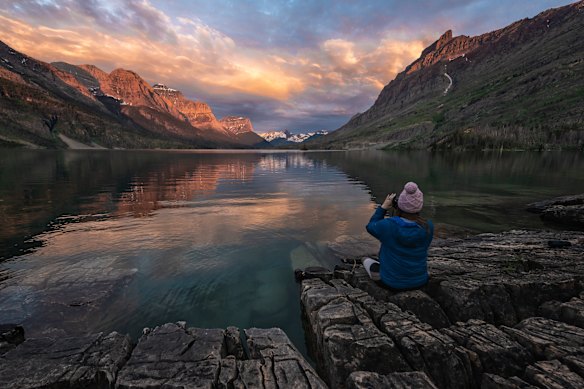
While Stone makes porridge for breakfast, I stroll to a nearby clearing and get my first proper taste of the park’s glacial grandeur – a dramatic curtain of mountains that crest in a succession of 3000-metre peaks. Formed about 170 million years ago, these ranges were created when 1.5-billion-year-old Precambrian rock was forced up and over much younger layers (a process called the Lewis Overthrust). As a result, Glacier harbours some of the US’s best-preserved sedimentary rocks and oldest fossilised remains.
The five-kilometre hike to our next campground is a glorious romp through wildflower-strewn fields and over pine-crested ridges. We meander along corridors of fluffy, head-high bear grass and cross bone-cold glacial streams, all while surrounded by a neck-craning amphitheatre of snow-dusted peaks. “On days like today,” says Stone, “there’s nothing like it.”
Along the way we meet an eclectic cast of fellow hikers, many of whom are tackling the 5000-kilometre Continental Divide Trail from Montana to Mexico. Some, like 30-something Jessica from California, are doing it solo (“I love how this is all I have to worry about,” she says, pointing to her backpack). Others, like a 61-year-old uncle and his nephew, are just hiking the Glacier portion. Particularly memorable are a pair of exuberant young brothers in matching floral shirts. “We did the PCT [the 4200-kilometre Pacific Crest Trail] when we were 15,” says one, “so we figured we’d give this a go and see how far we get.”
After setting up camp on the shores of Cosley Lake, three of us join Stone for an optional six-kilometre hike to the top of nearby Bear Mountain. As we follow a narrow, meandering trail through a bushy meadow, Stone suddenly stops. Up ahead, about 50 metres off the trail, is a grizzly bear lumbering through the undergrowth. Catching our scent, it turns, looks straight at us, then disappears into the trees. “Should we go back?” asks one of the group. “No, we’ll carry on,” says Stone. “Just keep an eye out to the left.”
We continue, hearts thumping, eyes glued to the tree line, but it never reappears. Stone says she’ll typically see 30 to 40 bears during a season and they’re almost always benign encounters like this. In the nine years she’s guided here, she’s never had to use her bear spray. When I asked a park ranger at the previous camp about the unsettling videos we had to watch before the trip, she sighed and said, “It’s a scare tactic. That’s what America does.”
The hike to the top of Bear Mountain involves climbing a scree slope via a relentless series of switchbacks. The prehistoric rocks, many still bearing fossilised ripple marks from their time on an ancient seabed, clatter like a xylophone as we trudge on. After passing through an eerie stand of ghostly whitebark pines, we emerge onto the windblown summit and are confronted by a glacial-carved landscape of plunging, lake-filled valleys so overwhelmingly spectacular, all I can utter is, “Wow.”
Tomorrow we’ll hike back to reality, to mobile coverage, emails and celebrity scandals. I won’t miss my backpack or my sleep mat, but I will miss this – a view I couldn’t have experienced any other way. It reminds me of something Stone said at the start of the trip: “Glacier’s not like other parks. People come here to hike.”
THE DETAILS
FLY
United Airlines to Glacier Park International Airport via San Francisco. See united.com
STAY
A former railway hotel, Belton Chalet has characterful accommodation and a fabulous restaurant. From $US180 ($252) a night. See glacierparkcollection.com
TOUR
Glacier Guides’ four-day Glacier Explorer backpacking trip costs $US1120 ($1573) per person and runs from June to September. Additional costs include equipment rental, if required, and park entry fee of $US35. The full rental set of backpack, tent, hiking poles, sleeping bag and mat costs $US196. See glacierguides.com
MORE
glaciermt.com
The writer was a guest of Western Montana’s Glacier Country.
 After abandoning a sensible career in IT, Rob McFarland now divides his time between Sydney, the US and Europe. He’s won seven writing awards, including Australian Travel Writer of the Year, and offers writing courses for tourism operators, PR professionals and aspiring travel writers. While not averse to a 5-star hotel, his most memorable travels include scaling the mountain behind Machu Picchu and rafting Patagonia’s Futaleufu River. Follow his travels on Instagram @mctraveller.Connect via email.
From our partners
Disclaimer : This story is auto aggregated by a computer programme and has not been created or edited by DOWNTHENEWS. Publisher: www.smh.com.au