Updated ,first published
MUSIC
Miss Kaninna | Blackprint Tour ★★★★★
Northcote Theatre, September 18
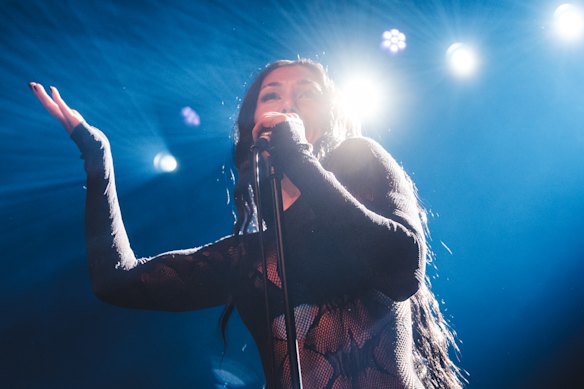
It’s a balmy Friday night in Melbourne and inside the Northcote Theatre, a sold-out crowd is chanting “f–k Donald Trump.” The main attraction hasn’t even taken the stage yet – YG’s FDT is playing interstitially over the speakers. The rage and energy is building, and when Miss Kaninna appears, it explodes.
The rapper has made a name for herself with her defiant music, which gives a middle finger to the establishment while proudly representing her Yorta Yorta, Dja Dja Wurrung, Kalkadoon and Yirendali heritage.
These are unapologetically political songs, and Miss Kaninna is unapologetically herself. It’s a potent combination that has her in high demand, with this show selling so strongly that it was moved from the Corner Hotel to the larger-capacity Northcote Theatre.
Hot on the heels of her debut mixtape, Blackprint, Miss Kaninna is firing on all cylinders, seamlessly spitting verses backed by drums, guitar and alternating flute and saxophone. Miss Kaninna’s flow is effortless, but she’s got pipes, too – her musical theatre background peeks through with soulful vocals on Backstreets and a cover of Rihanna’s Kiss It Better.
Palestine, police brutality and the abject cruelty of colonial so-called Australia are just a few of the rapper’s talking points, and her passion is palpable.
She flips the script, then burns it – Mob Ties turns the classic “Aussie Aussie Aussie” cry into a “f— you and your Southern Cross to all the Aussie boys”, and breakout single Blak Britney remains a statement of self in the face of adversity: “Still I prevail… I’m a deadly bitch.”
The crowd is heaving, hands in the air and throats screamed hoarse. The air feels electric, like there’s a galvanising force rippling through it – not unlike being at a rally, as people gather to fight for the future. Miss Kaninna is that kind of musician – as she says on stage, “We hold the memories and the hope of a Blak Australia.”
Reviewed by Giselle Au-Nhien Nguyen
MUSIC
Violent Soho ★★★
Forum Melbourne, September 18
It’s a bold band that plays Rage Against the Machine’s anarchic anthem Killing in the Name as their walk-on music. But ’90s-tinged anthems of cryptic revolt are Violent Soho’s stock in trade.
With tonight’s sold-out crowd already beers deep and mosh-ready, a scrim finally falls to reveal the reunited Brisbane quartet screaming into How to Taste.
Following 18 years of relentless touring, awards, chugging riffs, and a compelling preference for screaming “yeah” as the hook for most songs, Violent Soho went on hiatus in 2022. The pause has been kind – their 2013 LP Hungry Ghost has since gone Platinum, and it and 2016’s ARIA-award winning Waco were re-released to stoke the coals. Announced in April, this short run of reunion shows sold out instantly.
Not much has changed. Drummer Michael Hardy is still on the kit, after founding member Mikey Richards took leave in 2021. Guitarist and on-stage emcee James Tidswell’s hair has greyed, and their A/V tech has discovered AI.
But Luke Boerdam’s sneering vocal fry still rips through the mix, and his patchwork non sequitur lyrics continue to raise the spectre of suburban ennui and fractured friendships. Set to distortion pedals, this kind of stuff is timeless.
Whether it’s the time off or Melbourne jitters, it takes a minute to settle – a false start for Lying on the Floor, a guitar needing tuning. The crowd erupts for Viceroy – along with the smell of weed – and then escalates through to the inevitable eruption of set-closer Covered in Chrome, its compulsive denouement “hell f— yeah” forever Violent Soho’s Rosetta Stone.
“How many people are seeing us for the first time?” asked Tidswell earlier, before a bouncy Like Soda. The hundred or so hands that shot up suggest, more than 20 years on, Violent Soho might still be building steam.
Reviewed by Marcus Teague
DANCE
R.A.I.N ★★★★
Arts House, North Melbourne, until September 20
There’s nothing quite like the shared movement language of Harrison Ritchie-Jones and Michaela Tancheff. Their vocabulary of sporty grappling and mutual manipulation, first seen several years ago in the excellent Cuddle, combines rough-handling with exquisite responsiveness and apparent sensitivity.
The opening section of their latest collaboration has playful echoes of a ballroom routine. Extravagant lifts and twists and shifts of momentum also suggest a wrestling contest, with each dancer constantly tracing the other’s body to maintain contact, seeking ways to connect their repertoire of moves.
As in Cuddle, they keep up a murmured dialogue, discussing their options and deciding what comes next. Moves are named like invitations which can be accepted or rejected. These casual exchanges make the choreography seem negotiated live: an intricate physical conversation with its own laconic commentary.
Paradoxically, this verbal back and forth makes us more aware of who initiates and who responds, inviting us to diagnose power relations in the mechanics of partnering. Or, at the very least, it draws attention to the contrast in their stage personalities: one expansive and eager, the other more reserved and reactive.
Structurally, the development of the show from scene to scene feels a little arbitrary. Of course, the unexpected twists and turns are part of the fun, but I think I would have enjoyed this show even more if there was a clearer sense of narrative progress.
Ritchie-Jones’s program statement describes pushing their partnering practice to its limits and exploring how it fails. But what are the stakes? Does apparent failure count as success for the performers, or is the other way around? It sounds a little too much like navel gazing.
Fortunately, the absurdities of this surreal romp are sufficiently entertaining: horse-riding antics, a sudden mystifying leap into opera, crazy costumes and multiple unexpected bursts of song. There’s more than enough excitement at the surface to keep us from looking deeper.
Reviewed by Andrew Fuhrmann
MUSIC
Belle and Sebastian ★★★★★
Palais Theatre, September 12
“Welcome to the second recording session for this still quite-new band,” Stuart Murdoch says with a grin. His tongue is firmly in cheek – Belle and Sebastian, the indie-pop group he’s led for more than half his life, is on tour celebrating its 30th year. In 1996, the bookish Scots made their debut with two albums: Tigermilk and If You’re Feeling Sinister. On this anniversary tour, they’re alternating playing those records in full. Melbourne gets the Sinister treatment.
Playing albums in full live can be a cynical cash-cow in the age of commodified nostalgia, but there’s no denying the sheer delight of hearing a beloved album like this in all its glory. On record, Sinister’s arrangements are delicate; live, they’re injected with a shot of joyous energy, with buzzing synth to boot.
Many of these songs begin with Murdoch alone, singing with that sweet, instantly recognisable voice, before the eight other musicians on stage slowly blossom to create sunlight in musical form. Lead guitarist Stevie Jackson raucously takes on the harmonica for Me and the Major, his movements a chaotic blur.
As the album reaches its halfway point, a projection behind the band shows the LP being flipped on a turntable – “a bit of antiquated attention to detail,” Murdoch says. Eager fans have been dancing in the aisles from the beginning, but when the band plays Get Me Away, I’m Dying, the entire venue is on its feet. The gorgeous Mayfly is another highlight from this half, but really, it’s all joy, not least because Murdoch and co are clearly having a blast, too.
Murdoch’s signature humour is on display all night as he intersperses the music with quips, including a spiel about Victoria’s slogans as seen on number plates and a joke about Viagra as he takes his medication on stage. “Back to sweetness and light!” he says, and back they go.
A guitar-heavy I’m a Cuckoo kicks off the second set, comprising songs from the rest of the band’s long career. Belle and Sebastian have such a varied discography that it’s a grab-bag every night. There are some deeper cuts here, such as 2010’s Little Lou, Ugly Jack, Prophet John, recorded with Norah Jones; here, it’s long-time vocalist Sarah Martin who does the honours, beautiful as ever. 2006’s Funny Little Frog is a charming, nostalgic treat.
The band is pulling songs out on the fly by the end, with Another Sunny Day closing the night. It’s apt – with 30 years of sunny days up their sleeves, Belle and Sebastian keep on delivering.
Reviewed by Giselle Au-Nhien Nguyen
MUSIC
Pieter Wispelwey with Piers Lane ★★★★★
Melbourne Recital Centre, September 15
Pure genius. These two words arguably encapsulate the astonishing imagination behind the three solo suites that Benjamin Britten composed for the Russian cellist Mstislav Rostropovich between 1964 and 1971. Taking Bach’s fabled cello suites as a model, these tours de force remain revolutionary in pushing the instrument’s boundaries of timbre and texture.
Over three evenings, Dutch cellist Pieter Wispelwey, long an ardent and persuasive exponent of these works, is performing programs centred around each suite.
Prokofiev and Shostakovich were appropriate stablemates in the series opener, not least because Prokofiev wrote his Cello Sonata in C, Op. 119 for Rostropovich, but also that the cellist was part of the deep friendship and admiration shared between himself, Shostakovich and Britten.
Providing the first taste of Wispelwey’s chameleonic way with his 1760 Guadagnini cello, the Prokofiev ran the gamut of emotions, starting with its dark, sombre opening before flowering into rich lyricism, moments of childlike wonder and folkloric exuberance.
Britten’s Cello Suite No. 1, Op. 72 was full of ear-bending marvels, including a witty, cleverly constructed fugue and an evocative march in which the masterly bouncing of the bow summoned up martial images. A stunning moto perpetuo led to the return of the imposing, unifying Canto. Few others would be capable of bringing this music alive so vibrantly and comprehensibly.
Wispelwey ensured Shostakovich’s Cello Sonata in D minor, Op. 40 brimmed over with fascinating detail; bringing richly burnished tone to the eerie opening melody and plaintive Largo, unerring technique to the manic second movement and cheeky playfulness to the finale. Here and in the Prokofiev, pianist Piers Lane’s committed partnership was entirely empathetic.
Setting aside the substandard printed program that doesn’t even list the movements of the works performed, don’t miss the remaining two opportunities to hear astounding music performed by musicians of genius.
Reviewed by Tony Way
DANCE
Our Last Tree ★★★
La Mama, until September 18
Hobart’s Nelipot Collective bring something we rarely see on Melbourne stages: unpretentiously referential contemporary dance. Their latest show, Our Last Tree, points us with a sort of guileless enthusiasm towards the green earth and its wonders.
Sometimes the relentless self-reflexivity of our local choreographers – their unwillingness to make work about the world beyond the stage – can seem like a fear of artistic failure. Nelipot embrace that fear with an earnest, wilfully naive fable of loss and recovery.
Certainly, their slightly manic smiles and touchy-feely involvement of the audience suggest a community-oriented performance. You can imagine them at a farmers’ market, amid haybales and squealing children munching on small-batch fudge.
And yet I find their evocation of the life of the forest compelling. What they do best here is suggest – with reaching, serpentine limbs – the way that forests envelop us completely, above and below and all around.
The intimate stage at La Mama, further compressed by the placement of a cardboard tree along one side, suits these densely convolved bodies. They seem to fill the space completely, coiling themselves into any chink of vacancy.
Composer and violist Andrea Breen accompanies the performance with catchy, rather grand melodic hooks, which she returns to between wandering passages. Her music suggests something rooted yet inexorably moving, a tree’s stillness alive with change. Her score also implies a fuller orchestration: I hear the ghosts of horns and oboes underneath it. And yet the exposed solo voice suggests kinship with the last tree. Haunting, effective and beautifully played.
Other production elements are less impressive. The slime-green tulle and the cardboard trunk (endearingly ornamented with hand-drawn growth rings) suggest a production for children; I suspect a younger audience would respond well.
Yes, the work could be called unsophisticated, but only if that also means a refreshing independence from convention, as well as the courage to approach their subject directly.
Reviewed by Andrew Fuhrmann
OPERA
Serse ★★
Gasworks Theatre, until September 13
We’re all getting restless. Twenty minutes after the curtain was meant to go up for the opening show of Lyric Opera’s Serse, we’re still waiting for the conductor to raise his baton. Eventually, company artistic director and conductor Patrick Burns addresses the audience, explaining that though they’ve tried to fix the issue, they’ve had no success.
Both projectors have died. For the near-three-hour Italian opera we’re about to witness, there will be no surtitles. No translations. Oh dear.
Turns out, if it was sung in English, it’d be hard to follow anyway. Handel’s 1738 opera about the King of Persia is one of those operas stacked with couples pursuing, deceiving, rejecting and reuniting with one another, plus disguises and mistaken identities thrown in, of course.
Baroque opera has a small but loyal audience in Melbourne, but for a company that has commendably programmed contemporary operas in previous seasons, Serse is, frankly, an odd choice.
The production, by director Beng Oh and designer Christina Logan-Bell, is certainly clever, updated to the Regency era where it fits quite well, what with all the letter-writing and love-in-turmoil. But even with tech issues aside, faults remain. The ornamentation demands were too much for some, and the approach (though it is correct Baroque style) of leaving out vibrato resulted in some unenergised vocal patches.
Some shined, like mezzo Naomi Flatman, who with a honeyed, resonant sound, delivered the standout performance of the night. Soprano Rebecca Rashleigh too gave a consistently vibrant performance, with thrilling top notes. As Serse, it was testament to Sally-Anne Russell’s comedic talent that though we mostly had no idea what was going on, people still laughed when they were, presumably, meant to.
Though it was the initial problem, the ensuing convoluted plot, repetitive musical style and uneven singing proved that being sung in a foreign language is not the greatest measure of an opera’s accessibility.
Reviewed by Bridget Davies
DANCE
7 Dances for 7 People ★★★
Northcote Town Hall, until September 19
Yes, there are indeed seven dances – or sections – in choreographer Trá Mi Dinh’s latest work, but only the first of them is unambiguously successful. I would happily have watched this strange, lustrous gambit for the full hour, either extended or simply repeated.
Two dancers emerge from billowing clouds of smoke, like figures in a dream, amid an eerie tintinnabulation. Delicate unison stepping gives their progress toward the audience an insect-like grace; raised arms and joined hands further heighten their otherworldly appearance.
The awkward position of the arms, which restricts the movement of the upper body, creates a sense of fragility and risk. It’s as if their grip on one another is all that prevents them tumbling back in the cloud of smoke. It gives the whole scene a shimmery, slippery sort of ephemerality.
After the first dance, the movement becomes more eclectic. Smooth isolations, with their tensing and releasing, give way to looser spinning figures. Vaguely balletic poses contrast with thrusting modern dance gestures. And everything whirls together in the smoke.
The combinations are not always compelling, but something of the mysterious atmosphere of the first section persists. And interesting details register throughout, particularly in the way the seven dancers move between pairs and trios, with new arrangement materialising in the gloom.
This show is based on a shorter commission for Lucy Guerin’s Pieces in 2024, and it retains the same production team, including lighting designer Rachel Rui Qian Lee and costume designer Geoffrey Watson, who provides beautiful filmy smocks.
Tilman Robinson’s score feels a little too insistent. The opening section with its bells has an attractive alienness, but I think the heavier beats used thereafter impose too much on the choreography and a more ambient soundscape might have been more effective.
The work is apparently based on the significance of the number seven across religions and cultural traditions. Yet it is strongest when there is no theme: just fleeting relations between bodies – repetitions and doublings, divergences and singularities – in a world before number settles into meaning.
Reviewed by Andrew Fuhrmann
The Booklist is a weekly newsletter for book lovers from Jason Steger. Get it delivered every Friday.
From our partners
Disclaimer : This story is auto aggregated by a computer programme and has not been created or edited by DOWNTHENEWS. Publisher: www.smh.com.au