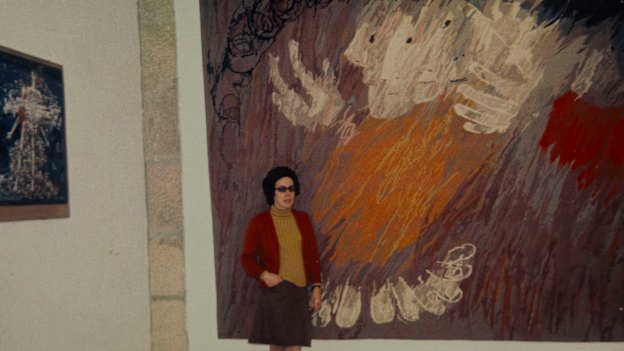
In the 1970s Arthur Boyd, the renowned Australian painter, commissioned a series of 20 tapestries that upon completion were never displayed together. Next month, that changes.
There is a story about St Francis of Assisi taming the wolf of Gubbio. The legend goes that the fierce beast terrorised the Italian city, first by taking livestock and then turning its sights onto humans, waiting outside the city gates for anyone who ventured out alone.
Francis, a man with sainthood in his future and the habits of a wealthy gadabout in his past, had turned his back on a life of leisure and founded the Franciscan order. By the early 1200s, he had fully embraced poverty and nature, amassed a dedicated following and arrived in Gubbio ready to solve the city’s problem.
Against all warnings, the future saint sought out the wolf’s lair. When the wolf saw him, its demeanour changed completely. Suddenly docile and subservient, it placed a paw in Francis’ hand and quietly returned with him into the city of Gubbio.
In present-day Assisi, as I stand near the basilica where Francis’ remains are interred, a guide who grew up within the walls of the medieval town tells me this story and then pauses. It’s a metaphor of sorts, she explains. The story has changed in its telling over hundreds of years. Francis was real, and he lived his life near where we are standing. The wolf, however, was likely not an animal at all, but a person cast out by society. A bandit, perhaps, or a sex worker.
The point of this story, then, is about Francis’ love and care for all humans, irrespective of the stamps society puts on them. His own story is carefully told across a series of 13th-century frescoes in the nearby basilica, most likely by Giotto di Bondone, which spell out a chronology of a man who renounces an easy life and begins his journey into miracles and sainthood.
Gubbio, the city where Francis performed his miracle, has embraced the story as truth. There is a statue of a stately man and a tame wolf; every souvenir store sells magnets depicting the scene as literal fact. And maybe it was. In the late 1800s, centuries-old wolf bones were reportedly dug up during renovation of a church in the area.
When Arthur Boyd visited Italy in 1964, the story of St Francis wasn’t new to the celebrated Australian artist, but it suddenly took a grip of his imagination. He saw the frescoes, walked the same streets and subsequently spent the next decade imagining and retelling the story through drawings, paintings, lithographs and finally, tapestries.
Born in Murrumbeena in 1920, Boyd was the son of artists Merric and Doris, and part of the creative dynasty whose branches stretch both backwards and forwards into architecture, visual art and literature. By the late ’60s he had firmly established himself: he had exhibited at home and abroad, was commissioned to create a ceramic sculpture for the 1956 Melbourne Olympic Games, and represented Australia at the 1958 Venice Biennale, alongside the work of Arthur Streeton.
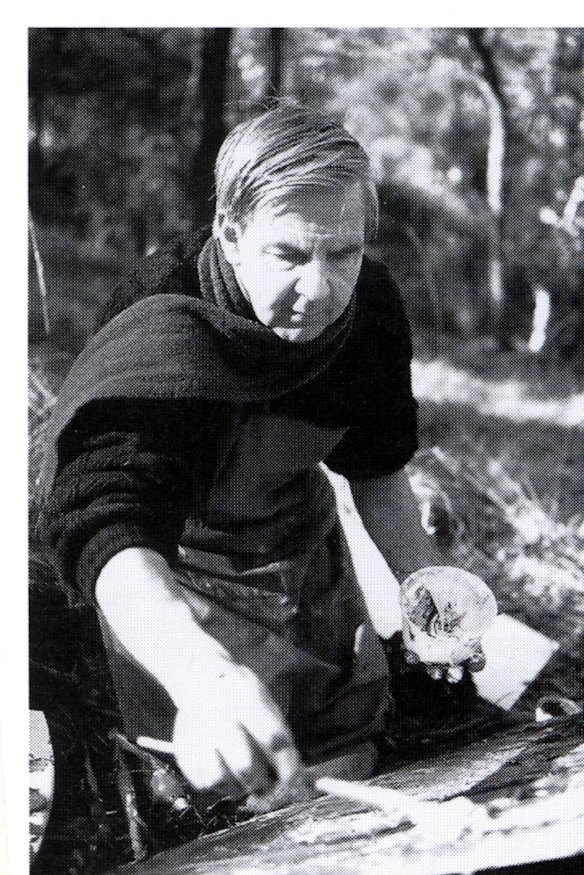
His close friends were essentially a checklist of the biggest names in contemporary art. John Perceval, Sidney Nolan, John Olsen. It was the latter two who suggested Boyd get in contact with Manufactura de Tapeçarias de Portalegre (TMP), a small workshop in Portalegre, Portugal, to reproduce some of his works as tapestries.
For the first half of the 1970s Boyd stayed in close contact with the workshop as the staff there took on their largest ever order – translating 20 of his St Francis series from their pastel originals. The result was years of round-the-clock work, millions of stitches, and a collection of artworks that ultimately took 51 years to finally put on display.
TMP was founded in 1946 by Guy Fino and Manuel Celestino Peixeiro and the first tapestry came “off the loom in 1947”, Fino’s daughter, Vera, explains. The workshop rapidly built a reputation for high-quality work, and this, coupled with a government commitment to spend 1 per cent of Portugal’s budget on public art, meant the business grew rapidly. By the time Boyd reached out to them, the workshop – then located up a steep set of stairs into a large room where looms stretched from wall to wall – was bustling.
A tapestry is essentially an image translated into an extremely fine grid – a painting or photograph rendered into a series of dots or pixels.
What set TMP apart from its contemporaries was its innovative technique of “splitting the stitch”. If a tapestry is, up close, a grid, then rendering a smooth diagonal line should be impossible, no matter how small your stitches. When each stitch is made up of a single colour, when different coloured stitches sit alongside one another, the result is “stepping” – a diagonal that looks like a staircase viewed from the side. The technique used in Portalegre means the individual strands of the thread are separated and other colours woven in, which results in smooth lines that exactly mirror the artwork.
Before the first stitch can be made, however, the artwork needs to be mapped out onto a grid.
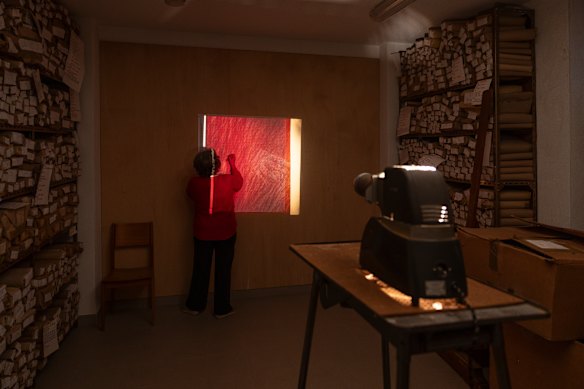
With pastels, the edges are soft, the colours bleeding into each other. Boyd had two sets of transparencies made for each drawing. One would be cut into sixths so it could fit into a slide projector, while the other remained whole.
Working for 30 minutes at a time – any longer and the slides would melt – the outlines of the artwork would be painstakingly traced onto a grid at TMP, and the grid would later be used by the weavers to render their copy, line by line. Every project the workshop took on would be given a difficulty category, which would help determine how many workers were needed and how long a project would take. The most difficult that Fino can remember was a 12. Boyd’s, with their mixed colours and gentle edges, were an eight.
Lurdes Branquinho has been working with the tapestry workshop since she was 13. Sixty-three years later, the building they are in now is smaller than the one where the Boyd tapestries were made, but the same natural light bleeds in.
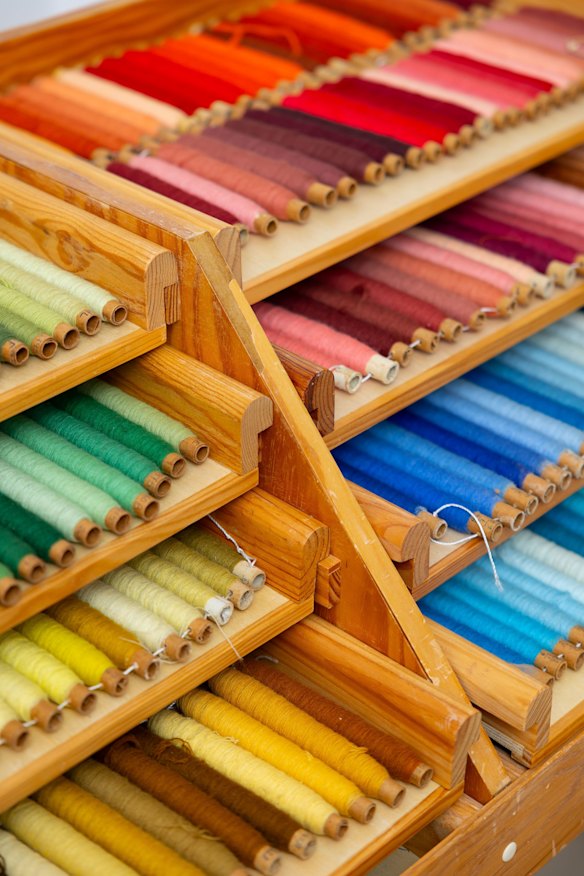
Branquinho holds a transparency up to the window, peers intently at it, then rifles through drawers housing yellow threads. Every cabinet in this room is filled with reel upon reel of colour, in almost every shade you can imagine, but store-ready colours are not enough. Branquinho picks through different kinds of yellow, bringing eight separate strands together to form a new whole.
“The working window for choosing colours is quite small,” Fino explains. “In the winter, when there is a very cloudy and dark day, [Branquinho] cannot choose colours. In the summer, on the very sunny days after maybe four o’clock, she cannot choose colours because the light becomes very yellow – and so the colours are changed.”
On the table next to Branquinho are pages that Boyd provided, with swatches of colours used in his original works. It’s well-intentioned, carefully thought out and basically useless. The book cannot consider the way that colour changes as a line passes over another, how different shades melt into one another, the light to dark impact of a change in pressure when a hand draws a line. By the time the colour-matching process is over, page upon page of carefully catalogued thread colours wait for the weavers.
The tapestries take Boyd’s original pastels and scale them up – from around 60 centimetres long to three metres. A finished tapestry would have between 4 and 8.5 million stitches and each took several months to complete, with up to six weavers working simultaneously on a single one, working in shifts. One shift, staffed by experienced weavers, could hope to produce three centimetres of new work. With work so labour-intensive, recreating the tapestries today would cost €150,000 ($243,000) each.
In the record of correspondence between Boyd and the workshop, an image quickly comes into focus of a man who cared deeply about his work. There are letters and telegrams about payments and meetings and the shifting political climate in Portugal. Boyd and Guy Fino were in regular contact, and there are allusions to meetings, dinners and visits to the workshop. The file contains a letter from Boyd’s wife, Yvonne, to “Senhora Fino” thanking her for her hospitality.
The tapestries arrived in batches, and across the years’ worth of pages there is a growing urgency from Boyd, who first envisaged an exhibition in 1972 and then in 1974. “I am very concerned to know how many of my tapestries are now completed,” he wrote in September 1972. “PLEASE TELL ME WHAT DAY OF DECEMBER THE TAPESTRIES WILL ARRIVE STOP I AM ANXIOUS,” he wrote in a telegram in December that year.
In March 1973, a letter from Boyd acknowledged receipt of five tapestries. “I think that four of them are very good indeed … but the fifth tapestry is much more crude than the others,” the artist wrote. Boyd’s letter queries whether the issue is with the transparencies. “I think the transparency may have been exposed to the sun and has consequently faded so that when the girls translated the images some of the details and variations had disappeared.”
It’s not clear which of the tapestries Boyd was disappointed with, or whether it was re-done, but it is clear that the workshop – both in Guy Fino’s day and in its present incarnation under his daughter, Vera – takes pride in getting things right.
“I can tell you about a big tapestry that was ready, and when my father saw it, he said no,” Vera Fino says. “It was a huge tapestry, I think it was like six metres by two-and-a-half … and my father said no, and cut it in small pieces, and started again.” The pieces are still in the workshop, on a shelf in the storage area.
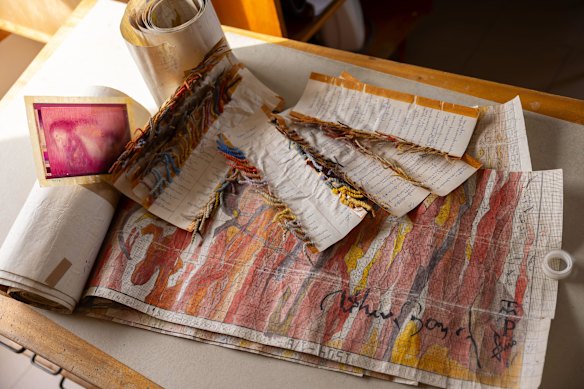
In September 1974, Boyd sent another telegram. “TAPESTRIES ARRIVED SAFELY THANK YOU”. The correspondence up to then had been increasingly urgent and anxious, but ultimately and unexpectedly, the exhibition frequently cited by Boyd never eventuated. After completion they were sold to the National Gallery of Australia at cost price alongside a donation of thousands of works. While a handful of them have been displayed across the years, they will be exhibited together for the first time in Canberra this month.
The reason it’s taken 51 years to show the works in full is likely because of their scale, says Elspeth Pitt, senior curator of Australian art at the NGA. They’re huge works – and to show them properly requires a large, dedicated space.
In Boyd’s St Francis series, walls and boundaries melt. Some of the stories he depicts are drawn directly from St Francis’ canon while others come from Boyd’s own mind. It’s impossible to pick out a chronology of events; instead we see snippets, perhaps literal, perhaps metaphorical.
“I think with Boyd everything’s kind of interconnected,” Pitt says.
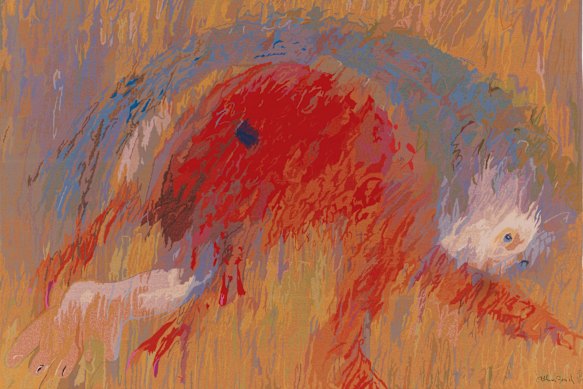
St Francis being beaten by his father depicts the saint cowering in the bottom corner, one hand grasped over his head, the other fending off a screaming figure clutching a stick. St Francis blowing Brother Masseo into the air is decidedly more whimsical. St Clare attending to St Francis feels more intimate and warm, the two figures drawn close, as Francis’ hair – a motif across much of the series – spirals across them. In The Wolf of Gubbio with St Francis in a bent tree, the figures melt so much into one another and the background it is impossible to say with any confidence which figure is which.
Boyd wasn’t a diarist, Pitt says, so we have more questions than answers. Does his fascination with St Francis stretch back to the series of murals Boyd painted as a young man at the family home, The Grange? Is the stick in Francis’ father’s hand a reference to Boyd’s own father, Merric, who would sometimes take a branch from a tree to beat himself on the leg? Is the wolf in The Wolf of Gubbio with St Francis in a bent tree inspired by Boyd’s dog, Peter?
“Something that people charge Boyd with [is] having this very complicated, sometimes convoluted iconography that’s quite difficult to understand because of its personal nature,” Pitt says. “But it’s very interesting when you go into it.”
Arthur Boyd: Tapestries is at the National Gallery of Australia from June 20 to October 18. Elizabeth Flux travelled to Italy and Portugal as a guest of the NGA.
The Booklist is a weekly newsletter for book lovers from Jason Steger. Get it delivered every Friday.
Disclaimer : This story is auto aggregated by a computer programme and has not been created or edited by DOWNTHENEWS. Publisher: www.smh.com.au