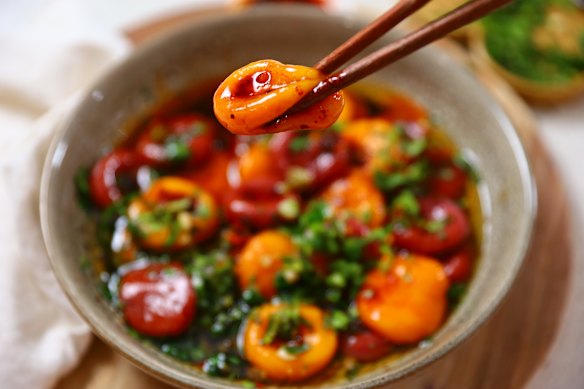
They’re satisfyingly squidgy, budget-friendly and look great, too. Here’s how to make these adorable “button” noodles, the bounciest sauce delivery system we’ve come across yet.

We know the social media formula: two ingredients + surprise and delight = a viral recipe hit. We just love the promise of a budget-friendly recipe that somehow delivers more than the sum of its parts for an unreasonably delicious result. And here’s the latest contender – two-ingredient “button” noodles that act as the bounciest sauce delivery system we’ve come across yet.
In a continuation of the potato noodle trend (cooked potato mixed with potato starch and using a bottleneck to create a “mushroom” shape), the latest iteration subs out the potato for various root vegies and a thumbprint for more colourful results. We’ve seen variations from beetroot to carrot and the dish itself has been called everything from “button noodles” to Korean-style gnocchi. But does it live up to the viral ooohs and aaahs creators lather it with?
Does it work
The premise of the recipe is simple. Steam carrot/beetroot/sweet potato/pumpkin until fall-apart soft. Mash smooth and mix with starch (glutinous rice flour/potato starch/tapioca flour) to make a soft and easy-to-handle dough. Roll it into little balls, press with your thumb to create a “button” shape, then boil until they bob to the surface of your bubbling pot, drain and serve drenched in chilli-garlic sauce of your choice. Popular versions have been shared by creators including Dan Dumbrell and Itsvegansis.
“I was a bit of a sceptic going in,” says cookbook author, sweet expert and creator of viral food content Catherine Zhang. “A noodle made from mashed potato and potato starch sounds like it should be gluey, but the first batch came out bouncy and slippery, somewhere between tteokbokki rice cakes and a thick udon. What won me over was the little dimple in the middle. It’s a tiny cup, so every piece carries its own pool of chilli oil.”
The best recipes from Australia’s leading chefs straight to your inbox.
Why do we love it
It’s a new riff on an old idea, simplified and made hyper-accessible by content creators for home cooks.
“Starch and a cooked root vegetable kneaded into a chewy dough exists all over Asia,” says Zhang.
“In Taiwan, there are taro balls and sweet potato balls of mashed root plus tapioca starch served in sweet soups – which is where I come at this from, as a dessert person.
“Hokkaido has imo mochi, mashed potato and potato starch pressed into discs and pan fried. Korea has gamja ongsimi — potato dumplings in soup. Northern China has pressed thumb pastas like cat’s ear noodles, and Italy has gnocchi, which is the same logic with wheat flour.
“So the social media version is really a mash-up: a Taiwanese taro ball dough, shaped like a Chinese thumb pasta in a Sichuan-style chilli oil sauce. I just call them button noodles, because that’s what everyone searches for, though at home they get called ‘the chewy potato ones’.”
While Zhang says they hit the viral big time because of their two-ingredient 20-minute ease and their built-for-video so-satisfying visuals, it’s the texture and the sauce that really seal the deal.
“There’s a whole generation obsessed with chew: boba, mochi doughnuts, tteokbokki … Button noodles are that ‘QQ’ bounce in its purest form,” she says, referring to the term some cultures in East Asia use to describe that satisfyingly squidgy texture.
The sauce is also a long-time winner: a combination of chilli, garlic, soy, vinegar, spring onion and hot oil sizzled over the top.
“The noodle changed, the sauce did not. So people already knew they would like it. The carrot and pumpkin versions kept it going because colour is a free hook.”
Is it worth making?
The short answer is yes. The bouncy little delicious results shift between slippery or chewy depending on your flour choice, with Zhang recommending the glutinous rice flour version.
“My honest verdict: they are more of a dumpling than a noodle, they are very moreish, and they are at their best in the first 10 minutes out of the pot.”
Yes, they are as easy to make as the social videos claim. They look great, and that little divot made by your thumbprint is a perfect sauce-pooling point.
Pro tips for making them at home
- Knead only a little – you’re not working gluten and over-handling dries them out.
- Mash the root vegies while hot and add your starch straight away to start the cooking process – it helps with structure.
- Work with weights rather than cup measures – Zhang recommends 2 parts cooked root vegie to 1 part starch by weight, adjusted by feel to avoid crumbly or gluey textures.
- Keep your buttons small so they cook through.
- Boil them hard and leave them in for an extra minute after they float.
- Rinse them under cold water to tighten the chew.
- Drench them in sauce as soon as they’re ready – they’re best eaten fresh, but can be revived in a little boiling water.
Zhang’s notes on starch types
- Potato starch is a more classic version for a clear, bouncy, slippery result.
- Glutinous rice flour gives a softer, more tender mochi chew, and it is the easiest dough to handle, but has a less glassy texture.
- Tapioca is the stretchiest and most translucent but becomes gummy very quickly, so is best in a blend.
Viral carrot and beetroot button noodles
This easy and eye-catching recipe is best when you make a batch of each of the carrot and beet versions and mix them together for a rainbow result.
INGREDIENTS
- 400g carrot or beetroot, peeled and large diced
- 200g glutinous rice flour + extra
- pinch of salt
Sauce ingredients
- 2 spring onions, very finely chopped
- ¼ cup coriander leaves, finely chopped
- 2 tsp garlic paste
- ¼ tsp chilli flakes
- 1 tsp caster sugar
- 3 tbsp sweet soy sauce
- 1 tbsp black vinegar
- ½ tsp sesame oil
- 2 tbsp rice bran or peanut oil
OR
- 2 tbsp chilli crisp oil
METHOD
- First, prepare all your sauce ingredients: finely slice spring onion, coriander and garlic. Mix together soy sauce, black vinegar and sesame oil.
- Next, make your noodles. Peel and cut your carrot or beetroot into small pieces. Cover with water and a pinch of salt and bring to the boil, simmering for 10 minutes or until completely tender and mashable with a fork.
- Drain, and while still hot, mash your carrot or beetroot until very smooth. When just cool enough to handle (but still hot) add the glutinous rice flour and knead into a smooth dough. If it’s too sticky or a little crumbly, adjust it with a little more glutinous rice flour or water until it can be easily rolled into a smooth ball.
- Bring a large pot of water to the boil.
- Break off small pieces of the dough, roll into small balls and then press with your thumb to create a button shape. Repeat until all the dough is used.
- Add the buttons to the boiling pot and cook until they all bob to the surface, then cook for 1 extra minute.
- Drain and run under cold or icy water to tighten the noodles for extra bounce.
- In a small pot, heat your rice bran or peanut oil until boiling.
- Put your cooked noodles into a bowl and add spring onion, coriander, garlic, chilli flakes, caster and sugar. Pour over the hot oil for a sizzle, then add the vinegar soy mix and toss through. Serve immediately.
Serves 2
 Jane de Graaff is a food writer and recipe developer who regularly demonstrates fun food on Nine’s Today Show.Connect via X.
From our partners
Disclaimer : This story is auto aggregated by a computer programme and has not been created or edited by DOWNTHENEWS. Publisher: www.smh.com.au