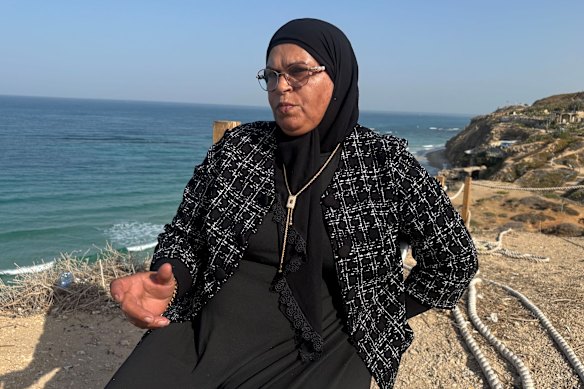
They were the 30 seconds that changed Watfa Jebali’s life forever. The 30 seconds that still haunt her dreams. In November 2018, Jebali and her husband were preparing to celebrate their wedding anniversary at their home in Tayibe, an Arab town in Israel near the border with the West Bank. Jebali’s son Saed, 26, was working in the family grocery store downstairs when a masked man walked inside, shot him dead and ran away. Jebali watched the murder unfold in real time on the family’s closed-circuit television set.
“It was all over in 30 seconds,” she says. Saad left behind a wife and six-month-old daughter.
According to Israeli police, the murder stemmed from a dispute with the killer’s family over a rental apartment the Jebalis had asked them to vacate. Three months after the shooting, two men, aged 18 and 19, were charged with murder and were later sent to jail. Determined to prevent other mothers from suffering the same fate, Jebali helped found a group of grieving mothers demanding action from authorities to reduce violent crime in Israel’s Arab communities. The Mothers for Life gained national attention here in 2020 when they walked for six days from Haifa, in northern Israel, to the Israeli president’s residence in Jerusalem to bring attention to the issue. To their dismay, the problem has only worsened in the years since.
Saad Jebali was one of 74 Arab-Israeli citizens murdered in 2018. That figure soared to 241 last year, an all-time high. Arab-Israelis – many of whom identify as Palestinian citizens of Israel – make up 20 per cent of Israel’s population, but 80 per cent of the country’s murder victims. The vast majority of killings involve Arab perpetrators and victims, with many murders linked to gang violence, racketeering, family feuds and entrenched disadvantage.
The Arab-Israeli murder rate doubled within a year when Prime Minister Benjamin Netanyahu appointed far-right agitator Itamar Ben-Gvir as national security minister after Israel’s last elections in 2022. In his youth, Ben-Gvir was convicted of incitement to racism and supporting a terror organisation when he brandished signs at a protest rally calling for Arabs to be expelled from Israel. For the last four years, he has run Israel’s police force and prison system. One of his signature policies has been a dramatic expansion of gun ownership, a move that has allowed firearms to flood the black market.
“We have nobody to talk to in this government. We are desperate,” Jebali says. “We live in Israel, we are citizens of this country, but no one is helping us. We are not even second-class citizens. We are third, fourth-class.”
‘We are suffering in the Arab society because of the fascist ministers.’Mohammed, history teacher, Qalansawe
While the Arab-Israeli murder rate is far higher than for Israeli Jews, the voter turnout rate is far lower. In the last election, just 53 per cent of Arab citizens voted compared with a national average of 70 per cent. Some decline to vote on principle, on the grounds they do not want to legitimise the Israeli government, while others stay home because of apathy and disillusionment.
That is expected to change when Israelis vote on Tuesday (Israeli time) because of Arab voters’ pent-up fury at the most right-wing government in Israeli history. Pollsters and campaigners estimate Arab turnout will reach 65 per cent, and perhaps as high as 70 per cent.
Buying fresh bread for his family at a bakery in Qalansawe, one of the towns that comprise “The Triangle”, a concentration of Arab-Israeli towns on the border of the West Bank, history teacher Mohammed says: “I never used to vote, but this time I will.”
“We are suffering in the Arab society because of the fascist ministers,” he says. “Crime families control the area and no-one is stopping them. This is like the Wild West here. At night people are afraid to leave their homes. It didn’t use to be this way.”
Making falafels at his restaurant a few doors down, Omar Abu Rass, 41, says he has only voted once before, but is considering doing so this time. His relatives are pleading with him to cast a ballot, telling him this is not a normal election. “There is a lot of shootings, a lot of murders,” he says. “The police are not doing what they are supposed to do. Ben-Gvir is deliberately trying to hurt us.”

The two main Arab groupings are the Joint List (a far-left alliance opposed to Israel’s occupation of the Palestinian territories) and Ra’am (a socially conservative, more pragmatic party that made history by forming part of a short-lived government in 2021). In what looks to be a canny move, Ra’am leader Mansour Abbas has put former top police officer Yoav Segalovitz second on his list — the first time a Jewish Israeli has run for an Arab party.
The latest polls show the Arab parties winning 15 or 16 seats in the Knesset, up from 10 at the last election. With neither the pro-Netanyahu bloc nor the opposition bloc led by former military chief Gadi Eisenkot looking capable of commanding enough seats to form a government in their own right, that should make the Arab parties the ultimate kingmakers. But there’s a catch.
A coalition with Netanyahu looks out of the question given the far-right nature of his bloc. As for the opposition, two of the bloc’s key leaders, Naftali Bennett and Avigdor Lieberman, have said they will not serve in a government dependent on Arab support. Eisenkot has declared that no Arab or ultra-Orthodox party currently meets his criteria for joining his government, including supporting Israel as a Jewish and democratic state, endorsing universal conscription and recognising Hamas as a terror group that must be destroyed. Serving with Arab parties has seemingly become taboo since the October 7 massacre – even though Arab citizens of Israel had nothing to do with the Hamas attacks and were among the terror group’s victims.
‘Bibi is prime minister now because we were tired last time; we didn’t go out to vote. This time it’s different.’Husen Basimi
Polling analyst and Haaretz columnist Dahlia Scheindlin has lamented “the foolish self‑imposed arbitrary constraint of not forming coalitions with Arab parties”, saying Eisenkot and co are boxing themselves into a corner for no gain. Certainly, it has not stopped Netanyahu from using his advertising to play on voters’ fears of a government dependent on Arab parties. “Right or Palestine” is his main campaign slogan, meaning a vote for anyone but his bloc will usher in a Palestinian state.
Drinking coffee with his buddies in Qalansawe, Hasan Taya, 60, says he feels insulted that the opposition is turning up its nose at voters like him. “We are 20 per cent of the country. Why push us aside?” he asks. Ultimately, regardless of their promises, he expects the opposition to cut a deal with the Arab parties if needed to form a government.
Taiseer Mahamed, a conflict mediator from the Arab town of Umm al-Fahm, says the politicians’ reluctance demonstrates how Arab-Israelis are often perceived as a “strategic threat to Israel, not as equal citizens. We are viewed with suspicion even though we are doctors, pharmacists, engineers”.
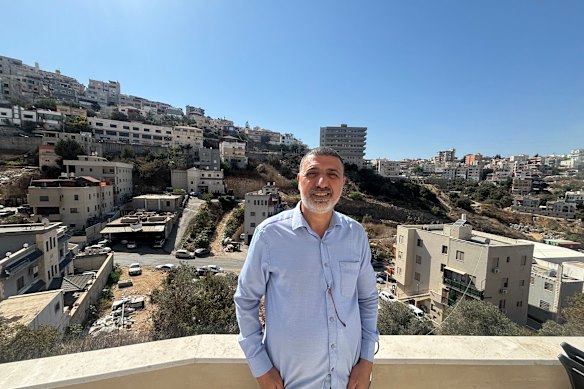
Arab citizens of Israel often have a complicated relationship with the state, reflecting the fact that their ties to the land predate the founding of Israel in 1948, which many call the Nakba or catastrophe. They are not required to serve in the military, and many Arab Israelis do not sing the national anthem, given it contains references to the Jewish soul. All are fluent in Hebrew, but usually speak Arabic among themselves.
“In Gaza, the West Bank and East Jerusalem, it is easy to say I am Palestinian and only Palestinian,” Mahamed explains. “In Israel, Arab citizens face more dilemmas and more conflict about their identity.” He personally feels no clash: “I am Palestinian and Israeli. They are not mutually exclusive.”
‘We have lived here for 300 years; we are not new here. We just want a home to live in and to live in peace.’Salman Abu Wadi
Drinking coffee in Nazareth, the largest Arab city in Israel, medical student Dimi sees it differently: “I’m very clear on my own identity and who I belong to. I am a Palestinian living in Israel.” She says Israel has become increasingly censorious and racist, prompting her to move to Europe to pursue her career as a doctor. “As a Palestinian Arab woman living here, I don’t think I can speak my mind freely. My beliefs are not accepted,” she says.
Salman Abu Wadi, meanwhile, is determined to stay put. Earlier this month, Israeli authorities came into his family’s unauthorised village and bulldozed 80 homes and the village mosque – part of a widespread operation to dismantle Arabic-speaking Bedouin communities across the Negev Desert. He and his son are living in the husk of their former home amid a desolate wasteland of demolished properties.
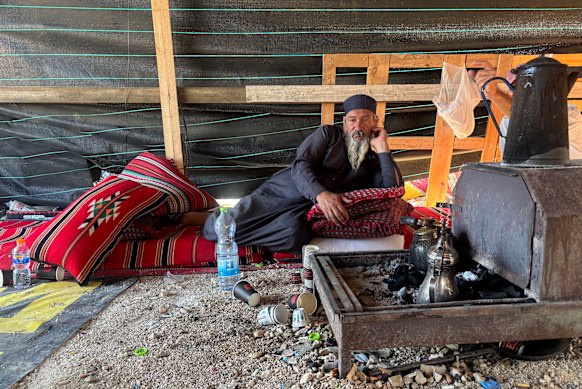
“We don’t know when they will come and demolish again; we live in anxiety. This is happening all over the Negev,” he says. Abu Wadi says families like his have lived in the region long before the founding of Israel, meaning they don’t have ownership papers.
“We have lived here for 300 years; we are not new here. We just want a home to live in and to live in peace,” he says. “There is no better country in the Middle East than Israel, but this government is the worst.” He will vote in the hope that a new government will allow families like his to stay on their land
Among the 180 Arab-Israelis who have been killed so far this year were Husen Basimi’s son Yahya, 22, and his two cousins. They were found dead in a burnt-out car last month near their home in Jaljulia, a town of 10,000 near Israel’s border with the West Bank. Every day Basimi tends to his son’s grave and torments himself with the same question: why?
“He was a nice kid, he loved helping people, he wanted to get married,” Basimi says as his wife pours us Arabic coffee in their living room. “The police haven’t given us any details. I am trying to find out and no-one has any.” If the murder is solved, it will be a rarity. Israeli police only solve around 15 per cent of murder cases for Arab victims compared to 75 per cent in Jewish communities.
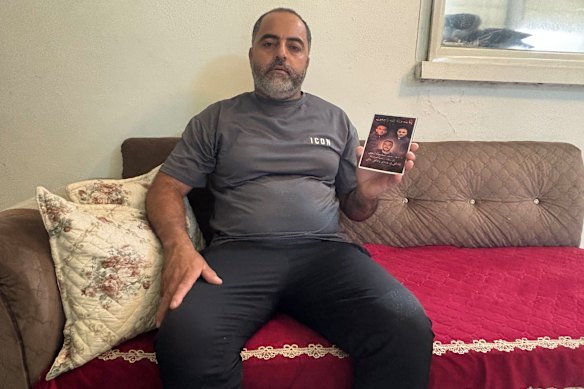
Basimi is furious that, while his son’s murder has been greeted with silence and inaction, Israel launched a sweeping military operation in the West Bank when two Israeli soldiers were killed last week.
Even in the midst of grief, he and his wife Amira are debating politics. Amira doesn’t think voting matters much. “You vote, you don’t vote, Netanyahu remains prime minister,” she says.
Husen believes Netanyahu will lose these elections and that a change of government will make a difference to families like his. “Eisenkot lost his son in the war, and he wants to unite the people. I think he will help us,” he says. “Bibi is prime minister now because we were tired last time; we didn’t go out to vote. This time it’s different.”
Read more on Israel’s election:
Disclaimer : This story is auto aggregated by a computer programme and has not been created or edited by DOWNTHENEWS. Publisher: www.smh.com.au