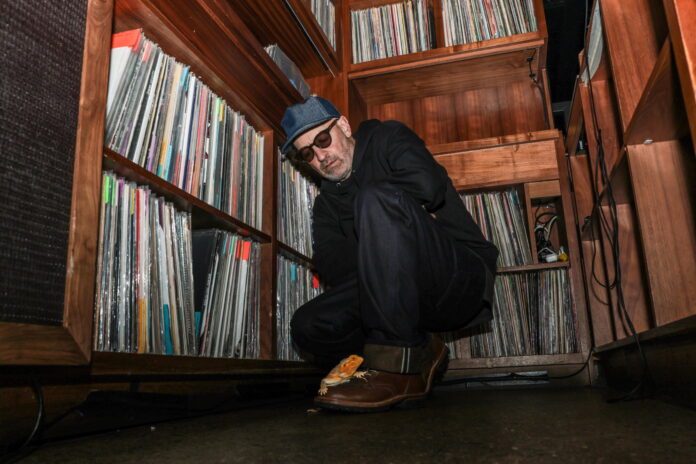
Chris Manak walked into his Highland Park bar Gold Line cradling a formidable lizard.
The DJ, producer and founder of the longtime L.A. record label Stones Throw, who performs as Peanut Butter Wolf, was looking after his daughter’s bearded dragon, Sweet Pea, for the afternoon. The scaly beast looked curious as it walked atop the reams of vinyl at Manak’s bar, on the ground floor of Stones Throw’s offices, which take up half a block on Figueroa Avenue.
Stones Throw, like the creature climbing up his shirt, is a resilient survivor. Founded in 1996 as an indie hip-hop label, the imprint has stretched to all corners of funk, rock and rap music, with records like Madvillain’s “Madvillainy” that influenced generations of artists including Tyler, the Creator and Ye. It earned plaudits from Questlove and Snoop Dogg, won a Grammy for progressive R&B album, and hung on as the record business imploded and rebuilt in the streaming era.
Manak — a new hire into KCRW’s DJ ranks as well — will celebrate his label’s 30th anniversary with a three-day festival in Highland Park on Oct. 16-18. He spoke about staying vital as hip-hop waxed and waned commercially, how his office’s bar revamped local nightlife, and whether technology has changed the value of good taste.
Thirty years is a hell of a run for Stones Throw. Could you have imagined still doing this now when you founded the label?
When I was in high school, I had a term paper talking about having this record label. I saw it again years later, going through storage, so I must have manifested it. But we weren’t thinking about making hip-hop beats and rapping 30 years later.
I remember as a kid watching the Motown 25-year anniversary on TV. I was probably 12 at the time, and I was buying contemporary Motown records, Rick James and DeBarge. But I wasn’t interested in seeing all the stuff from the ’60s then. I was like, “That’s my parents’ music.” So it is weird to think that this label has lasted longer than Motown had at that anniversary.
The fest has both young and classic Stones Throw acts. How does the festival define where the label is now while nodding to its history?
We started with the artists [Automatic and Los Retros and Sudan Archives] that were putting records out now. But then as I started looking at it, I did want to have Rasco and Planet Asia, because those are the first rappers that I worked with on the label. Architect and Wildchild too. Some of them haven’t played shows in a long time.
People say they hear a “Stones Throw sound,” but I can’t explain what it is. If you go back to Quasimoto’s “The Unseen” for example, that was one of the first albums on Stones Throw, but those are songs that he just recorded at his house. I liked the intimacy and the rawness of it. There is stuff that’s more pretty now too, but I definitely see a through line and the label evolving as my personal taste evolves a little too.
You got into hip-hop when it was a subculture, and now, with some exceptions, it’s back on the commercial margins. Does it feel more like that early era again?
I think so. When I wanted to do this as a living, I didn’t care about the top 40 or the Grammys. It wasn’t our goal to be in the Rock Hall. I remember back then, older people were saying sampling is not real music, rappers are not musicians. But DJ Premier, Pete Rock, Bomb Squad, they all made really interesting music that I wanted to hear more than anything.
And yet you did win your first Grammy last year for the NxWorries record with Anderson .Paak.
I’m flattered. It’s something that I can explain to my parents who still don’t understand what I’m doing 30 years later. Anderson .Paak spearheaded that, but since he’s won so many Grammys before, I didn’t even think he would care. But when it happened, he was so excited. I think, for him, it felt better to be able to do it with an indie label because it must be the talent and not politics.
Chris Manak at Gold Line Bar, his popular spot that’s part of the bar-hop scene in Highland Park.
(Robert Gauthier / Los Angeles Times)
The Stones Throw documentary showed how you’ve influenced some of the biggest acts in hip-hop — Ye, Tyler, the Creator and so on. Do you have any residual hunger for a huge hit record?
I tried not to do that. This sounds kind of self-sabotaging, but we met with Odd Future when they first were buzzing in L.A. They hadn’t done any shows yet and they were interested in Stones Throw. I was interested in them, but I didn’t really pursue it, and they ended up doing their own label. The rest was history.
Even with Anderson .Paak, I heard his more contemporary stuff that I wasn’t really interested in, but I saw that he was gonna be a big deal. I didn’t try to be involved with all that. It was like, go where you want. I felt like I would be holding him back in a way, or it wasn’t the Stones Throw sound.
One of the guys from Rüfüs Du Sol came to the office last week; we have a mutual friend. I wasn’t aware of how big they were, and I saw that they did five shows in a row at the Forum. Like damn, how does someone get that big? Yet he was asking about my history, he was interested in early 2000s hip-hop and the trajectory of Stones Throw.
The label’s tenure coincides with the collapse of the record business and the rise of streaming and the resurgence of vinyl. Is it easier or harder to make a living on records now?
I never really did well with five-year plans or any of that. It was always what record am I going to put out next, and everything else has always kind of figured itself out. I’m like the cat that lands on its feet.
Almost every release that we have to this day has a vinyl version. But when streaming became the main part of our business, it was a difficult time. A lot of it now is AI music — just look at the statistics of how many songs are being released now compared to even like 10 years ago. It’s astronomically more. With a business model of streaming where you’re getting a piece of the pie, there’s just so much more in that pie now.
It’s a hard place to be right now as far as touring too. The fans are all over the place — it’s harder to get someone in small rooms, and you have to start off that way. There’s less of those kinds of venues now. It’s going to be an interesting time to see how that shakes itself out.
Touring is so expensive and grinding for all but the biggest artists these days.
It’s so hard to do 250 shows in 365 days. I’ve never even done a monthlong tour in my life, maybe once with Cut Chemist in like 1997. It’s good for me that I could put on my hat for putting out other people’s music and then go back and DJ and curate music that way too.
You just got a new job in the rotation at KCRW. You arrived at a complicated time there, how has it been?
It’s just once a month, so it’s kind of a specialty show and I can do whatever I want. I’ve been using it to play a lot of unknown records. The other DJs on there play so much stuff that I don’t know, and it’s crazy how much new music is out there, and so much of it is good, and I don’t know how to discover it. So much of it is algorithmic. I don’t see as many curators these days, but I love seeing the DJs here, at Gold Line.
Gold Line set a precedent for L.A. bars that are meant for close listening to records on a great hi-fi. You opened Palomino here recently too. How have these bars changed the way people go out in L.A. to hear music?
We’d used this space for private parties. I had one where we put crates floor to ceiling and had people DJ with my records, and I had a really good time seeing how other people used them. I found out that in Japan, they have these listening bars, and I wanted to do that here. Someone said it’s gonna be all middle-aged white men in here, but good music brings people from all walks of life together. Our oldest DJ is in his 70s.
How is L.A. feeling as a music town these days? People are fighting to stay afloat, and whenever I see the film industry get new tax credits, I wonder why music doesn’t advocate for that too.
I loved the music scene in L.A. and that’s what I moved here for more than anything, not for the industry. Certain small venues that nurture the scene, like Lodge Room and Zebulon, are the curators. But even having the DJs at this bar, it helps them pay their bills. A lot of the up-and-coming artists that I deal with, they don’t have a 9 to 5, they DJ three nights a week at different places.
I see people that I think are so talented, and they’re not able to really make money at their music yet. I have people who’ve been doing it for five, 10 years and are still forced to work on cars. I think about like some of the artists I work with that get government grants in Austria and Canada and the Netherlands. I wish there was more of that in the U.S. in general. When I sign artists, my goal is always to help them get to the point where their day gig is the music.
More to Read
Disclaimer : This story is auto aggregated by a computer programme and has not been created or edited by DOWNTHENEWS. Publisher: latimes.com