
They also brushed harder, which was not only ineffective at removing the plaque that accumulates in our mouths, it can also damage the gums.
Researchers say there is hardly any health behaviour performed by such a large proportion of the world’s population as regularly as cleaning your teeth.
That’s a big win for health. Yet the results are still imperfect.
Andrew Terry, a senior lecturer teaching dentists and oral health therapists at the School of Dentistry at the University of Sydney, says about 30 per cent of Australian adults have moderate to severe gum disease caused by poor and ineffective brushing.
Some people don’t know how to do it properly, and most people lack time. The cost of dental treatment is high in Australia and the public system is overwhelmed, making it difficult to get help or a lesson.
“Many people have never been shown what to do,” Terry said. “Even the advertisements from dental companies in the 1980s and 1990s did not depict accurately how to do it properly.”
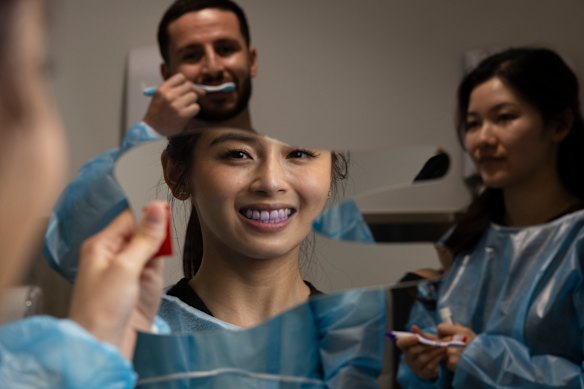
To show the plaque build-up, after brushing teeth in the morning, by 6pm, young oral health therapists with beautifully cared-for teeth who work in private practice and at Sydney University with Terry used disclosing tablets.
Within 30 seconds in the mouth, these tablets highlight new plaque in pink, and where it is old and harder to remove, purple.
Even those with the best and whitest teeth who’d brushed that morning had a pink tinge. None were in the purple.
Terry said that oral health experts’ new goal was putting the mouth back into health: “The mouth is connected to the rest of the body.” Sickness in one part of the body affects the mouth, and vice versa. Anaerobic bacteria in the mouth have been linked to osteoporosis, premature birth in women and diabetes.
“Where someone has died of a heart attack, and they’ve actually analysed the clot contained in the actual blood vessel, they’ve found oral bacteria from gum disease in these areas,” he said.
Teeth-brushing 101
If you use a manual brush: Err on the side of a gentle brush with a small head. Brush gently near and on the gum line in a small circular motion.
If using an electric brush, the approach will depend on the type. But guide it around the area, hovering on each tooth for a few seconds.
Ask your dentist or oral health therapist for tips, and get advice on how to use interdental brushes to get in between the teeth.
The problem is not the time spent brushing teeth, or the number of times a day that someone brushes their teeth, but other factors. Some brush with a sawing horizontal motion, pushing too hard. Others use a hard brush that can damage the gums, and many miss the inside of the gums.
In another study, young adults were asked to clean their teeth in front of a camera. Videos showed that most of them scrubbed, which is not recommended. Many people brushed by sawing from side to side (not recommended). “This is a remarkable and disturbing result,” the researchers said.
Everyone overestimated their oral cleanliness by twofold. Another study found that parents said their children brushed twice a day, exaggerating what really happened.
An oral health report last month by the Australian Institute of Health and Welfare (AIHW) found 43 per cent of all children aged five to 14 had a moderate accumulation of plaque.
One in 10 adults had missing teeth and other dental problems, and one in 25 aged over 15 years of age had lost all their natural teeth.
‘I never brush my teeth in the bathroom. It’s boring.’
Angelee Murdoch, oral health therapist
AIHW spokesperson Dr Adrian Webster said that without good oral health “a person’s general quality of life and the ability to eat, speak and socialise is compromised, resulting in pain, discomfort and embarrassment”.
Our test
The four oral health therapists who participated in this masthead’s test using disclosing tablets said that most people brushed poorly and too quickly.
- Audrey Wong said teenagers brush for about 30 seconds – “very, very quickly”.
- Cindy Tran said: “There’s clearly a lot of plaque that I can see left behind in the mouth that’s contributing to dental disease like gingivitis, periodontitis, cavities, dental caries.”
- Angelee Murdoch didn’t really care where her patients brushed their teeth, preferring them to do it when they had three minutes while watching television, listening to music or walking around. “I never brush my teeth in the bathroom. It’s boring.”
- Matthew Koma said that more needed to be done to develop a habit in children early to brush well.
- Terry was pragmatic. He would prefer someone brush well once a day than two rushed attempts.
Make the most of your health, relationships, fitness and nutrition with our Live Well newsletter. Get it in your inbox every Monday.
 Julie Power is a senior reporter at The Sydney Morning Herald.Connect via X or email.
From our partners
Disclaimer : This story is auto aggregated by a computer programme and has not been created or edited by DOWNTHENEWS. Publisher: www.smh.com.au