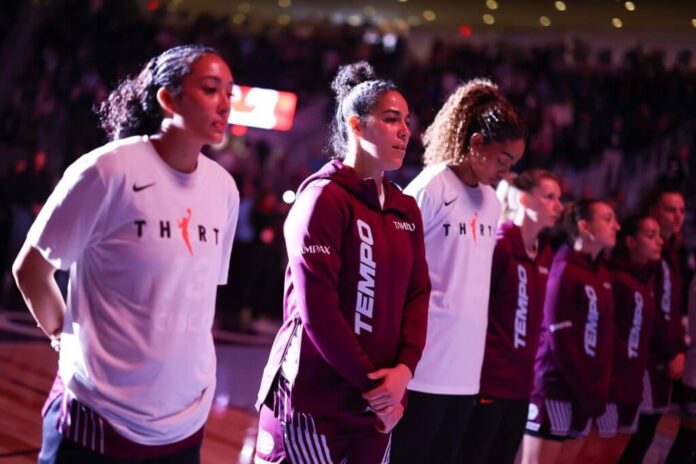
TORONTO – From the window-wrapped 68th-floor lounge atop Scotia Plaza, the view is the point. Maybe some people come for the coffee or the halibut with lemon risotto. It’s more likely that meetings take place here so everyone can take a load off, talk quietly and gaze upon the sprawl of the city and Lake Ontario, contemplating vast horizons. And here comes Monica Wright Rogers, phone pinned to her ear, asking about a photo shoot across town, very much accustomed to looking around and ahead in all directions.
She is the first-ever general manager for the Toronto Tempo, the first-ever WNBA franchise in this country. She ends her call, takes a seat and exhales on a Wednesday in late April. Less than three weeks before this precise moment, her team did not have a single player on its roster. Meanwhile, there was that regular-season game set for May 8. Another first-ever, at home and not budging. “I told my husband, ‘Can you call my mom? Let her know I’m alive?’” Wright Rogers says.
Advertisement
The job is simple and boundless: Build a marketable, recognizable and professionally competitive group to represent a nation of 41 million people. In a whole 35 days.
The Tempo are not alone on this log flume ride of WNBA expansion in 2026. Across the border and the continent, the resurrected Portland Fire works along the same timeline. In tandem, they’re vital to the larger purpose of confirming there’s enough money and interest to make the league’s growth make sense – a bet that will continue with three more WNBA expansion clubs by 2030, which reportedly will bring in a total of $750 million in expansion fees. But that doesn’t necessarily equate to the same stakes for all of them.
To be the only team in Canada is to be a magnet for nationwide curiosity and to operate at the forefront of the WNBA’s global ambition. The Tempo will get grace for trying to be everything to everyone in basically a month. They also don’t really have time for grace in the first place.
“While it’s very exciting to have Canada behind us and everybody’s excited, there’s an expectation level that comes with it,” says Marina Mabrey, the eighth-year guard selected sixth overall in the expansion draft held April 3 to give the two new teams the basis for rosters, plucked from the existing WNBA franchises. “And all of us know it. We feel it. We don’t want to be the first expansion team to be getting our asses kicked. Nobody wants to be that.”
Advertisement
This last part has been a sprint from a standstill. Practically speaking, though, the Tempo has been figuring out who it is for a while.
On Dec. 4, 2024, and after paying the league a $50 million entry fee, Toronto officially became a WNBA expansion franchise, backed by billionaire Larry Tanenbaum – chairman of Maple Leaf Sports & Entertainment, which owns several sports franchises including the NHL’s Maple Leafs and NBA’s Raptors – and his wife Judy. A month and a half later, the club hired Wright Rogers, a former national defensive player of the year at Virginia who was an assistant general manager for the Phoenix Mercury, to run the show. By WNBA All-Star weekend in July 2025, the core basketball operations group was in place, allowing for scouting at all levels to begin in earnest.
Sandy Brondello, who has led two WNBA franchises to championships, took the head coaching gig in November. In December, Wright Rogers and assistant GM Eli Horowitz canvassed Spain, France and Turkey to evaluate players possibly available for the expansion draft. The all-hands plan for traditional college scouting revolved around getting in-person eyes on the top 20 to 30 prospects throughout the winter and spring.
In sum, it’s less dramatic than a Big Bang into existence.
Advertisement
Still, as of April 2, the team had no players. Nobody to slot into a campaign with Sephora Canada, a cornerstone corporate partner. No one to fill a meticulous, minute-by-minute schedule for the first team media day. Ongoing collective bargaining negotiations between the league and the players, meanwhile, put everything in suspended animation, rendering the momentous expansion and college drafts completely TBD.
All the front office had was a collection of best guesses. “We prepared ourselves for every possible situation,” Wright Rogers says, “without even really knowing what was to come.”
After months of scouting and expansion player pool simulations, Wright Rogers and her staff reached two conclusions. They surmised four WNBA teams would leave two valuable players unprotected, so it was optimal to pick second in the expansion draft and make consecutive selections in the snake-draft format. Further, the sixth pick in the college draft was crucial, as they saw a talent drop-off after a half-dozen prospects. (Toronto and Portland were locked into either the sixth or seventh college draft spots.) When the Tempo won a coin toss on March 27 and chose to pick sixth in the college draft and second in the expansion draft, it set the terms of both drafts as desired.
This was not the same, however, as getting the desired outcome.
Advertisement
For one thing, according to Wright Rogers, multiple conversations with agents for potential expansion draft targets turned into curveballs: Their clients chose not to play in Toronto. And after running expansion mocks before the April 3 proceedings, the Tempo anticipated veteran wing Bridget Carleton — native of Chatham, Ontario – would be available for the second pick.
Then Portland took Carleton first overall.
“A tough pill to swallow,” Wright Rogers concedes.
Still, among the 11 players the Tempo acquired in the expansion draft, the front office scouted four in Europe: Julie Allemand, Maria Conde, Kitija Laksa and Nikolina Milić. It was a notable hit rate. “There’s just some things that don’t show up on film, and we felt so much better making those selections knowing for sure what we would be getting,” Wright Rogers says. More consolation arrived 10 days later. With the fifth pick in the college draft, the Chicago Sky selected UCLA’s Gabriela Jaquez. “We almost fell out of our chairs,” Wright Rogers says.
Advertisement
All along — or at least that’s the story the Tempo sticks to — the front office coveted UCLA point guard Kiki Rice for her combination of size, explosiveness and growth trajectory at a premium position. And now Rice was theirs for the taking, fitting the vision completely. “My prerequisite is that guards need to be able to score one-on-one at their position consistently,” Wright Rogers says. “They need to have one thing that they can go to, that we know if we give it to her in that position, she’s gonna do this and we’re gonna get a bucket.”
Multiple free-agent signings completed the training camp roster. The Tempo, finally, had players. This led to the next singular task: assimilating everyone into a foreign country across roughly five days.
Onboarding began with each player filling out an information packet, which allowed the Tempo to kickstart the process of securing both a Canadian work permit and a visa. (All of the new players had passports, much to the staffers’ relief.) It’s not outrageous, but it’s more fraught than, say, deplaning at Portland International Airport. When veteran guard Brittney Sykes signed as a free agent and subsequently arrived on a red-eye flight from Los Angeles, she went through customs. Then she spent about 20 minutes in immigration. Then she paid for her visa. And finally, she moved along to baggage claim. “That was different, I’m not gonna lie,” Sykes says. “I’ve never had to, fresh off the plane, get a work permit to even enter the country comfortably.”
The club did have a natural resource available to its newcomers: Kia Nurse, the Hamilton, Ontario, native who signed with the Tempo out of free agency on April 14. “That was the first time in the eight years that I’ve been in the league that I created the group chat,” Nurse says. “It’s a whole thing.” She collected phone numbers from operations staff and punched them in while her car got detailed. If you need anything Canadian-related, she wrote, I’m your girl. To that end, Nurse explained life north of the border to her new teammates. TSN is ESPN. Crave is a must-have streaming service. There are no Targets.
Advertisement
It helped. Kind of.
Rice needed toiletries upon her arrival and searched for a CVS location, only to find that there is no such thing as a CVS. Shoppers Drug Mart, the rookie guard discovered, is the equivalent. Sykes learned she needed that work permit to get WiFi and couldn’t set it up on a weekend. Mabrey, at least as of the first week of training camp, still had several semi-serious telecommunications beefs. “That TV is going to piss me off soon,” she says. “Like, why can’t I get on ESPN? Why do I have to go to TSN and make a whole account and make a Canada Amazon account and use a VPN and plug it into the (bleeping) HDMI?”
Player comfort, in all senses, is actually no laughing matter. A disjointed, drifting group would slingshot into the season and hit a wall.
To avoid this, Brondello, the winner of 271 games across three WNBA stops, thinks big and small all at once.
Advertisement
The first time every member of her inaugural training camp roster occupied the same space was … the first day of training camp. She reflected on the big-picture opportunity to build something in her welcome speech and then rolled tape to demonstrate core offensive and defensive principles. She’s filled practices with both drills to teach proper hook-screen angles and requests that players learn something new about a different teammate daily. For the purpose of microwaving team chemistry, Sykes and center Temi Fagbenle learning how to communicate through a botched dribble handoff is as important as Mabrey learning that forward Nyara Sabally is a fan of coconut ice cream.
“I always say the most connected team off the court, it will help them on the court,” Brondello says. “Look at the Golden State Valkyries (as an expansion team in 2025). I thought they had so much joy playing. I want to play with the same joy. Get to know your teammate better off the court and then you know how you can get the best out of them on the court.”
Finalizing the roster produced no major surprises, though two of the expansion draftees scouted in Europe, Laksa and Milić, were among the last cuts. The Tempo are who they largely expected to be. And now an audience of millions awaits.
A team outing to a Toronto Sceptres PHWL game on the third night of training camp was meant for bonding but opened eyes as well: When the Tempo crew appeared on the scoreboard video screens, an ovation erupted. “I look up and I’m like, ‘Oh s–, it’s us, guys! Look alive!’” Sykes says. “We haven’t even played a game yet, and I feel like we won the championship, the way they cheered for us.” The Tempo sold all 8,210 seats at Coca-Cola Coliseum for an April 29 exhibition against the Connecticut Sun. Another full house is expected for the regular-season home opener against the Washington Mystics.
Advertisement
The interest is not altogether sudden. The first brand partnership meetings took place within a day of the Tempo hiring a chief financial officer back in 2024. Fans stopped players in grocery stores and shopping centers before the Tempo even held a practice. “We’d already built a pretty solid level of awareness and had kind of figured out how to connect with our fans,” says Whitney Bell, the franchise’s chief marketing officer. “Having players now is like the icing on the cake.”
The attention can unlock doors. On the drive to a second day of the Sephora shoot, Tempo veteran Isabelle Harrison was overcome with emotion; she’d previously applied to partner with the brand and described the opportunity to chief financial officer Lisa Ferkel as a “dream come true.” “You should have seen her on set that day,” Ferkel says. “She was just out of this world.” But all that interest, here, also can generate another ticklish dynamic.
“Canadians pay attention, especially when there’s only one of that team from that sport,” Nurse says. “There’s more eyes on you, essentially. You look at the Maple Leafs here in Toronto, look at the (Edmonton) Oilers — my brother’s there, so I’ve seen a lot of that. And it does take a little bit of getting used to, because there is a little more, I guess, scrutiny. But also they will love you and they will be behind you and they will rally with you the whole way through.”
Around 1:30 p.m. on the first Friday of training camp, a couple walks through the lobby turnstiles at the University of Toronto’s Goldring Centre for High Performance Sport. They’re carrying new Toronto Tempo backpacks with the tags still attached, headed for a black Mercedes idling by the curb outside.
Advertisement
Larry and Judy Tanenbaum had watched practice from courtside folding chairs, at last seeing their new investment at work. When Brondello called over for impressions from a team circle at midcourt, Larry simply raised his hands and applauded. Being the boutique interest of billionaires is no minor advantage, beyond a post-workout menu featuring roasted Latin chicken with chimichurri or already-announced plans for a $100 million dedicated training facility. It suggests a capacity to endure and thrive, long-term, before there’s a single result on the board.
In that way, the Toronto Tempo’s 35-day dash to functionality is a checkmark waiting to be blurred by time.
But it is nonetheless a breathless end to the beginning.
“At the end of the day, this is a building foundation,” Mabrey says, “and we have to start somewhere.”
This article originally appeared in The Athletic.
Toronto Tempo, WNBA, Sports Business
2026 The Athletic Media Company
Disclaimer : This story is auto aggregated by a computer programme and has not been created or edited by DOWNTHENEWS. Publisher: Sports.yahoo.com