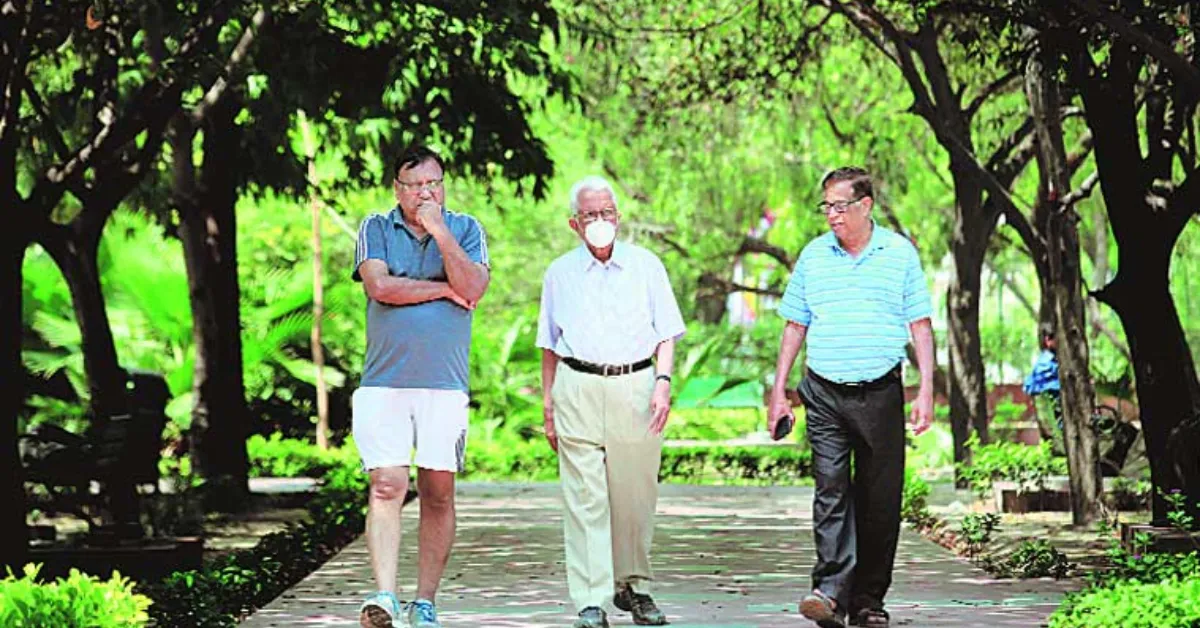
Imagine Rajan, a 41-year-old Chennai resident. He goes to the gym three times a week, eats home-cooked meals, and has no family history of diabetes. At his last check-up, his doctor said he was fine. What nobody told Rajan — what nobody could tell him, with the tests available — is that his blood sugar has been quietly climbing for two years.
He is not sick. Not yet. But he is not entirely well either.
Rajan’s story is not isolated. An estimated 136 million Indians are living with prediabetes right now — blood sugar quietly sitting in the dangerous grey zone above normal, but below the threshold that triggers a diagnosis. Most of them have no idea. The condition produces no pain, no obvious fatigue, no dramatic warning sign. It simply waits.
And then, one day, it becomes diabetes.
A tunnel, a walk, and a discovery
Inside King George’s Medical University in Lucknow, Dr Seema Tewari from the physiology department asked a deceptively simple question: what if the body was already trying to tell us something — and we just weren’t listening in the right way?
Her team built an 11-metre tunnel. Not a complicated structure — just a short, measured corridor fitted with Dual-Energy X-ray Absorptiometry (DEXA) scanners and motion sensors. Then they asked people to do the most ordinary thing imaginable: walk through it.
44 participants took part — 22 with diabetes, 22 without. As each person walked, the machines recorded everything. How fast they moved, how their weight shifted, how well they balanced and how their muscles fired, step by step. Handgrip strength was measured too.
What the data revealed was both surprising and, in hindsight, deeply logical.
Your legs know before you do
People with diabetes walked differently. Their muscles were measurably and consistently weaker. And here is the detail that makes this discovery genuinely fascinating: the weakness showed up more on the right leg than the left.
This is not random. The right side of the body is controlled by the left hemisphere of the brain — the same hemisphere responsible for coordination, balance, and the fine motor signals that keep us upright and moving smoothly.
Fluctuating blood sugar levels, Dr Tewari explained, interfere with exactly these brain functions. The disruption shows up first — and most clearly — in the dominant side of the body.
“Diabetes is known to affect both muscles and the brain at an early stage, and this understanding led us to carry out the study,” she said.
In other words: before a blood test flags anything, before a single symptom surfaces, the way a person walks may already be carrying a signal that, until now, no one was reading.
The research was published in Acta Scientific Neurology and the Government of India has recently granted the team a patent.
Why India needs this
Here is the uncomfortable reality. India is the diabetes capital of the world — not because Indians are uniquely unhealthy, but because prediabetes in India is dramatically underdetected.
Standard screening requires fasting, blood draws, laboratory infrastructure, and the kind of consistent healthcare access that remains out of reach for hundreds of millions of people.
By the time most Indians receive a prediabetes diagnosis, the condition has often been progressing silently for years.
A walking test changes the rules of that game.
It is non-invasive and causes no discomfort. It requires no fasting, no needles, no laboratory. In principle, it could be deployed anywhere — a health camp in a village, a corridor in a government hospital, a wellness counter in a railway station.
Dr Tewari’s vision goes further: cameras powered by artificial intelligence, she says, may one day be able to analyse walking patterns automatically — flagging individuals at risk before they have ever thought to see a doctor.
That future is close enough to imagine, and far enough away to require more work.
What the walking test can and cannot tell us
Dr Tewari is careful, as scientists are, not to overstate the findings. Blood tests remain essential for diagnosing and monitoring diabetes. This walking test is not a replacement — it is an early warning system. A first filter. A way of identifying who deserves a closer look.
How many years before a conventional diagnosis can this test detect risk? The researchers do not yet know. Large-scale studies are needed.
The team plans to expand their work through ICMR — the Indian Council of Medical Research — and the Clinical Trials Registry of India. More participants, more diversity, more data.
But the foundation is solid. The science is peer-reviewed. The patent is granted. And the insight at the heart of this research — that the human body communicates metabolic distress through movement, long before medicine thinks to look — is both scientifically rigorous and quietly revolutionary.
The takeaway
For Rajan — and for the 136 million Indians like him — the message is one of possibility.
Prediabetes is not a life sentence. It is a window. If caught early, it can be reversed through changes in diet, movement, and sleep that do not require expensive interventions or specialist care. The problem, until now, has been finding it in time.
A team in Lucknow just took a significant step toward solving that problem — with nothing more sophisticated than an 11-metre tunnel and the willingness to pay attention to the way we walk.
The next time you take a stroll, remember: your body is always talking. We are only just learning how to listen.
This article is for awareness purposes only. If you are concerned about your blood sugar levels or diabetes risk, please consult a qualified medical professional.
Sources:
‘Now a simple walking test may help doctors spot prediabetes‘: by Grover Aditya for Times of India, Published on 4 May 2025
‘Screening for Diabetes and Prediabetes and their Prediction‘: by Daisy Duan, Andre P Kengne, and Justin B Echouffo-Tcheugui for Endocrinology and Metabolism Clinics of North America, Published on 12 July 2021
Disclaimer : This story is auto aggregated by a computer programme and has not been created or edited by DOWNTHENEWS. Publisher: thebetterindia.com