At eight, Sia Domkundwar remembers scratching her scalp until it hurt.
A bacterial infection had left her with painful boils and clumps of hair falling out. There was no diagnosis for it. But for her family, it changed the way they thought about skincare.
Her mother became cautious about every product that touched her skin or hair. Shampoo labels were studied. Ingredients were questioned.
Nothing was casual anymore.
For Sia, that early discomfort became a lesson.
It taught her that healing is not only about medicine. Sometimes, it is also about what comes after: the choices people make every day to live comfortably in their own bodies.
Nearly a decade later, that understanding has led the 16-year-old Pune student to build something that may change recovery for many others.
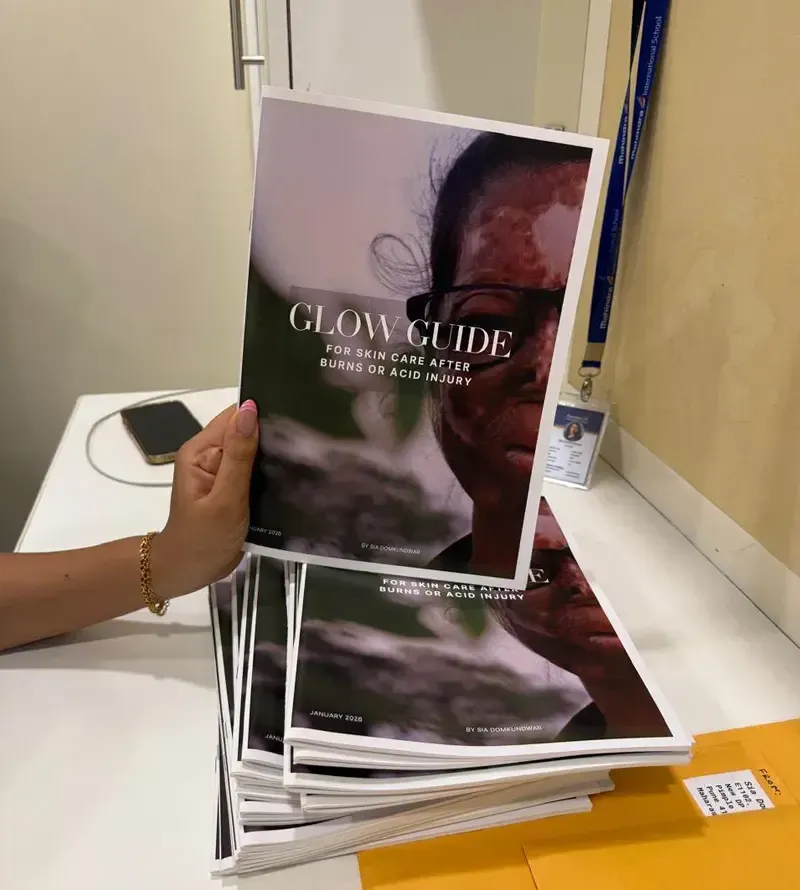
It is called The Glow Guide: a 60-page, trauma-informed, survivor-led resource designed for burn and acid attack survivors trying to navigate everyday self-care after treatment ends.
What began as a mentored internship project has now become a practical guide already being shared with hospitals across India.
The Glow Guide does not prescribe or recommend medication.
It is designed as a recovery-stage, everyday-care guide for burn and acid attack survivors, to complement medical treatment rather than replace it.
The focus is on the practical questions that often come up after or alongside medical care, like skincare, clothing, hygiene, cosmetics, nutrition, hair and scalp care, nails and hands, and other aspects of daily life.
It brings together information across three broad categories: dermatologist-led and small-batch brands, relevant service providers, and NGOs and hospital programmes that may be useful to survivors.
The guide also has a trauma-therapy-informed component, so that the information is presented without placing pressure on survivors to “fix” their appearance or follow a prescribed timeline of recovery.
There is no commercial affiliation with the project. The guide is intended to remain a free, accessible resource rather than a commercial product directory. It is currently available in English.
A different kind of care
Sia was working through BuildUp, an internship programme that places students into real-world problem-solving, when she was introduced to the Chhanv Foundation.
The organisation has spent years supporting acid attack survivors, offering rehabilitation, community and long-term support.
For Sia, the connection opened a door into a world she had not fully understood.
She began speaking directly to survivors. She interviewed around eight survivors. At first, she expected conversations about surgeries, scars and pain.
But what she heard instead was somewhat harder to map.
Survivors spoke about sunlight. About clothes that hurt. About skin grafts that reacted unpredictably. About hair that no longer grew the same way.
About not knowing which creams were safe, what fabrics to wear, how https://thebetterindia.com/videos/health/he-lost-his-limbs-but-not-his-hope-nikhils-inspiring-journey-12206534to protect their skin, or whether makeup could trigger irritation.
The medical system, Sia realised, had done its job of saving lives.
But daily living was still full of unanswered questions.
“I observed that there was a gap in the non-prescription, non-medicated, everyday care and products they need for their bodies,” Sia says.
Most survivors, she found, were relying on trial and error.
And trial and error, after trauma, can be exhausting.
What happens after discharge?
That question stayed with her.
In many burn and acid attack cases, recovery can stretch over years. There are surgeries, grafts, medication, and regular medical follow-ups. But outside clinical care, much of life becomes self-managed.
For many survivors, especially those from rural areas, that can mean rebuilding routines with little information.
One of the survivors Sia spoke to was Anshu. Her account sharpened the problem.
In the early stages of recovery, doctors advised her family to keep the skin dry and avoid products that might cause infection. Later came sunscreen and moisturisers. But beyond that, there was little guidance.
“Apart from the doctor, there was no one to guide us,” Anshu says.
Coming from a village, she says her family had no understanding of skincare routines or ingredient safety.
They were learning everything as they went.
“If this guide had been available when I was recovering, it would have made things much easier,” she says.
That sentiment became one of the strongest validations for Sia’s work.
The Glow Guide was not trying to replace medical advice. It was trying to make everyday life easier.
Built by listening
Before this, Sia had already spent years thinking about product safety.
In primary school, she worked on a project studying ten harmful chemicals commonly found in beauty products and their effects on the body and environment.
At the time, it was a school assignment.
Looking back, it feels like preparation.
This time, the stakes were different. To build the guide, Sia spoke not only with survivors but also with specialists who work with burn and acid injury patients. She began collecting both medical insight and lived experience.
But translating those conversations into something usable was harder than she expected.
Survivors often had conflicting advice. What soothed one person irritated another.
What worked for one body failed on another.
That inconsistency itself became part of the guide’s design.
Rather than prescribing, it informs. Rather than claiming certainty, it offers direction.
More than skincare
The Glow Guide covers skincare, hair and scalp care, nails, clothing, hygiene, nutrition, cosmetics and recovery tools.
It also includes an ingredient safety decoder and a “Glow Directory” — a collection of survivor-vetted products, professionals and NGOs.
But for Sia, its purpose is larger than utility. It is about agency.
It is about helping survivors rebuild familiarity with themselves.
In her conversations, she found that many survivors were not trying to “hide” what had happened to them.
They were dressing up. Wearing makeup. Experimenting with nail art to express themselves.
“The survivors all said they love their face and feel beautiful,” Sia says. “But for them, the meaning of beauty has changed.”
Beauty, in this context, was not about appearance. It was about reclaiming.
Anshu’s story
Sia met Anshu over a video call.
Anshu spoke about the violence of the attack, but also about the years after it.
Sia says what struck her was the life that had continued beyond the trauma.
“She had so much joy,” Sia recalls. “She didn’t let the attack take that away.”
When Sia asked if she had ever felt self-conscious, Anshu said yes.
In the beginning, that feeling was unavoidable. But over time, she began to understand herself beyond the attack.
She wanted to keep living. And eventually, she wanted to return to things that felt ordinary, like doing makeup, getting dressed, taking care of herself.
“Every girl wants to feel beautiful,” Anshu says. “And when you can do your makeup or take care of yourself, it gives confidence. That feeling matters.”
That sentence now sits at the emotional centre of The Glow Guide.
What comes next
Today, The Glow Guide has already been shared with the Chhanv Foundation and is being circulated to 10 hospitals across India. For example, the Shrishankara Superspeciality Hospital in Nanded, Maharashtra, is carrying the guide.
There are also plans to build a digital and social media presence around it, making it easier for survivors and caregivers to access.
Some survivors have told Sia that the guide changed how they think about recovery.
Not as a list of restrictions. But as a process of rebuilding.
“They said it helped them think not about what to remove from their lives,” Sia says, “but what to add.”
For survivors, recovery often carries the weight of loss: of skin, certainty, routine, confidence.
A Trauma Therapist on why recovery must go beyond medical treatment
Anushka Desai, a trauma therapist who assisted with the development of The Glow Guide, says the resource emerged from a gap that is easy to miss when recovery is viewed primarily through a medical lens. In her conversations with survivors, she found that doctors were often already providing strong medical support. The more difficult questions came when survivors had to return to everyday life.
“When it comes to any kind of medical treatment, they’re so focused on the body,” Desai says. “We’re trying to treat the injury, the bruise, the scarring, the infection, or basically whatever is going to support physical healing. But everyone knows that recovery doesn’t really end when you’re just being physically treated.”
/filters:format(webp)/english-betterindia/media/media_files/2026/10/05/glowg-2-2026-10-05-18-35-42.png)
What emerged, she says, was that their concerns were not necessarily about whether they were receiving adequate medical treatment. Several had supportive doctors and were confident that their physical injuries were being treated correctly.
“From a trauma perspective, healing isn’t always just about your skin or your scars,” she says. “It’s also about feeling like you’re safe in your own body, as well as feeling like you’re safe in your own surroundings, especially when something that harrowing has happened to you.”
That understanding also shaped how The Glow Guide was designed.
In the immediate aftermath of violence, she explains, a survivor’s choices are already taken away by the perpetrator. Medical treatment can then involve another series of decisions being made on their behalf because of what is medically necessary.
Interestingly, she found that survivors were not always asking for extensive skincare or cosmetic advice.
One survivor, she recalls, particularly enjoyed getting her nails done and liked wearing long, red nails.
“It was a lot about reclaiming a part of their old identity that existed even before this attack happened,” she says.
Respecting the journey of the survivor
Not all of them had been victims of an intentional attack. One survivor the team spoke to had suffered burns after a gas-related accident, while others had categorically been attacked.
For Desai, that reinforced the need for a resource that does not assume that every survivor will follow the same route.
“What I really liked about Sia’s approach was that we weren’t trying to prescribe a path to recovery,” she says.
For Desai, that ability to choose may appear small from the outside, but after trauma, it can have considerable meaning.
“The minute you give people that choice, even in small ways, is really important,” she says. “This goes far beyond, I’d say, acid attack or burn survivors. This goes for anyone who has experienced any kind of trauma or violence.”
The Glow Directory is not a product recommendation list. Survivor experiences were particularly important because skin responses and everyday needs can vary significantly from person to person. The guide therefore does not present any product as universally suitable or as a medical solution.
Disclaimer : This story is auto aggregated by a computer programme and has not been created or edited by DOWNTHENEWS. Publisher: thebetterindia.com