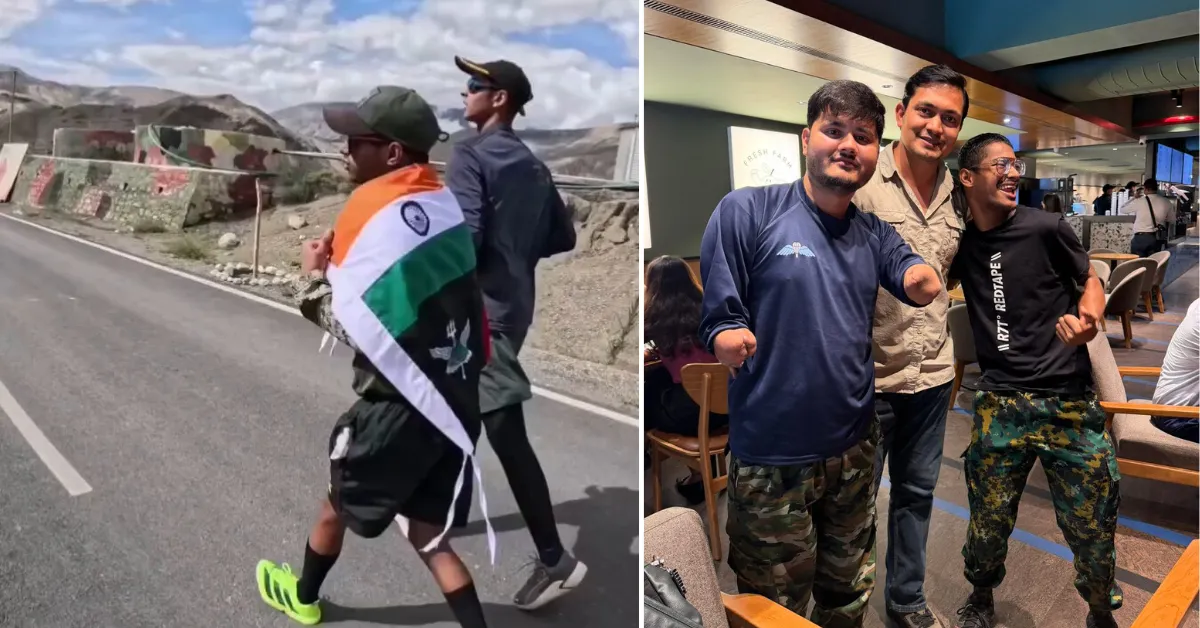
In May 2026, runners from 28 states gathered in Uttarakhand’s remote Niti Valley for a three-day ultra-running event held nearly 4,300 metres above sea level, near the Indo-Tibetan border.
Among the 933 athletes who took part was 25-year-old Anurag Rawat, who completed the 10-kilometre category in the thin Himalayan air.
For most participants, the altitude alone made this a test of endurance. For Anurag, who was born with cerebral palsy, it was the culmination of a journey that began with doctors and teachers telling his family that his life would have limits.
The future others tried to define for him
Cerebral palsy is a neurological condition that affects movement, posture, and muscle coordination, caused by disruptions to brain development before or shortly after birth.
It is among the more common motor disabilities in Indian children, with studies estimating a prevalence of roughly three cases per 1,000 children nationally, though experts believe the real figure could be higher because of gaps in rural healthcare access and diagnosis.
For Anurag, originally from Pauri Garhwal and now based in Delhi, the condition meant a childhood of navigating a world that wasn’t built for him.
He was forced to leave school after Class 8, cutting short his formal education far earlier than most of his peers. His father served in the Indian Army, and following in those footsteps had once felt like the obvious path forward. Cerebral palsy made that dream seem impossible.
The early years after leaving school were not easy. Without the structure of a classroom or a clear career path ahead of him, Anurag spent time figuring out what his days would even look like.
Cerebral palsy meant that even simple physical tasks demanded more effort and more patience than they did for those around him.
There was no single moment of clarity, no dramatic turning point. Instead, there was a slow, often frustrating process of testing what his body was capable of, one small attempt at a time, long before any of it resembled the discipline of an athlete.
Many young people facing similar setbacks find their ambitions quietly shelved by well-meaning families or by a system unsure how to accommodate them.
Anurag took a different route. Instead of measuring his life against the future he had been told he couldn’t have, he began building one centred on what his body could still learn to do.
One small victory at a time
Fitness became his entry point. Rather than chasing dramatic transformations, Anurag focused on consistency, training his body through patient repetition rather than quick fixes.
Over the years, this approach took him from basic strength work to far more demanding physical challenges, including a 300-kilometre cycling journey that tested both his stamina and his resolve.
His biggest test came at the Niti Extreme Ultra Run, organised by the Uttarakhand Tourism Department along with the Indian Army and the Indo-Tibetan Border Police to promote adventure tourism in the state’s border regions.
The event, held across categories ranging from 5 km to 75 km, demanded a valid high-altitude medical fitness certificate from every participant, a requirement that underlines just how taxing the terrain truly is.
/filters:format(webp)/english-betterindia/media/media_files/2026/06/26/3-2026-06-26-17-38-32.png)
/filters:format(webp)/english-betterindia/media/media_files/2026/06/26/3-2026-06-26-17-38-34.png)
Running 10 kilometres in oxygen-thin mountain air would challenge most able-bodied athletes. For someone managing the physical complexities of cerebral palsy, crossing that finish line carried a different weight altogether.
Beyond the physical demands, high-altitude events like this one require sustained mental focus, something Anurag has spoken about as central to his approach. He has often said that his goal was never to be the fastest, only to finish what he started, a mindset shaped by years of working with, rather than against, his own body.
That approach mirrors the experience of other Indian athletes with disabilities who have taken on extreme endurance events, showing how adaptive sport in India is expanding definitions of who gets to call themselves an athlete.
A community built on honesty
Parallel to his fitness journey, Anurag began documenting his life online, from training sessions and travel to the unfiltered realities of living with a disability that many people misunderstand. That openness has earned him a following of over two lakh people, drawn less to a story of pity and more to one of visible progress.
For Anurag, the Army uniform he once dreamed of wearing remains out of reach. But the discipline, grit, and resilience that uniform represents have shown up anyway, on cycling routes, in gym sessions, and on a Himalayan trail at 12,000 feet.
His story is a reminder that the limitations placed on someone at birth are rarely the ones that define how far they eventually go.
Images courtesy of Instagram/@_the_distinctive_
Sources:
‘From Class 8 Dropout To Inspiring 2 Lakh+ People‘: by Video Team for The Better India, Published on 10 June 2026
‘Niti Extreme Ultra Run kicks off with 933 athletes from 28 States‘: by Pioneer Edge, Published on 1 June 2026
‘Niti Valley in Chamoli will host a 75 kilometer ultra marathon for the first time‘: by The Better Uttarakhand, Published on 23 March 2026
Disclaimer : This story is auto aggregated by a computer programme and has not been created or edited by DOWNTHENEWS. Publisher: thebetterindia.com