
For six months, Janak Patel watched money slip away from his dairy farm in Gujarat. His buffalo was going into heat without the visible signs farmers usually depend on. By the time he realised the short window had opened, it had already closed. Another month of feed costs. No pregnancy. No milk.
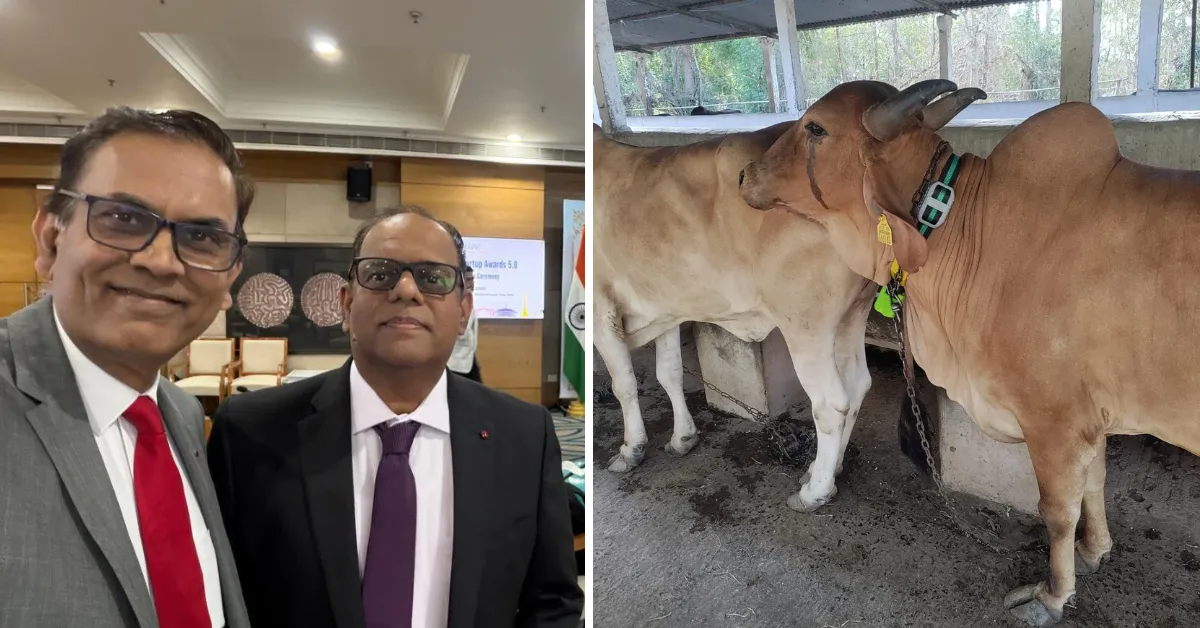
Then his farm started using ‘Ayushman Cowfit’ — a fluorescent, sealed, smart collar that sits around a cow’s neck and tracks skin temperature, jaw movement, activity levels, and sleep duration at the same time.
Within days, it sent him the alert he had been missing. “Thanks to the AI belt, we noticed a cow’s silent heat that we had been missing for six months,” Patel said. “The alert allowed us to perform AI (artificial insemination) quickly. The application provides detailed AI tracking and has been incredibly helpful for our dairy farm.”
What changed for Patel is the exact problem Pune-based Areete Business Solutions (ABS) was built to solve. Increasingly, it is doing that one farm at a time.
One missed cycle can cost a month’s income
India is the world’s largest milk producer, accounting for nearly 25% of global output, and home to over 300 million bovines — of which 125.75 million are milch cows and buffalo, according to the Department of Animal Husbandry and Dairying’s 20th Livestock Census.
Livestock farming contributes 5.5% of India’s economy and provides a livelihood for more than 80 million farmers. And yet, for the small farmer who owns between five and 15 animals, the system is riddled with inefficiencies that quietly eat away at income year after year.
One of the biggest losses comes from a missed heat cycle. A cow’s heat window lasts just 18 hours, occurring every 21 to 25 days. Within that window, the ideal insemination period is only eight hours. Miss it, and the farmer loses an entire month of feed costs with no milk production to show for it — a single missed cycle costs between Rs 8,000 and Rs 15,000.
The challenge grows because India’s ratio of artificial insemination (AI) agents to cattle stands at approximately 1 to 15,000-20,000, against an ideal of 1 to 3,000-5,000.
Even when a farmer detects heat in time, the agent may be serving 150 villages, travelling hours away, carrying semen stored in liquid nitrogen that must be thawed precisely on-site. The variables compound on each other, and then the window is gone.
Beyond reproduction, health monitoring is equally fragmented. Most small farmers have no way to tell a cow is getting sick until the animal is visibly unwell — by which point treatment is expensive and productivity is already lost.
Two founders, one shared obsession
For V S Shridhar, this gap was difficult to ignore. After decades in technology, including years at IBM and nearly 19 years with the Tata Group, his thoughts kept returning to agriculture, where he felt technology could create the most meaningful impact.
“My heart wanted to do something for the agriculture industry; that is where maximum impact would get created,” Shridhar says. “Technology should go to the mass market. Touch every farmer if that is possible.”
That belief eventually brought him together with Srinivas Subramanian, who founded Pune-based Areete Business Solutions in 2021 and now serves as its Managing Director.
/filters:format(webp)/english-betterindia/media/media_files/2026/06/24/5-2026-06-24-18-16-54.png)
Shridhar joined him as co-founder and Joint Managing Director, and both arrived at the same conviction independently: cattle health for small Indian farmers needed an affordable, practical solution.
International wearable devices existed but were priced between Rs 15,000 and Rs 18,000 per animal, required fibre or wired connectivity, and were designed for large, organised operations in Europe or North America — none of them calibrated for Indian breeds, none designed for tied animals, which is the norm on Indian farms. “When we looked at India,” Shridhar says, “there was no one doing it.”
A collar built for the Indian farm
The Ayushman Cowfit wraps around the animal’s neck on an adjustable belt sourced from Ahmedabad. One size fitting everything from a buffalo to a smaller Indian breed. The device houses four sensors.
The casing is sealed against dust and water, and built to withstand high temperatures.
Getting the hardware right took five casing iterations. The electronics worked from early on, but India’s farm conditions defeated several early designs through water seepage. The fifth version held.
Manufacturing is 100% Made in India: electronics from a Bangalore-based partner, the belt from Ahmedabad, and weight components from Kolhapur.
The device’s expected lifespan is five to seven years, and farmers never charge it — ABS field staff replace the batteries as a service every three years. “He’s got 10, 20, 30 cows — whose device is he going to charge?” Shridhar says.
/filters:format(webp)/english-betterindia/media/media_files/2026/06/24/6-2026-06-24-18-18-23.png)
For Mounish of Rohini Dairy Farm in Bagalkot, Karnataka, that reliability translated directly into output. “We used to get 280 litres from 40 cows previously. After installing Ayushman Cowfit, we started tracking rumination and changed our feed and nutritional supplements. At present, we get 340 litres,” he said.
Reading every cow as an individual
What separates Ayushman Cowfit from a basic sensor is how it processes data. Rather than applying universal health standards, the system spends its first two weeks learning each animal’s individual baseline: eating hours, activity levels, sleep duration, skin temperature.
From the third week onward, the AI flags deviations from that personal baseline, not a herd average.
“You and I are different ages — my blood pressure and yours should not be the same standard,” Shridhar explains. This design also helps it work for tied animals, while global devices are largely built for free-roaming operations.
“It doesn’t matter which animal I put it on — it starts learning about that animal,” he says.
The result is an 80% daily app usage rate among farmers, who check the app each morning the way one might check a weather forecast.
/filters:format(webp)/english-betterindia/media/media_files/2026/06/24/3-2026-06-24-18-18-42.png)
Swati Dhobale from Pune is one of them. “After installing the Ayushman Cowfit device, I have been able to monitor every heat cycle in my cows without fail, greatly improving their reproductive success,” she says.
Helping farmers spot sickness before it becomes costly
The device detects illness approximately two days before visible symptoms appear, because sick animals eat less, sleep more, and grow less active. These are changes the sensors catch early.
Nanda Dhobale from Maharashtra was initially sceptical, but changed her mind when a health alert led her to call the veterinarian. The vet confirmed that one of her HF crossbreed cows was in the early stages of illness.
“With only a few medications, I was able to recover my cow’s health,” she says. Early detection meant minimal treatment costs and no productivity loss.
For Vijayakumar Pawar from Satara, the return on investment was immediate. After two failed insemination attempts on a cow with breeding issues, and after spending Rs 10,000 on sorted semen, he used the Cowfit to track the heat cycle precisely for the third attempt. It resulted in pregnancy.
“The device cost was recovered within a month,” he says.
From Big Co-operatives to the Raj Bhavan
ABS currently serves close to 1,000 farms across Maharashtra, Gujarat, and Punjab. Key institutional customers including several major co-operatives in Gujarat. Some of them even use the device specifically for buffalo heat detection.
/filters:format(webp)/english-betterindia/media/media_files/2026/06/24/2-2026-06-24-18-18-59.png)
The Lucknow Raj Bhavan Gaushala (cow shelter), which manages 17 devices across a mixed indigenous herd and submits reports to the Chief Minister of Uttar Pradesh, attested to an 85% accuracy rate.
Punjab farmer Gurlad Singh, who manages over 150 cows, put it simply: “Managing the heat and health of my 150-plus cows is effortless with the Ayushman Cowfit device.”
The company supports a virtual care team that calls farmers proactively in Punjabi, Gujarati, and Marathi whenever the system flags a missed action or health event. The device can also be installed remotely. It has already been deployed in the Andaman and Nicobar Islands.
The big vision? To reach the small farmers
The recognition has begun to follow. In January 2026, ABS won the National Startup Award in the Innovation category. It has also received a Maharashtra State Innovation Award, ICAR certification, and a Torch Award from Thailand.
But for the founders, the real test lies far from award stages: in the homes of small dairy farmers who make up 95% of India’s dairy farmers. The Maharashtra government’s direct benefit transfer subsidy scheme for farm modernisation could help the device reach many more of them.
Their larger dream is to build a live health map of India’s cattle. If a disease begins spreading in one region, the system could help detect it early. It could also give policymakers a clearer picture of where cattle are healthy, where farmers need support, and where intervention is needed most.
“We want to be able to convey to policymakers the overall health of India’s cattle, and provide region-wise data to drive better livestock development outcomes,” Shridhar says.
At Rs 6,500 for a device that pays for itself in a single averted missed cycle, the economics are already working. The harder task is reaching India’s vast, dispersed population of small dairy farmers. That is the frontier ABS is now focused on crossing, one fluorescent collar at a time.
Images courtesy of Areete Business Solutions.
Disclaimer : This story is auto aggregated by a computer programme and has not been created or edited by DOWNTHENEWS. Publisher: thebetterindia.com





