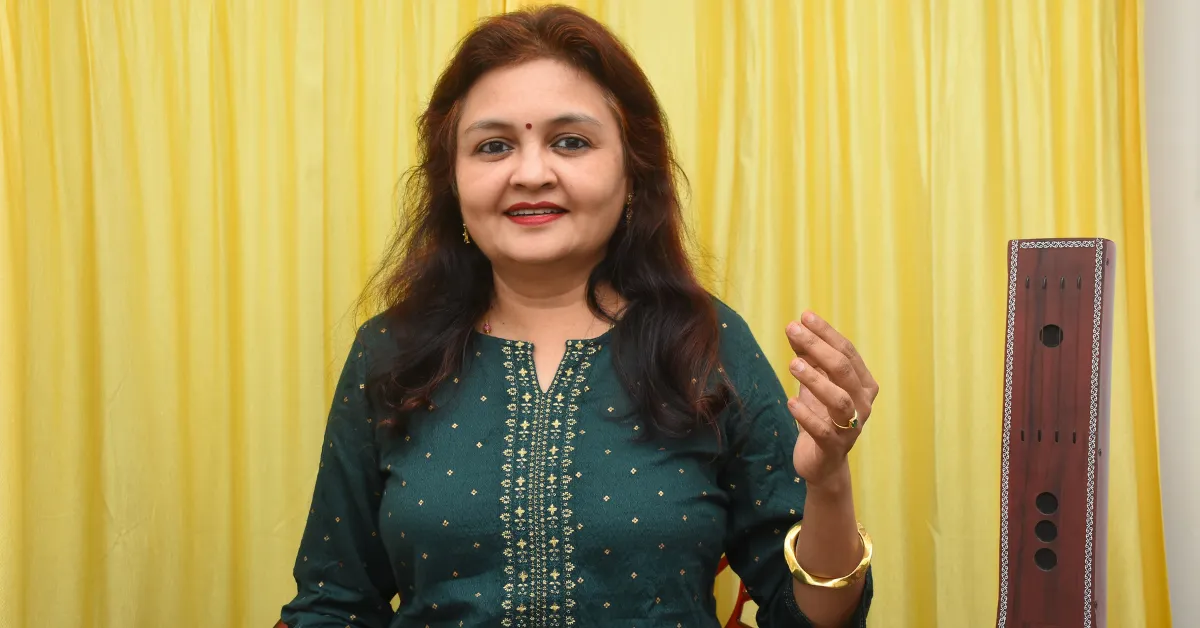
On a late evening in 1994, in the shadow of the Brihadeeswara Temple in Thanjavur, a twenty-something Bharatanatyam dancer stood on an open-air stage before the towering Nandi.
What she did next was unusual for a classical performance at the time.
Before beginning each dance piece, she paused and spoke to the audience in Tamil, explaining the story, emotion, and meaning behind the movements so they could follow the performance.
At a time when Bharatanatyam performances rarely paused for explanation, she brought a narrative, audience-first approach to the stage. It was a small but meaningful shift — one that would go on to change the way many people experienced classical arts.
When the performance ended, an elderly man walked up to her. “He had tears in his eyes,” recalls Vidya Bhavani Suresh, now 56.
“He gave me Rs 11, which was a significant amount then. I was so deeply touched.” For her, the moment was affirming. “That was a sign that I was on the right track.”
More than three decades later, that instinct, to explain, to include, and to make people feel they belong, has become the foundation of Vidya’s work. She follows a simple belief: classical art reaches people more deeply when they are helped to understand it.
Do you feel left out while watching classical performances?
For many people watching Bharatanatyam or listening to Carnatic music for the first time, the experience can feel slightly intimidating.
You may be sitting in the audience, watching people around you nod, smile, or respond to something in the performance, while you are still trying to understand what is happening.
Part of this comes from the way a Bharatanatyam recital is usually structured. It follows a set order, with pieces such as alarippu, jatiswaram, varnam, and padam. Each piece brings together footwork, hand gestures, facial expressions, rhythm, music, and storytelling.
Through these movements and expressions, the dancer is often telling a story from mythology or devotional poetry. The songs may be in Tamil, Telugu, or Sanskrit, and they carry their own meaning, emotion, and literary beauty.
But when the language, story, or context is unfamiliar, much of this can be difficult to follow.
The audience is often expected to already know the story or understand it through abhinaya (expressions and gestures). For those trained in the art form, this can be a rich and deeply moving experience. For many others, it can feel like they are watching something beautiful from a distance, without being fully let in.
Carnatic music concerts can also create a distance like this. A singer may move from one composition to another, or begin an improvisation, without explaining the raga or the meaning of the lyrics.
For regular listeners, recognising a raga can be part of the joy of the concert. For a newcomer, however, it can feel like everyone else is part of a conversation they have not been introduced to yet.
“People who cannot identify feel left out,” Vidya says. “There are people who even avoid going to Carnatic music concerts.”
For Vidya, this is where the problem begins. Over time, she believes, this silent expectation has made classical arts feel closed to many people. The issue is not talent or interest alone. It is also about access, exposure, and whether someone has been given a way to understand what they are experiencing.
‘Any art form lives because of the audience’
Vidya’s response to this problem was simple, and deeply unconventional for its time. She began to speak. In a performance ecosystem that valued continuity and silence, her decision to pause and explain felt like a welcome change.
She broke down compositions, contextualised emotions, and directly engaged audiences, not as passive spectators, but as participants in the performance. “When I started to come on the stage and talk to people, I could actually see the body language,” she says. “People would nod. That would give me the hint that they understood it better that way.”
/filters:format(webp)/english-betterindia/media/media_files/2026/05/27/2-2026-05-27-16-42-16.png)
Her explanations were not lectures, but conversations, delivered in what she calls the tone of a friend. “I’d say 40 percent of the success comes from the explanations I give for the dance items,” she says.
This approach reshaped the experience of watching classical art. “People must not feel that the art is impossible to understand,” she says. “They must not feel the artist is coming from a different planet.”
At the core of her work is a simple belief. “Any art form lives because of the audience and not the other way around.”
Questioning tradition, gender roles, and caste history
Vidya’s way of looking at art was also shaped by an academic and professional background outside the usual classical arts route.
She holds a postgraduate degree in folklore and is a qualified CS (Company Secretary). She spent about five years in the corporate sector before choosing to pursue classical arts full-time. “Maybe having a diverse background also taught me to think critically for myself when it came to my art,” she says.
Alongside this, she had trained in Bharatanatyam from a young age under a guru (teacher), following the conventional path of rigorous, long-term learning.
However, at 19, she began questioning the themes she was asked to portray.
Much of the traditional repertoire centres on a heroine waiting, longing, and adorning herself for a male figure, often a deity. For Vidya, who was also engaging with feminist ideas, this created a disconnect. “I could not identify myself with it,” she says. “I felt I was demeaning myself.”
/filters:format(webp)/english-betterindia/media/media_files/2026/05/27/5-2026-05-27-16-42-40.png)
She also points to the history of Bharatanatyam, which evolved from sadir, a form practised by women from specific communities like the ‘devadasi’ artists, before being reshaped and presented by upper-caste practitioners. “The communities changed. The art form was taken from them but they weren’t given the recognition they deserved,” she says. “A conservative system does not teach its students that.”
Leaving her guru at 19 was a difficult and unconventional decision. “I did face a lot of alienation,” she says. “Certain ideological strands you take, they ruffle feathers.” The decision allowed her to rebuild her practice with a different lens.
In the years that followed, she continued exploring the art form independently, rebuilding her practice through research, interpretation, and experimentation.
Teaching students to interpret, not imitate
Over the years, in her classroom, on stage, and in her talks, this philosophy translates into a focus on independent thinking. “I don’t like a student to repeat what is taught,” she says. “Whether Krishna should come from the right or left, why should I tell you? You figure it out.”
Over the years, she has taught around 150 students. “Teaching is a really good phase of my life,” she says.
For Lakshmi Priya, a Bharatanatyam teacher who discovered Vidya’s books years ago, this approach affirmed her own way of teaching. “Vidya writes like she is talking to someone close to you,” she says. “That made something very complex feel simple. I have my own way of interpreting the art form, and her books showed me that it is right in its own stance.”
/filters:format(webp)/english-betterindia/media/media_files/2026/05/27/3-2026-05-27-16-42-55.png)
She continues, “That was the inspiration for me to continue my life towards dance.”
From a village with no access to global practice
For Hanshi Balamurugan, who runs a karate centre in Chennai, those barriers were even more rigid. Growing up in a village near Madurai, he remembers violence being part of the environment around him. “There were a lot of rowdy and gangster activities,” he says. “Kids had to learn karate.”
Dance was not even an option. “It was considered taboo for a boy,” he says. “And there were caste and class issues.”
When he moved to Chennai and trained under Vidya, his relationship with dance began to change. “She did not just teach me dance,” he says. “She taught me the art form itself, how to interpret it on my own, and how to expand my horizons.”
A turning point came in 2000, when Hanshi joined Vidya on a performance tour linked to a music album by acclaimed singer K J Yesudas. As part of the tour, Vidya presented an interpretive work built around the idea of ahimsa (non-violence). Watching that process changed the way Hanshi understood movement and meaning in dance.
“That is when I really learned how to look at dance differently,” he says.
What followed was experimentation. “I started to see similarities between karate and Bharatanatyam,” he says. “Both require grace.” With Vidya’s encouragement, he developed a new practice that blends Bharatanatyam, karate, and tai chi. Today, around 500 students across the world learn this form under the tutelage of Hanshi Balamurugan and his disciples.
For a boy who had grown up in a place where dance felt out of reach, that moment stayed with him. “My parents came from our village to Chennai to watch me perform,” he says.
Taking classical arts into books, classrooms, and lecture halls
Vidya’s work extends beyond performance into lectures and publishing.
At just 23, she won best lecture demonstration of that year’s December season at the Music Academy for a lecture demonstration, a space usually dominated by senior artists.
She then went on to present regularly at institutions like the Indian Fine Arts Society and Tamil Isai Sangam, where she introduced new topics year after year.
Her sessions have also reached newer spaces. At IIT Bombay, she conducted a session on public speaking, focusing on practical challenges faced by students. “They were asking real questions,” she recalls. “The enthusiasm with which they were engaging has become a fond memory for me.”
Over the past 25 years, she and her husband have published 47 books on classical arts, with an estimated one lakh copies in circulation. Her writing simplifies complex ideas using everyday examples, making them accessible to a wider audience.
/filters:format(webp)/english-betterindia/media/media_files/2026/05/27/4-2026-05-27-16-43-49.png)
“The idea is to make people feel comfortable,” she says. “They should feel this is something I can understand.”
For Shiwangee Chandrakar, who studied her work as part of an academic project, this approach is what sets it apart. “She identified a gap,” she says. “Vidya and her husband created something with depth, while keeping it accessible.”
‘Art must be enjoyed by people’
For Vidya, the larger goal is clear. “Anything that is only in archives is not a living tradition anymore,” she says. “It becomes living only when it is among people.”
Her work shows that accessibility simply means opening art up while respecting its depth. “This can be done by anyone,” she says. “Institutions, artists, teachers. You must genuinely want to communicate.”
From that evening in Thanjavur to classrooms, books, lecture halls, and students across the world, she has spent decades doing one thing consistently: opening doors for people to enter classical art.
“A song must be sung. A proverb must be said,” she says. “Art must be enjoyed by people.”
And perhaps that is where her work reshapes the future of classical arts: by helping more people feel they belong within it. When people understand, they stay. And when they stay, the art lives.
Disclaimer : This story is auto aggregated by a computer programme and has not been created or edited by DOWNTHENEWS. Publisher: thebetterindia.com