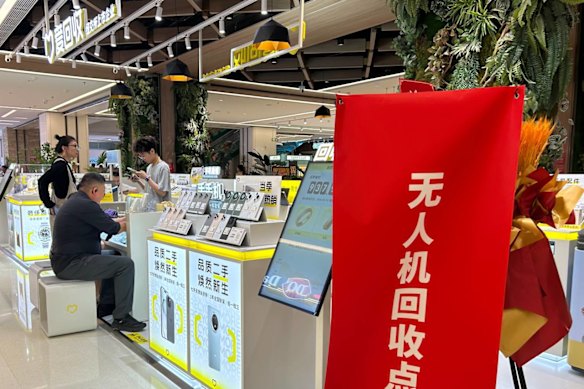

Beijing: At authorised buyback stores across Beijing, residents are reluctantly surrendering their drones to comply with a new ban that has sparked a rare venting of frustration from some owners in the usually tight-lipped city.
Under rules announced this month, Beijing authorities imposed a total ban on the possession of drones inside the capital, forcing owners to sell them or move them out of the city by November 15.
For the past fortnight, a steady procession of drone owners have queued at drone maker DJI’s stores and other designated buyback sites across the city to offload their devices, as complaints have circulated about low resale values and property rights.
“My freedom’s been restricted,” said Li, a pseudonym, who spoke to this masthead outside a store in the city’s financial district.
“This is not a fair and normal request for the government to ask citizens to take. It’s my property; I don’t think it’s fair for me to have to sell it.”
Li said he originally paid about 5000 yuan ($1060) for his drone and only used it to take photos of friends and family and while travelling. It was now a “write-off”, he said.
The September regulations extend and even override drone rules introduced only in May. Those earlier measures banned new drone sales and imposed a no-fly zone over Beijing without prior approval, but had allowed existing owners to keep their devices as long as they registered them with police.
To comply with the May rules, DJI – a global leader in consumer drones and a Chinese company success story – and other sellers had to clear out stock from the shelves of their Beijing stores. It underscores an underlying tension in government policies, as Beijing tightens security measures over the capital while championing the low-altitude economy as one of the country’s key strategic industries.
The latest crackdown comes after a pilot flew a small recreational aircraft into Beijing’s tallest skyscraper in June, killing himself and injuring 13 people, in an incident that exposed security vulnerabilities over the city’s airspace.
Drones can still be purchased and flown outdoors in other parts of the country, provided they are registered with authorities. In Shenzhen, a tech hub in China’s south, drones regularly buzz over the CBD skies, delivering food to designated sites operated by takeaway giant Meituan.
To cushion the blow, Beijing authorities are offering subsidies to owners who resell or recycle their devices through designated buyback platforms. Residents can also ship the drones out of the capital free of charge, or sell them to buyers in other Chinese cities on second-hand trading sites.
Despite the November deadline, some owners have reported being contacted by police urging them to offload them more quickly. Others have taken to Chinese social media sites to lament low-ball offers on the second-hand market as buyers capitalise on the forced sales.
“I’m really reluctant to let it go,” one owner commented on Red Note, a video platform. “It comes with three batteries, and the system has only gone through a single charge cycle. A lot of people don’t see the value – they just treat it like a joke and are looking to snap it up at a bargain-basement price.”
“I’m speechless,” said another said, who sold their device for a quarter of its retail value. “Literally bought it last August and flew it less than five times.”
And selling to individuals outside Beijing can come with other hurdles.
Li said he received a text message from his local residents’ committee – neighbourhood groups that are often closely affiliated with the Communist Party – advising that if he transferred the drone outside the city, he would need to provide photographic evidence of the buyer holding the drone in front of a prominent landmark.
“If I send it to Shanghai, the person would have to hold it on the Bund, or somewhere like that,” he said.
At another buyback shop in Beijing, 26-year-old Chen said he was offered about 1400 yuan ($300) for his four-year-old DJI drone, about $125 less than he might get via a second-hand online retailer.
But if the second-hand buyer disputed the purchase after receiving the drone, Chen wouldn’t be able to have the drone sent back to him in Beijing, potentially leaving him with nothing.
Chen said he was dismayed by the policy, but believed it was trying to regulate irresponsible behaviour by drone flyers in the past.
“That eventually led to the situation we have now, where we’re no longer really able to fly drones even as a personal hobby. I think that’s quite a shame,” he said, giving only his surname.
“We hope the government can continue improving the regulations, so that people can have ways to fly them.”
Get a note directly from our foreign correspondents on what’s making headlines around the world. Sign up for our weekly What in the World newsletter.
 Lisa Visentin is the North Asia correspondent for The Sydney Morning Herald and The Age based in Beijing. She was previously a federal political correspondent based in Canberra.Connect via X or email.
From our partners
Disclaimer : This story is auto aggregated by a computer programme and has not been created or edited by DOWNTHENEWS. Publisher: www.smh.com.au