
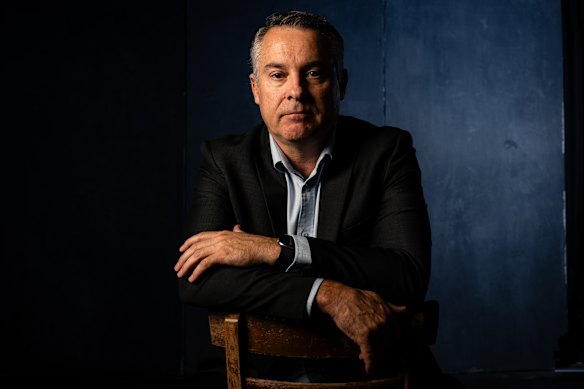

As Graeme Simpfendorfer walked through the police station in Wodonga, past the cops who worked for him, he started to shake.
“I literally started crying in the office, sobbing and shaking,” recalls Simpfendorfer, who was then the detective sergent in charge of the sexual abuse crime unit. “A breakdown.”
Just then, a senior detective walked by. “You OK boss?” he asked Simpfendorfer, who had just heard of the case of a predator and the grooming of an alleged victim. “He had no idea what was happening. All I remember thinking was, ‘I need help’.”
It was 2013. And for nearly two decades before then, Simpfendorfer, then 38, had felt he was exactly where he was meant to be. He had first realised he wanted to be a cop at 19, when he witnessed, from behind the service counter at a bank where he was working in rural NSW, an armed hold-up.
“It was real cops and robbers stuff; I thrived on it,” he recalls.
Simpfendorfer also found some of the greatest meaning in his life by helping victims – or the family members of victims – survive the worst days of their life. After they’d been left shattered by violent robberies, homicides, and sexual assaults.
But a revelation, about a year before he walked through his police station, began unravelling him.
He had been sitting in a Victorian police academy classroom in Melbourne, surrounded by fellow cops, and listening to a lecturer speak about the common tactics used by sexual predators, to groom their victims.
They were all training to be part of the Sexual Offence and Child Abuse Investigation Team.
The lecturer was talking about a particular case, in which a predator started tickling a victim, as a way of grooming them, and getting them more accustomed to being touched, says Simpfendorfer. “And it just hit me,” he says. “It took me back to my own childhood and being offended against.
“I was in shock. I remember thinking, ‘Everyone in this room is going to see my reaction to this, and they’re going to pick it.’”
While Simpfendorfer’s body was in the Melbourne classroom, his mind had been thrust back to 1988, when he stood in the lounge room of a family friend. Simpfendorfer was 14. The family friends weren’t there. But a teacher he knew allegedly was.
Recalling the incident now, Simpfendorfer claims: “And then, before leaving, I don’t know exactly the details, but eventually I was on the ground being tickled, and then he abused me, putting his hands down my pants and [he] started touching me.”
For nearly a year, after that class in Melbourne, Simpfendorfer deteriorated, day by day. He drank too much, and was reckless at work, making sure he was the first person to arrive at the scene of a crime.
“Almost daring the world to hurt me,” he says. “It’d be easier to be off work with an injury that was a physical injury [than admitting to his trauma].”
He was infused with shame.
“You know, [I was thinking] ‘Why me?’ A bit of shame, a lot of shame. A lot of guilt around it. And just, ‘How did I keep this secret?’ And then, you know, the trauma that comes with that. Just as a man, it’s, how did this happen to me? You know, we’re meant to be strong. We’re meant to, you know, those things aren’t meant to happen to us. We’re protectors, right?”
He quit the police force in 2021.
That Simpfendorfer has begun speaking publicly about his experience is, sadly, necessary.
Because although child sexual abuse is astoundingly common here – nearly one in four Australians have reported to have experienced child sexual abuse, according to the most recent Australian Child Maltreatment Study – many in the wider community don’t understand that it impacts people for life.
“Look, I do think that people have a sense that this [abuse] happened so long ago [for someone], surely you’ve got over it,” says Dr Janine Bush, CEO of The National Centre for Action on Child Sexual Abuse. “Or that people move on after time, so yes, that is a common misconception.
“It can impact on relationships; people’s experience of intimacy, trust. And these types of issues can re-emerge immediately, obviously, or decades later after the experience.”
Indeed, Bush speaks of some survivors who wait until they’re in their 70s or 80s, before they disclose their abuse for the first time, as some did as part of the landmark Royal Commission into Institutional Responses to Child Sexual Abuse, and in other state parliamentary inquiries.
“Someone might not want to die without telling someone because they’ve kept that secret through their life … Look it’s probably more common than you’d think,” says Bush.
And survivors can be thrown back into recalling – and suffering from – the trauma of their childhood abuse at various “trigger points”, like becoming a parent or when their child transitions to school, says Bush. “It can happen when someone who’s experienced abuse in an institution moves into an aged care residential facility.”
It’s for these reasons, that one of the recommendations of the Royal Commission – the last findings were handed down nearly 10 years ago – was the need for “a more responsive, trauma-informed safe system that supports victims survivors of child sexual abuse”, says Bush.
But that system has yet to eventuate, she adds, noting that in its place is a fragmented patchwork of services that are often inaccessible, and that don’t have at their core the crucial understanding that the trauma of sexual abuse impacts a person throughout their life, “from zero through to end of life”.
“So, for example, a child might experience sexual abuse in an environment, and what we find is that there are services that can support them around counselling. There might be support in their education. There might be health support that’s required, physical health. They’re all different systems. And then maybe support around mental health. There aren’t any support services that might be specific to children who’ve experienced child sexual abuse. So they need, often, a coordinated system.”
Also, adds Bush, the taboo associated with child sexual abuse is even greater for boys and men, than it is for girls and women.
“Look I think for men, yes the stigma associated with child sexual abuse [can be greater than for girls and women],” says Bush. “Issues around masculinity, and not wanting to show vulnerability can come into these experiences of willingness to talk about them, in ways that are more gendered.”
It’s, in part, why Simpfendorfer now feels passionate about speaking openly about his experience. Though it hasn’t been without a personal cost.
Particularly agonising, he says, was telling his three children – now aged 14, 16 and 24 – about his abuse. He did so only last October, when the man who he alleges abused him, was facing court on this charge.
“Yeah, to tell my [youngest] son, and for him to look to me like, ‘That happened to you at this age’; that was hard,” says Simpfendorfer, noting that his son is now the age that he was when he was allegedly abused. “To have them [his kids] see you like this, to have to reassure them that, ‘I’m OK, I’ve got good support’…” he says, his voice trailing off.
But telling, he says, has changed his life. Even though his alleged abuser was found not guilty in court, last year, of the abuse – he has been jailed for separate offences against other students, and has lodged an intention to appeal his case – Simpfendorfer hopes the more voices that join him, perhaps the less common this crime will be.
“I just think there’s so much great work being done in this space around gender-based violence and domestic violence [against women]. And there’s not enough men standing up to say, ‘We’ve had enough of that’. But also, not enough men coming forward and normalising this conversation. Because these predators work in the shadows. They thrive on silence.”
“So for me, my purpose is to tell my story. Be vulnerable, to tell it, to tell the whole lot. Be vulnerable, and go, ‘There is help out there’. There’s great help. It doesn’t mean you have to go and report to the authorities. You don’t have to. You can still go and tell the counsellor. I got help. It’s the best thing I ever did. The version of me now is so much better than the one that held the secret.”
Anyone needing support can contact 1800 RESPECT (1800 737 732), National Sexual Abuse and Redress Support Service 1800 211 028 and Lifeline 13 11 14.
Start the day with a summary of the most important and interesting stories, analysis and insights. Sign up for our Morning Edition newsletter.
From our partners
Disclaimer : This story is auto aggregated by a computer programme and has not been created or edited by DOWNTHENEWS. Publisher: www.smh.com.au


