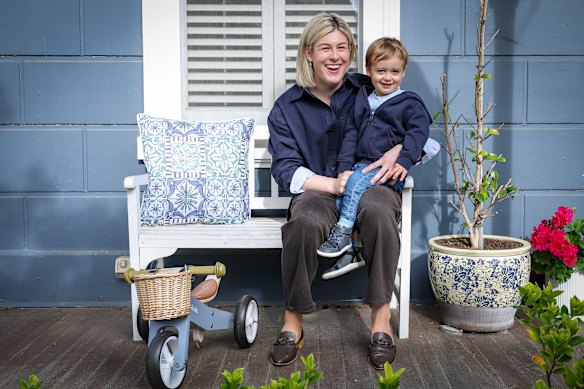
Driven by a lifelong competitive streak, Jess Wilson is determined to deliver a “fresh start” for Victoria. In the quiet moments of the campaign, however, there is something that worries her.
“You go Jess!” shouts a woman across the road from Jess Wilson’s house, as the Liberal leader, at 8.30am, contemplates the day.
A tradie is on all fours on a blue tarp removing a dead tree stump along the boundary, music blaring from a radio. Wilson’s son Patrick, 2, races around, opening and shutting wheelie bins lined up at the front of the heritage home.
“Are you going to the park today?” Wilson bends down to ask Patrick. The federal shadow defence spokesman, Senator James Paterson, a close friend of Wilson and her husband Aaron Lane and godfather to Patrick, takes the boy’s hand and heads off to the park.
Paterson is travelling on Wilson’s campaign bus when he can, but he “will do anything”, he says. Later, Patrick will be with Wilson’s younger sister, Aunty Sarah.
“It’s just an absolute juggle,” says Wilson, 36, smiling at the understatement.
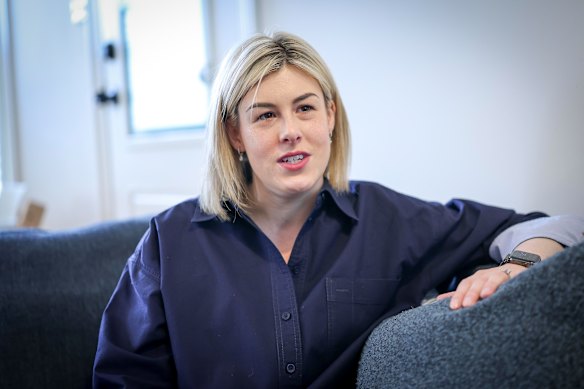
The crazy life of a suburban young family is, in political terms, “relatable”. If the Coalition wins the election in just over two weeks, Wilson will be Victoria’s first Millennial premier, of the generation that queued at bookshops for the latest instalment of Harry Potter – her favourite book.
Wilson’s youth – she looks barely 30 – embodies the Liberal slogan,“a fresh start”, the antidote to Labor’s pains at the end of 12 long years in government.
She’s a “Millennial on steroids”, says family friend and former state Liberal minister Mark Birrell, who has known Wilson since turning up at the hospital with flowers the morning after she was born. She exudes, he says, “young-mum energy”.
Victorians have warmed to Wilson. She is easily the preferred premier in The Age’s latest Resolve Political Monitor, which points to a Coalition rout if it holds until November 28. If the Coalition, with a daunting 16 additional seats to win for majority government, can do that, it would avoid the nightmare of relying on One Nation support in the lower house.
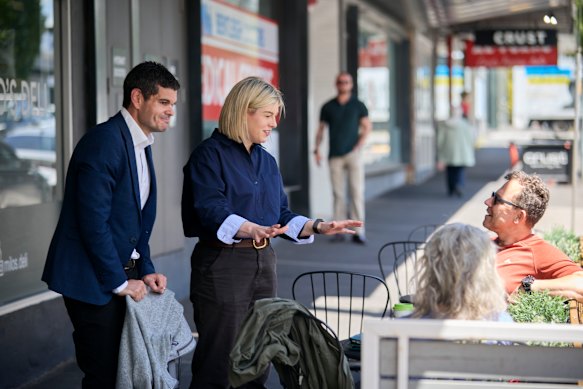
Wilson is popular, but she remains largely unknown. Next Wednesday, she will have served as the Liberals’ first female leader for just one year. She was only elected four years ago to the leafy eastern electorate of Kew, then aged 32, and she has no ministerial experience (although neither did Labor’s Steve Bracks, nor the Liberal Ted Baillieu when they became premier).
Victorians are getting to know her, but within the Liberal Party, “she’s a generational talent, she’s been the next big thing for quite a while“, says Tony Barry, a former deputy state director of the Victorian party.
She grew up with the party. Her father, Ron, was a Liberal MP for a single term before the Bracks landslide in 2002, and she joined the Liberals aged 19. Paterson says that “for years, every time a vacancy arose, she was one of the names that was immediately on the top of people’s lists”. Her strengths, he says, were obvious: “A seriousness about her from a very young age, professional and diligent and thoughtful.”
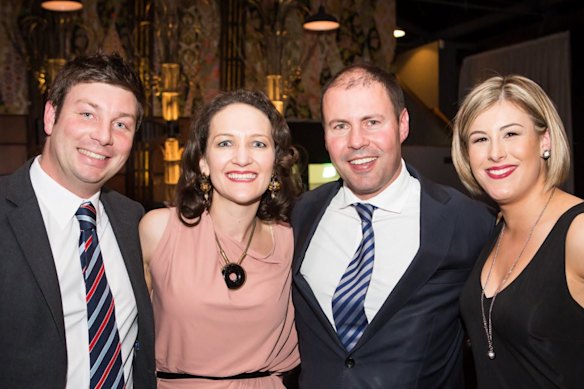
I ask her about her remarkable rise, from Victorian Young Liberals president in her mid-20s, to first-term MP, to premier contender in a decade. (There is a fascinating Young Liberals photo from 2015 where she is flanked by then-leader Matthew Guy and MP John Pesutto, with Kew MP Tim Smith. Wilson would take over from Smith in Kew after a drink-driving accident pushed him out, and Wilson is now Guy and Pesutto’s boss.)
“It’s been hard work along the way,” she says simply, sitting on a blue couch in her lounge room. “I think you have to prove yourself in everything that you do.”
Were you always driven? “Yes,” she says.
Even as a kid? “Yes”.
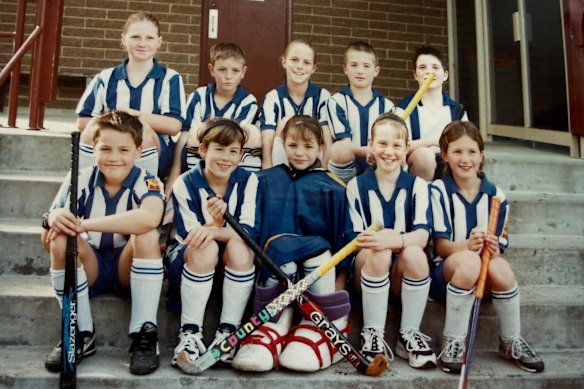
The way she explains it is that “I think I’ve always been competitive”. She played hockey from a young age “and I was always competitive in that. But also I wanted to be more than just a team player – I was the captain of the team. That meant a lot to me because I wanted to make sure that we were, as a team, working in the right direction.”
Timing and luck are crucial in politics, and since Wilson became leader, the once indomitable Labor has flailed. Jacinta Allan was pushed out as premier in July after poor opinion polls and mounting allegations revealed in The Age of corruption on building projects, wasting billions in public money, and now Premier Ben Carroll faces the agony of royal commission hearings in the middle of the campaign.
Barry, now a director of pollster RedBridge, says its research suggests many voters have stopped listening to Labor’s promises and are not so much waiting on the porch with baseball bats, “they are waiting on the verandas with machetes”.
An opposition still needs to pass the credibility test, and the Liberal Party was a rabble before the humiliating 2022 election defeat, a more dispiriting result for the party than even the 2018 “Danslide”. The campaign this time leans on the credibility and appeal of Jess Wilson. She’s on the JESS EXPRESS bus, and election posters don’t just say Liberal, but Jess Wilson’s Liberals. It’s all about her, and it’s not just Victoria watching.
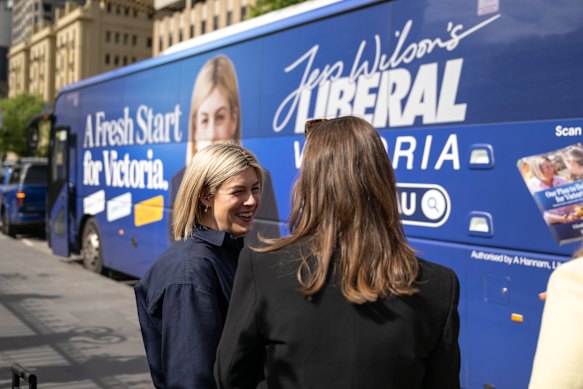
For a party that federally, and in Victoria, has been in an identity crisis for at least a decade, repelling young people and women, a victory by the more moderate Wilson would be a hopeful sign, says Barry, with just a hint of hyperbole, that “the Liberal Party is not dead yet”.
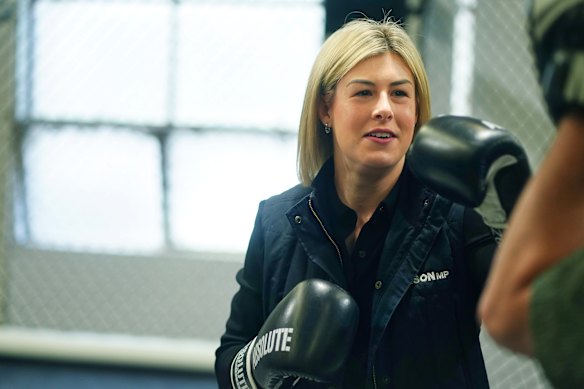
Wilson revels in the responsibility. She has whittled away distractions to give her full focus, even in her no-nonsense wardrobe. “I love a navy pantsuit [because] you can put a different shirt on underneath. You make a lot of decisions every day, and if you can minimise them about little things, that’s a good thing.”
She insists this election is a team effort, but understands the spotlight is on her. “As the leader of the team, I do carry a huge responsibility, and that’s not lost on me in any way, shape, or form.”
From wannabe cop to ambitious politician
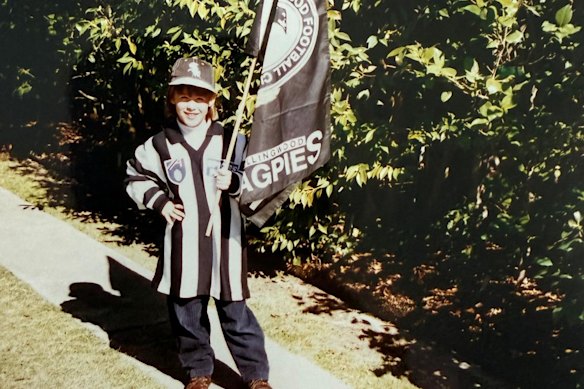
Wilson had a “very happy childhood”, a picture of suburban wholesomeness. She rode bikes and baked cakes with younger sister Sarah, and she is glad there was none of the social media pressure on her childhood that exists now. By her telling, it was all rather sweet.
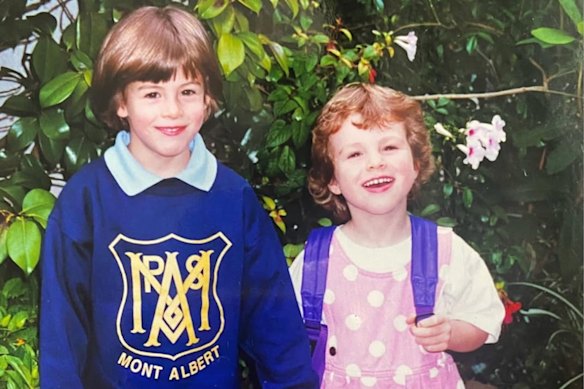
She was obsessed with the Maggie Doyle character in police drama Blue Heelers, role-playing her ambition to be a police officer by insisting Sarah’s play shop had been burgled, pretending to dust for fingerprints, and then arresting Sarah as the thief.
The Wilsons were financially comfortable, and both parents worked full-time – Ron lost his seat when Wilson was 12 and has recently retired as chief executive of Navy Health. Wilson went to Mont Albert Primary and then the independent Strathcona Girls Grammar in Canterbury where her mother, Jo, worked in community relations and where Wilson – inevitably – became a prefect.
She may be a Millennial, but she’s hardly an edgy one. She’s daggy, nominating in a pop quiz for this story who she would most like to ask to dinner: the late Queen, she says, and Julie Andrews, star of the 1965 family movie, The Sound of Music.
Her sister Sarah says Wilson “was very wise, she always seemed so much older than she was”. Whenever there was drama or an emergency in the family, everyone looked to Jess to be calm.
Sarah, who has two young boys, often helps with caring for Patrick, but says Jess will get home from campaigning, no matter how late, and make her son’s lunches for the week – homemade chicken nuggets, muffins, cut up veggies and fruit, all neatly labelled. “Her energy, I don’t know how she does it.”
The Wilsons were a close, ordinary family in many ways, but family barbecues were full of politicians and prominent opinion leaders, and Wilson soaked it in.
Many of her inner sanctum are fellow Millennials, tight-knit friendships forged at Monash University, where she studied arts and law, and at the Young Liberals, a “training ground” for parliamentarians, as Birrell puts it.
Ron Wilson was the president of the Young Liberals, and so was Jess Wilson in 2015 and 2016. Husband Aaron Lane, now a barrister, had the same job a couple of years before, and became friends with James Paterson, also a Young Liberals president – both also worked at the conservative Institute of Public Affairs.
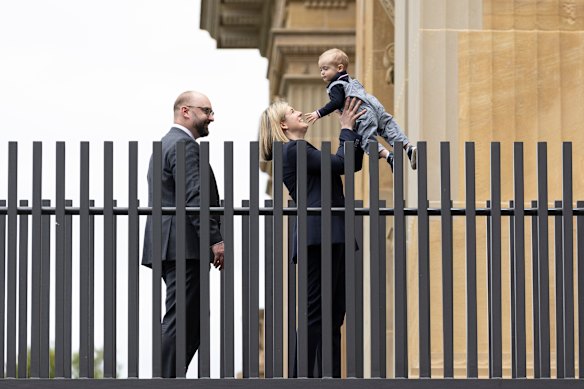
Paterson’s wife Lydia is Wilson’s deputy chief of staff and close friend. Frontbencher Evan Mulholland was Wilson’s vice president at the Young Liberals. Her chief of staff Byron Hodkinson is also a former Young Liberals president. Wilson lured him from a corporate job in Sydney to join her team.
It’s an intensely loyal and political group. Lane once sought a political career, too, but resigned as a Liberal candidate in 2014 – before he and Wilson were a couple – over homophobic social media remarks. He said he was “deeply embarrassed” by them.
‘[Jess] has got a capacity to get across complexity in a way that I’ve rarely seen.’Jennifer Westacott, former CEO of the Business Council of Australia
Ron Wilson introduced his daughter to Josh Frydenberg while she was a university student in 2009 and, Frydenberg writes in his new autobiography, A Grateful Son, she began work for him as an unpaid intern after he was elected. She was “extremely competent and dedicated”, he writes, and would later work on his staff.
Jennifer Westacott, then-CEO of the Business Council of Australia (BCA), watched Wilson in Frydenberg’s office and when she worked as a consultant at KPMG. She poached her in 2017 to work on energy and climate policy, and later as executive director of policy and company secretary – Westacott’s second in charge. Wilson said in her maiden speech, “I would not be here today without the mentorship of Jennifer Westacott”.
What Westacott saw in Wilson, not then 30, was a “massively thoughtful person … someone who has got a capacity to get across complexity in a way that I’ve rarely seen … to translate complex things into not just understandable chunks, but into understanding what’s the next thing you need to do”.
“If you’ve been around for as long as I have,” Westacott says, “you get a sense that you know you’re dealing with someone who’s got all the ingredients that make great leaders.”
She remembers Wilson’s role during the COVID pandemic, when the BCA acted as a conduit between business and the federal and state governments about the impact of lockdowns and public health orders.
As the pandemic wore on, Wilson was a key driver of business attempts to suggest a pathway out of lockdowns once vaccination thresholds were reached. The council took out ads in papers across the country signed by senior business figures.
“We had, in Jess’ great style, put a serious piece of work behind it to show the economic impacts of these restrictions, to show where they were hurting the economy the most … and a way forward,” Westacott says. “The long and the short of it is that there was nothing you would ask this woman to do that she wouldn’t do.”
Westacott knew Wilson had political ambitions, “but when she said she was going to leave to go into politics … a part of me was proud, a part of me was crushed”.
The policy challenges that loom for a Wilson government
It’s hard to find anyone who will criticise Wilson personally. Nobody denies her intelligence, capacity for work, or her essential decency. She hasn’t been around long enough to gather political baggage, and she has displayed grit to unite a party worn out by ideological divisions and drama.
The craziness of former leader John Pesutto being sued for defamation by upper house member Moira Deeming for implying she was associated with neo-Nazis made the party look comical. It was on Wilson’s watch that the party finally rid itself of Deeming, after she refused to apologise to Matthew Guy for wrongly accusing him of assault – another bizarre episode.
And it has not gone unnoticed that party conservatives said nothing publicly when Wilson matched a Labor promise to make abortion free up to 16 weeks gestation.
She’s brought discipline, says Paterson, “and that’s a direct result of the strength of her leadership”.
Bev McArthur, more conservative than Wilson and more than twice her age, was called the “Queen maker” in the spill that brought Wilson to the leadership, and was rewarded with the leadership of the party in the upper house. “We’ve perhaps been paralysed by various issues, but she’s been able to navigate a way through things very clearly, where everybody just agrees to the outcome, that’s a great skill.”
Wilson says her approach has been to listen, to consult, to give people time. And she’s implemented a traditional cabinet process that she would bring into government if she gets the chance. “You can work through that [different views] and bring people together.”
Will it last? Political commentator Paul Strangio, emeritus professor of politics at Monash University, says the focus on a leader is not new, but he wonders if divisions are being held in check by the scent of victory. “Her face is everywhere, and you sense that she is holding that whole show together, perhaps with some sticky tape and string.”
And if One Nation wins several seats in the upper house, which seems likely, her negotiation skills will be tested.
Where there is scepticism of Wilson is in some of the policies announced so far. This may prove to be an “It’s Time” election, more about how people feel than the sober weighing-up of policy offerings, but serious economists such as Saul Eslake have said that neither major party has a credible plan to tackle Victoria’s “dire” fiscal position, heading to a net debt of almost $200 billion by 2030.
Wilson has identified the right goal – to reach a cash surplus by 2032 (a cash surplus means more money coming in than going out, including spending on infrastructure, so debt stops growing). But the numbers don’t add up, Eslake and others argue: Wilson is promising billions in reduced taxes, alongside a boost in spending of billions on everything from 3000 new police, halving elective surgery waiting lists, capping tolls and fixing potholes.
Her $24 billion in announced savings (mostly over 10 years from a freezing of “back-office” public service jobs) just won’t be enough to start to seriously fix the budget. Eslake has urged her to “come clean” before the election: the only way to tackle the debt is to reduce spending and increase revenue, he says, which could be done carefully without slashing services.
Wilson rejects the criticism. “I understand that there are economists that would like us to go harder and faster, and in many ways, yes, we would [like to] … [but] we have to invest in essential services because our roads are the worst they’ve ever been. We don’t have enough police. We need to reduce the elective surgery waiting list, and I won’t compromise that while we repair the budget.”
I suggest to her that if she is elected, and throws her hands up and says the books are worse than expected, and announces major spending cuts or tax increases, her credibility will be destroyed. Her pledge is that within 100 days of forming government, the Coalition will “deliver an honest budget update”. At that time, she says, they would be “upfront with Victorians” and make decisions.
“It is going to be a massive challenge to turn this state around, and I’m particularly conscious of opening the books and finding out the true state of the books,” she says. “It’s something that I think about all the time. I often find myself at 5am in the shower thinking about ‘if this happens here, how will we manage this over there’?”
Like many opposition leaders before her, she acknowledges people are weary of politicians saying one thing before an election and another afterwards. She says she wants to be different, to be honest, and is willing to be judged on that.
Another area of policy scepticism is energy and climate policy. At a Kew candidates forum before she was elected in 2022, Wilson sounded like a true believer.
“We’re at a pivotal time,” she said. “We must accelerate the transition, reduce emissions across our economy as fast as possible.” She had spent five years at the BCA working with big employers on a path to net zero, she said. “We must modernise our transmission system” to “unlock the potential to install more renewable technology”. As for gas, it was a transitional fuel, but “as part of a net-zero economy, it will cease to be part of the mix”.
The language has changed, and the tone, partly because of cost-of-living pressures. Now, the party wants to “throw open the doors” to new conventional gas projects to “keep the lights on and prices low” as ageing coal-powered stations retire, scrap Labor’s ban on gas connections for new homes, and cancel the VNI West transmission project – the heart of the government’s plan to replace fossil fuels with renewables, which has blown out in cost and delays.
Tony Wood, senior fellow of the energy program at the Grattan Institute, says there is no evidence the Coalition’s plans will do as Wilson says: bring down power bills or improve reliability. Gas is expensive and conventional exploration is already legal now – only fracking is prohibited, and Wilson confirmed that that won’t change.
Gas has a role to play, Wood says, but “(reducing) gas at the household level is overwhelmingly important if you take climate change seriously. The Liberal Party says it does, but they are not being allowed to do what that would mean by their Coalition buddies or the other party on the sideline [One Nation].”
Wilson is clear that existing “targets are not changing”, meaning Victoria’s emissions cuts targets and the 2045 net-zero date. Wood says it’s impossible to reach that target if you expand gas.
I ask Wilson if her views have changed since that Kew forum four years ago. “I’m someone who is focused on delivering outcomes and operating in the realities in which we are – you have to bring people on a journey,” she says. “Anyone who’s ideologically opposed to gas just doesn’t understand the realities of the transition, and that’s why we are absolutely focused on gas”.
‘I promise you I’m going to fix it’
Jess Wilson crouches next to a huge pothole on Mahoneys Road, in the eastern suburb of Forest Hill. This is a busy intersection with Canterbury Road, and it’s astonishing this pothole has been here for many weeks, so famous that someone set up a satirical Instagram page in its honour.
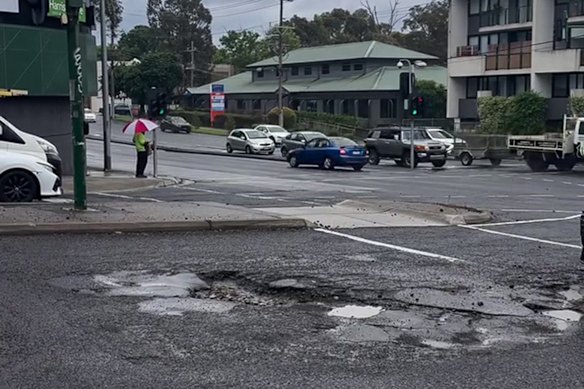
It’s at least a metre wide, and deep enough to damage a tyre. Cars crawl past to try to avoid it and drivers honk their horns when they see Wilson. A man raises his arm out of his car window and shouts, “Go Jess! Go, Jess! Come on!” A woman slows almost to a stop as she dodges the pothole, winding down her window to speak directly to the woman who may be the next Premier. “Please fix this!” she pleads.
Another woman comes up. Wilson is a hugger – she’s approachable, people want to talk to her and she often puts her arms around them. This woman says her tyres were destroyed by this pothole. “It’s f—ed, it’s so bad,” she says. Wilson replies in her earnest way: “I promise you I’m going to fix it.”
If potholes have become the symbol of this campaign, a tangible sign of the neglect of the basics, this time there’s relief. In a day or two, there’s no pothole, it’s been fixed. Whether it was Jess Wilson’s doing, or not, she’ll take it. So far, it’s all going her way.
Read more on the Victorian election:
Disclaimer : This story is auto aggregated by a computer programme and has not been created or edited by DOWNTHENEWS. Publisher: www.smh.com.au