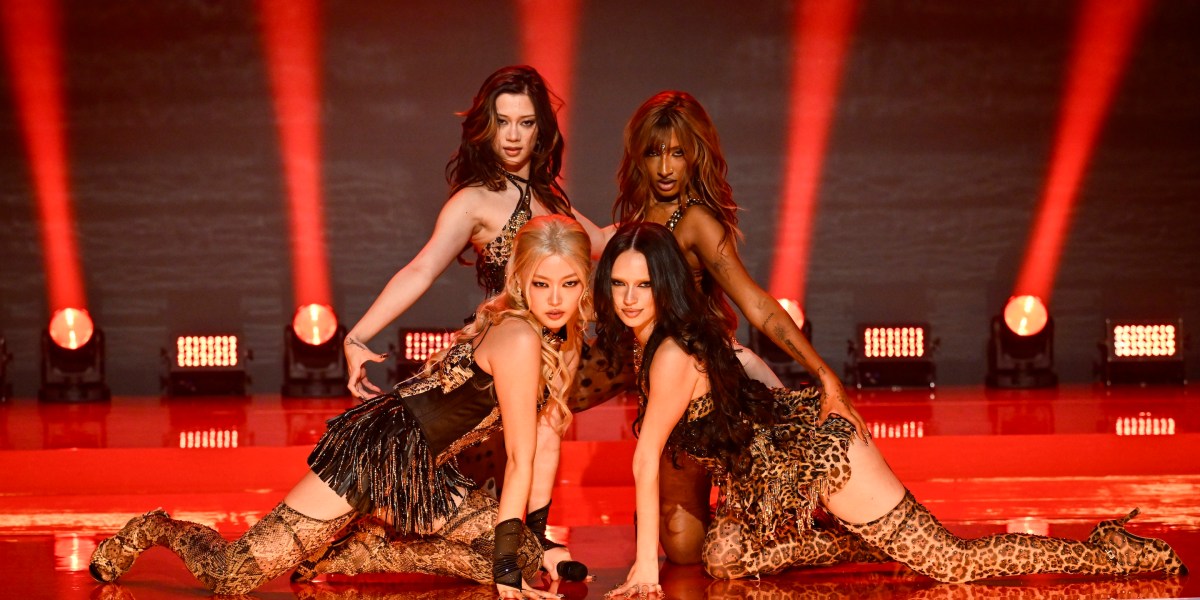
When global girl group Katseye took the stage at Austin’s Moody Center on Nov. 10, two members were, as usual, conspicuously absent. More jarring was the addition: a chair.
Megan Skiendiel, 20, who is recovering from a concussion, sang from that chair at the side of the stage while her bandmates danced around her. Behind oversized sunglasses, she belted into a microphone but stayed largely removed from the routines that made the six-member group a viral sensation.
Clips spread quickly, raising concern among fans and at least one fellow pop star. Kesha, commenting on a Billboard Instagram post about the show, wrote: “This doesn’t feel right to me.” The backlash wasn’t about Skiendiel’s inability to perform the group’s elaborate choreography. It was about why she was performing at all.
That question reaches well beyond one singer. Katseye is the flagship of a bet by HYBE, the South Korean entertainment giant behind BTS, and Universal Music Group’s Geffen Records to export K-pop’s highly structured talent system to a global audience. Its run of injuries and health breaks is an early test of whether that system’s show-must-go-on ethos travels, and of what it costs the young performers carrying a fast-growing franchise.
Cultural commentator Brett Collins drew the same distinction on his podcast, Girl Blogger. Fans, he argued, weren’t demanding that Skiendiel dance through her injury.
“Fans aren’t upset that she wasn’t performing and dancing along and doing what she normally would have done. Fans were more upset because they were concerned as to why she was on stage at all,” Collins said. “We don’t want to see Megan sitting in a chair immobile with sunglasses on when we would normally see her doing the ‘Pinky Up’ dance.”
The concern only grew the next night in Dallas, when Skiendiel did do the “Pinky Up” choreography, still in dark sunglasses. Collins said the quick turnaround fueled speculation among fans about whether she was being pressured to return before she was ready. No public evidence shows she was forced to perform.
Skiendiel has described her return as carefully limited. “I am still actively recovering from my concussion,” she wrote to fans before the Austin show, adding that her doctors had recommended reduced choreography, less intense movement, and breaks as needed, and that she would be reassessed before performing without restrictions. “I won’t be going full out just yet!” she said.
Austin was only the latest disruption in Katseye’s rapid ascent. Skiendiel’s injury had already forced the group to postpone three dates, starting with a Nov. 3 show at Detroit’s Little Caesars Arena that was called off roughly 30 minutes before it was set to begin. Shows in Chicago and Minneapolis followed. In August, an ankle sprain she suffered pulled the group out of Olivia Rodrigo’s Daisy Chain Fields festival.
Two other members have been gone far longer. Manon Bannerman began what the group called a temporary hiatus in February, citing her health and well-being, and has no announced return date. Sophia Laforteza, the group’s leader, stepped away in August to focus on her health; in October, HYBE and Geffen said she would miss the rest of the North American tour and all promotional activity through 2026, returning in the first week of January.
Katseye’s Wildworld tour has kept going anyway.
How HYBE and Geffen built a global girl group
For a group whose commercial appeal depends on tightly synchronized choreography, a full complement of performers, and a carefully curated image, the absences are more than a logistical headache. They raise a harder question for the business: what happens when the machinery that creates a pop phenomenon starts to wear down the people at its center.
Katseye is an especially useful case study because of how it was made. The group is the product of a joint venture between Geffen and HYBE, a company built through an ever-growing sequence of deals since BTS made it a global force. The partners set out to bring K-pop’s talent-development system to a global audience and assemble a group with cross-border appeal.
Netflix chronicled the search in “Pop Star Academy: Katseye.” More than 120,000 people applied, 20 made the competition, and six made the group: Daniela Avanzini, Lara Raj, Manon Bannerman, Megan Skiendiel, Sophia Laforteza, and Yoonchae Jeung.
The strategy worked. Since debuting in June 2024, Katseye has punched well above its weight for a group this new and this young; its members range in age from 18 to 24. Singles including “Touch” and “Gnarly” built its international audience.
Then came Gap. The group starred in the retailer’s 2025 “Better in Denim” campaign, a dance-driven ad seen 80 million times that introduced Katseye to a far broader audience, as Fortune reported in its look at Gap’s celebrity-driven turnaround under CEO Richard Dickson.
The pace since has been relentless. In August 2025, Katseye drew an estimated 85,000 people to a daytime Lollapalooza set, a crowd widely reported as a record for the slot. It earned two nominations at this year’s Grammys, including Best New Artist, played Coachella in April, and was the musical guest on the season 52 premiere of “Saturday Night Live” in September.
That kind of momentum is difficult for a young act to achieve and even harder to sustain. Katseye’s recent struggles suggest that keeping a fast-growing entertainment franchise running places considerable demands on the young talent expected to power it.
Why the show goes on in K-pop
The South Korean idol industry has spent years confronting questions about the conditions its performers work under. The traditional development system involves intensive training in singing, dancing, and performance, often beginning when prospective idols are teenagers. After debut, schedules stack music releases, rehearsals, promotional appearances, travel, and tightly choreographed shows.
Many fans pointed out that an injured idol performing from a seat is practically a rite of passage. At BTS’s comeback concert in Seoul in March, its first since its members completed mandatory military service, leader RM performed with an ankle injury from rehearsal and spent much of the show seated while it streamed live on Netflix.
The industry has also faced longstanding criticism over restrictive artist agreements, disputes over compensation and control, and expectations that performers keep grueling schedules with little time for rest. Those tensions have repeatedly landed in court, from EXO members’ 2023 legal fight with SM Entertainment to VCHA member KG’s lawsuit against JYP Entertainment, which JYP USA called “false and exaggerated.”
The 2019 deaths of Sulli and Goo Hara intensified scrutiny of the pressures facing young K-pop stars.
What HYBE and Geffen haven’t said
Bannerman’s absence is a particularly sore subject among fans. Beyond a general reference to her health and well-being, HYBE and Geffen have not explained what is behind her prolonged absence, nor detailed the factors behind the group’s broader pattern of health-related interruptions.
The next tests come quickly. Skiendiel must be reassessed before she can perform without restrictions; fans in Chicago and Minneapolis are waiting on rescheduled dates, and Laforteza is slated to rejoin group activities in January.
Collins hopes the backlash over Skiendiel’s performance sets a different standard: fans shouldn’t have to accept a compromised show simply because a concert is already on the calendar.
“If the show can’t be what it’s supposed to be, you’re better off just canceling,” Collins said.
But in Austin, the show went on anyway. Skiendiel sat in her chair, sunglasses on, and sang. The industry still hasn’t answered why she had to be there to do it.
Disclaimer : This story is auto aggregated by a computer programme and has not been created or edited by DOWNTHENEWS. Publisher: fortune.com