Rosedale Cemetery, in the working-class New Jersey suburb of Linden, not far from New York City, houses a gravesite unlike any other: a 36-ton, life-size granite replica of a 1981 Mercedes-Benz 240D. The hulking monument marks the resting place of Raymond Tse, a car-lover who was only 15 when he died in 1983. Tse’s older brother, David, commissioned the Mercedes, complete with Ray’s name on the license plates, for a reported fee of $250,000, and had it installed behind the mausoleum where Ray is interred.
Not all the graves at Rosedale are so conspicuous. When John Matthew Shippen Jr. was buried there in 1966, he was commemorated only by a slab of concrete demarcated by a number. No name, no birth or death year, no acknowledgment of Shippen’s deeply important place in golf history. Just a random numeral — 70 — assigned by the cemetery’s record-keepers.
***
IF YOU’RE UNFAMILIAR with Shippen, that’s kind of the point. For decades, he was the trailblazing golfer who time forgot — but who is certain to get some shine this week. That’s because the U.S. Open is for the sixth time returning to Shinnecock Hills Golf Club (est. 1891) on Long Island’s East End. In the first of those editions, in 1896, Shippen, then a 16-year-old assistant professional at Shinnecock, represented his club in a 35-player field made up largely of Scottish and English pros. Shippen’s youthfulness was not what made his appearance in the second-ever U.S. Open notable — his race was.
Shippen was born in Washington, D.C., in 1879 to a Shinnecock Indian mother and Black father. When John was 9, his father, John Sr., a Presbyterian minister and former slave, moved the family to the Southhampton, N.Y., area after he’d been assigned a ministry on the Shinnecock Indian Nation.
John Jr. began caddying at Shinnecock Hills, a course he’d helped build as a member of the crew that cleared the land. He was a fast study and a fine player. By 16, he had ascended to an assistant-pro role and soon after found himself in the field at the 1896 U.S Open, aided by Shinnecock members who covered his entry fee. Playing alongside Shippen was another trailblazer with the Shinnecock membership’s backing: Oscar Bunn, a Shinnecock Indian who, like Shippen, caddied at the club and developed an aptitude for the game.
John Shippen in 1913.
getty images
Shippen and Bunn would become the first Black and Native American golfers, respectively, to play in a U.S. Open, though their starts didn’t come without resistance. When the other pros in the field learned that golfers of color would be competing, they threatened to boycott the championship. USGA president Theodore Havemeyer didn’t blink, proclaiming the event would proceed even if only two players remained on the tee sheet. The protesting pros stood down, and on July 18 the competitors dug in for the one-day, 36-hole contest.
In the morning round, Shippen shot 78 on the 4,400-yard setup, good enough for a six-way share of first at the midway point. His stellar play continued in the afternoon … until it didn’t. On the short par-4 13th — the same hole on which Phil Mickelson would melt down 122 years later, in the 2018 U.S. Open — Shippen missed right onto a sandy path. Things got uglier from there. Years later, Shippen, as quoted in Pete McDaniel’s “Uneven Lies: The Heroic Story on African-Americans in Golf,” said, “I kept hitting the ball along the road, unable to lift it out of the sand and wound up with an unbelievable 11 for the hole. You know, I’ve wished a hundred times I could have played that little par-4 again.”
An 11. Seven over.
It’s silly to play the what-if game in golf, but, in this case, hard to resist. Shippen signed for an 81 in the second round to finish at 159, seven behind the winner, Scottish pro James Foulis. If Shippen had made par at 13 instead of a mess, who knows — today he might have his own wing at the World Golf Hall of Fame.
***
SHIPPEN WASN’T ONLY the first Black club professional but also the first American-born club pro, period. He played in five more U.S. Opens, his last in 1913, when another longshot, Francis Ouimet, famously prevailed at The Country Club in Brookline, Mass. It would be another 35 years before another Black golfer would play in a U.S. Open (Ted Rhodes, 1948, Rivera); another 46 years before a Black golfer would make a cut at the U.S. Open (Charlie Sifford, 1959, Winged Foot); and another 87 years before a Black golfer would win a U.S. Open (Tiger Woods, 2000, Pebble Beach).
Soon after Shippen’s U.S. Open debut at Shinnecock Hills, he landed the head-pro role at the Maidstone Club, just east of Shinnecock, before transitioning into the same job at Aronimink, the Philadelphia-area club that hosted the PGA Championship earlier this year. In 1924, Shippen took another head-pro post, settling into a club at which he would spend the bulk of his career: Shady Rest Country Club in Scotch Plains, N.J., where he taught golf and built clubs for 36 years.
Shady Rest, which opened three years before Shippen came aboard, was the first Black-owned country club in the U.S. The property offered nine holes of golf cut into a hillside and so much more: horseback riding, croquet, skeet shooting, a baseball diamond and tennis courts, where greats Althea Gibson and Ora Washington honed their games.
Shady Rest, which opened three years before Shippen came aboard, was the first Black-owned country club in the U.S.
Shady Rest also had a lively social scene and was a popular venue for many top Black musicians, including Louis Armstrong, Duke Ellington and Ella Fitzgerald. Shippen, who lived on the second floor of Shady Rest’s clubhouse, was central to the club’s growth, as a manager, steward and ambassador. He never lost confidence in his game, either, challenging any comers a dollar that they couldn’t outdrive him. Few could.
Shippen lived to 88, spending his final days at a Newark nursing home, apparently with little savings. He was buried about 10 miles south, at Rosedale Cemetery, beneath an unmarked gravestone, which would remain unmarked for the next 29 years. It’s hard to fathom such an important figure in the game’s history resting in anonymity, but such was Shippen’s fate. The nondescript grave was symbolic of a larger injustice: the golf world’s general lack of recognition of Shippen’s accomplishments and contributions.
That began to change on Feb. 14, 1991, when the Newark Star-Ledger published an article by sportswriter Jerry Izenberg that detailed Shippen’s story and unheralded place in history.
“Nearly a quarter of a century has passed since his death,” Izenberg wrote, “but the life and times of John Shippen shamefully remains a patch of rarely recalled history. This comes to mind this morning because school systems everywhere are celebrating Black History Month but, in the town, where John Shippen died in 1968 nobody speaks his name, and no historical plaque marks his passing. Maybe there are too many other heroes whose stories are easier to tell or maybe there are times when it is simpler to create ersatz ones. It takes a little work to piece together his remarkable story.”
Scotch Plains residents Ruby and Thurman Simmons were prepared to do that work. When the Simmons were tipped off to Izenberg’s piece by a history professor of Ruby’s, honoring Shippen’s legacy became their calling. By this point, the course was owned and operated by the town of Scotch Plains and had been renamed Scotch Hills Country Club. The Simmons presented Shippen and Shady Rest’s stories to the city council and began a years-long lobbying campaign that resulted in an annual tournament, youth academy and foundation, all in Shippen’s name.
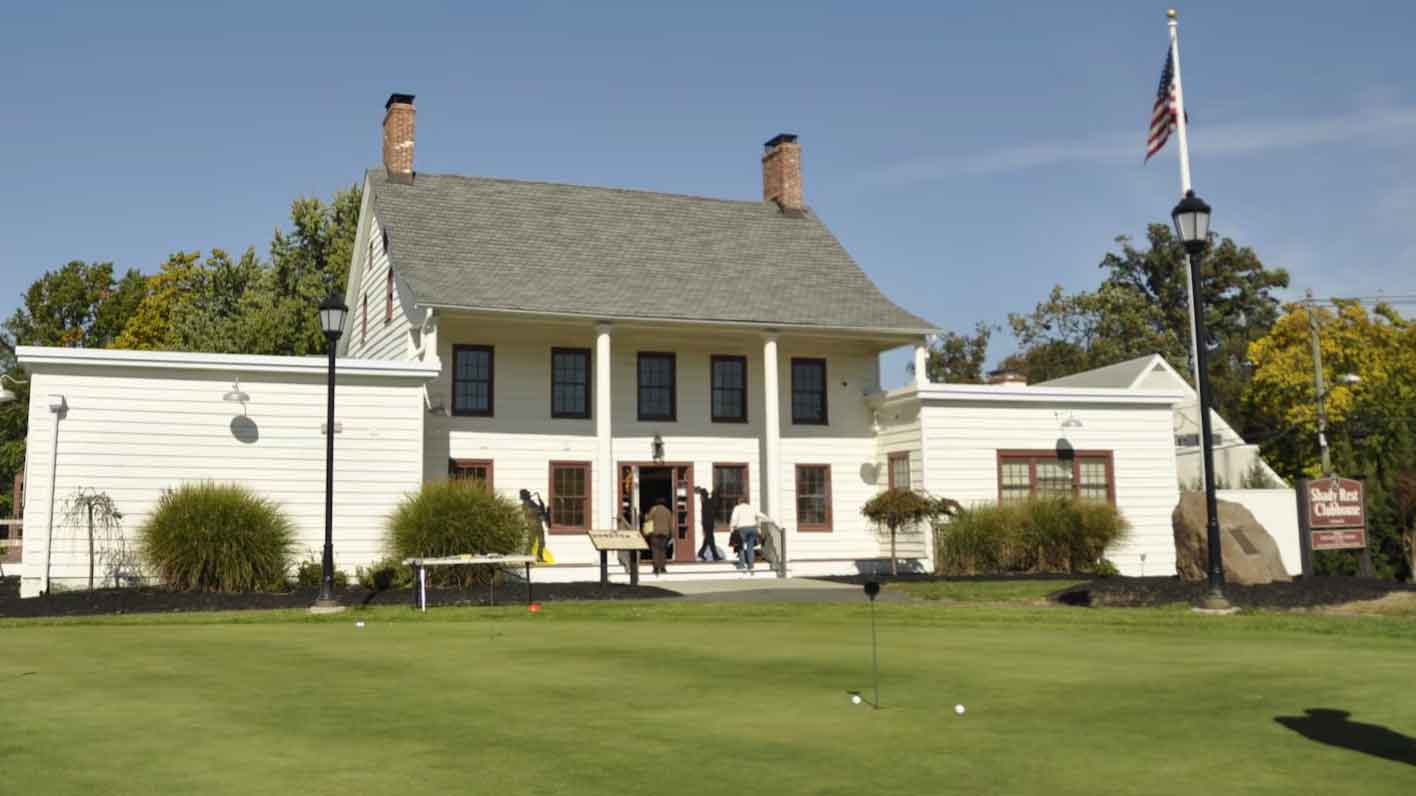
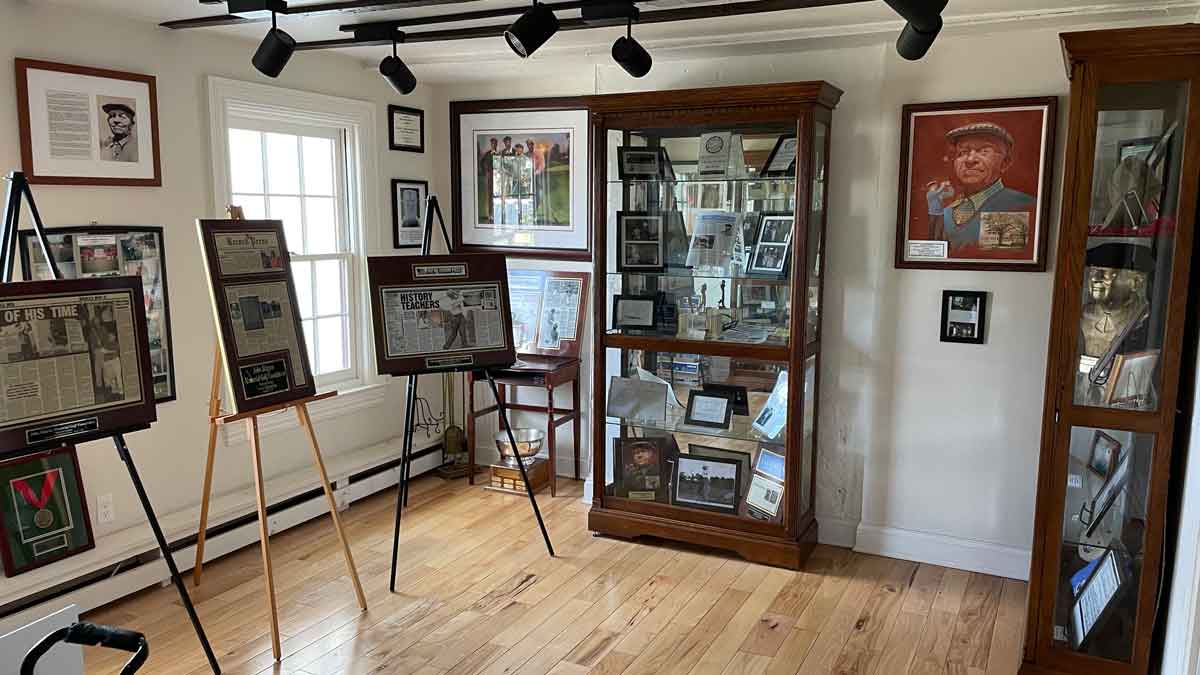
In 2015, the clubhouse underwent a $1.1 million restoration. In 2019, the township dedicated a room in the clubhouse to Shippen’s memory, filled with memorabilia, artifacts and news clippings. In 2021, the course was rechristened again, returning to its original name. “It is time, in my opinion, to right a wrong,” Scotch Plains Mayor Josh Losardo said at the time. The following year, the National Park Service granted Shady Rest a listing on the National Register of Historic Places.
Shippen’s resting place also got the respect it deserved.
Shady Rest’s restored clubhouse……and the room commemorating John Shippen.
***
IN THE EARLY DAYS of Thurman and Ruby Simmons’s quest to commemorate Shippen, Thurman couldn’t get past Shippen’s unremarkable burial site. “The haunting image of an unmarked grave at Rosedale Cemetery lingered in his mind, a stark reminder of Shippen’s forgotten history,” Ruby wrote in “A Golf Legend,” her and Thurman’s 2024 memoir of her and her husband’s pursuits.
Yet another wrong that needed to be righted, and Thurman dedicated himself to the cause.
“I thought I’m gonna do some research and try and find out where he is,” Thurman told me in a phone interview the other day; he’s 82 now and said he tires quickly. But over a 25-minute conversation, it was clear his passion for honoring Shippen has not waned.
That research, over weeks, led Thurman to an old friend who owned a funeral home. As luck would have it, the home had Shippen’s resting place in its records.
“So I went to the cemetery and I asked in the office, where is John Shippen located?” Thurman continued. “They said, ‘Well, he’s over in this area called Sunny something.’”
That would be Sunnyside, a plot with hundreds, if not thousands, of graves on the northwest side of the 125-acre property. “So I went over there and walked the whole area for about an hour or so,” Thurman recalled. “Finally, I found a slab of concrete, and there was a number, 70.”
Shippen’s number. Thurman had found him.
Ruby’s recounting of her husband’s discovery offers more color. Again, from the couple’s memoir: “As he returned home, bursting through the door, he shouted to me: ‘I found the marker!’ The words hung in the air, resonating with the weight of the journey, and the significance of the revelation. Shippen, once lost in obscurity, now had a marker, a beacon to guide future generations to the remarkable story of the first American-born golf pro.”
Thurman took his find to the township, along with an ask to properly commemorate Shippen with a tombstone. “I went back to my committee, and I told them what I did,” Thurman said. “And they said, ‘Why do you want to do that?’ I said, ‘Because John Shippen did what he did over 100 years ago. He should be recognized in the world of golf. They hemmed and hawed, and they finally okayed it. It cost $800 to put the tombstone there. And that was it.”
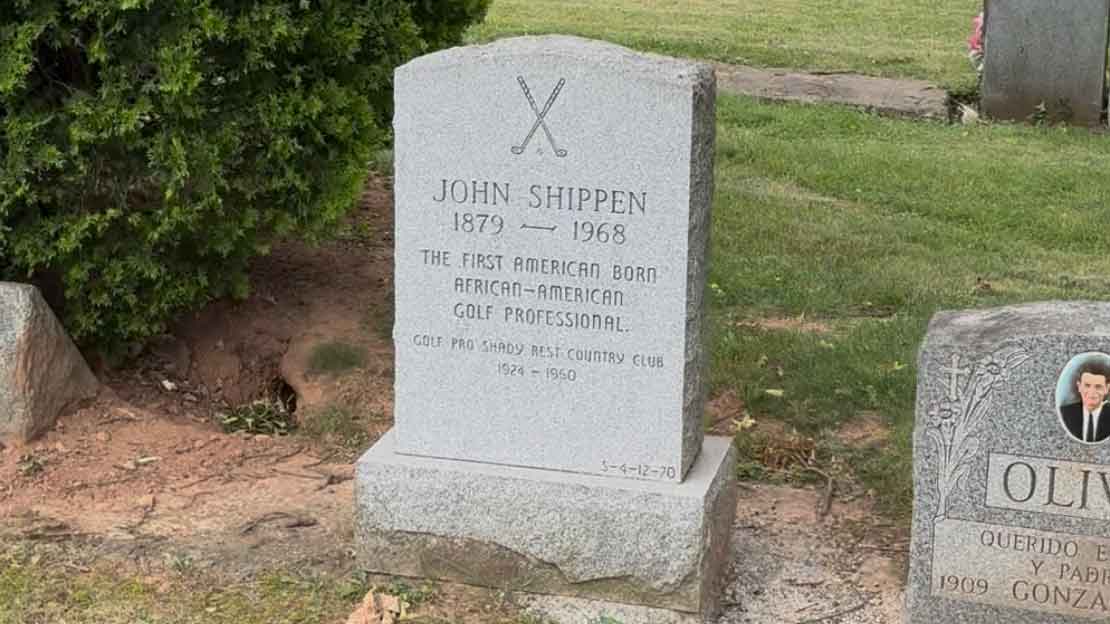
You can visit the site. Shippen’s light-gray granite headstone stands about 3 feet tall, just to the right of a cedar tree and a stretch of unmarked graves. His stone reads:
JOHN SHIPPEN 1879 — 1968
THE FIRST AMERICAN BORN AFRICAN-AMERICAN GOLF PROFESSIONAL
GOLF PRO SHADY REST COUNTRY CLUB 1924 — 1960
In the bottom righthand corner, in smaller type, are a letter and three numbers that signify the grave’s location but also serve as a reminder of its formerly unidentified status: S-4-12-70.
Shippen’s headstone at Rosedale Cemetery.
Alan Bastable
Thurman said he was satisfied with the headstone. He also takes great pride in all that he and Ruby have been able to do to honor Shippen’s legacy. But, he said, so much more still needs to be done. A college event called The John Shippen has been awarding a PGA Tour and LPGA exemption since its 2021 founding, but Thurman would like to see a professional event in Shippen’s name that annually moves from state to state. He’d like to see a Shippen statue installed in front of the Shady Rest clubhouse. And generally, he’d like to hear Shippen’s name mentioned more frequently alongside the game’s other Black pioneers.
“It’s a shame that the golf world still don’t know who Shippen was,” Thurman said. “People who teach young kids about golf only talk about Tiger Woods, Charlie Sifford, Lee Elder, Mr. [Pete] Brown — they don’t talk about Shippen. … I watch golf on TV a lot. They don’t hardly mention that man’s name. They mention everybody else.”
That will not be the case this week as the U.S. Open returns to Shippen’s old stomping grounds. Shippen look-backs, like the one you’re reading, will be published by many media outlets. But one week of attention, Thurman will tell you, cannot make up for decades of neglect.
“We wanted to correct this here wrong,” Thurman said of his and his wife’s mission to shine a light on Shippen. “The man should get his due for what he did.”
Disclaimer : This story is auto aggregated by a computer programme and has not been created or edited by DOWNTHENEWS. Publisher: golf.com