
Johanna Park might just be an ambassador for Gwinnett county, Georgia, one of the 10 most ethnically diverse counties in the United States.
Park owns Cafe Amico at Suwanee Town Center, one of her three Italian coffee shops in the area just north of Atlanta. She was born in Korea and lived much of her life in Argentina and Peru. She’s been in Gwinnett for more than 20 years, part of an early wave of Korean immigration that’s built Korean American car dealerships, banks, insurance agencies, supermarkets and restaurants like her own. It’s also a population that’s increasing in influence and not just numbers.
In 2020, Gwinnett was 30.6% white, 27.8% Black, 23.7% Hispanic, 13.2% Asian, and 4.0% multiracial, according to the US census. About 28% of Gwinnett residents were born outside of the United States. About half of those are US citizens. Extraordinary diversity is simply a fact of life here. According to the US census diversity index, there is an 84.9% chance that two randomly selected Gwinnett residents will belong to different racial or ethnic groups.
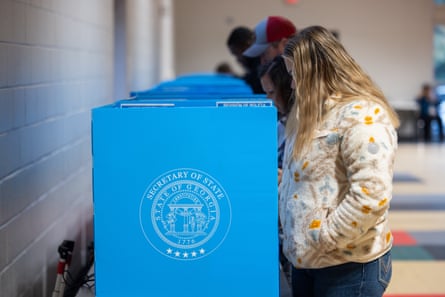
Control of the Senate may come down to the results of Georgia’s contest between US senator Jon Ossoff and US congressman Mike Collins. And Georgia’s election may come down to a handful of places where turnout and partisan sentiment aren’t easily predicted. Gwinnett, with its surge in population, of both US-born newcomers and immigrants, may be one of those places.
Park, who has generally voted for Democrats, has little good to say about the economy or the Trump administration.
“They’re deporting all of the Hispanic people from here, left and right,” Park said. With little media fanfare, ICE began a “shadow surge” of arrests in August. Called “Operation Safe Community”, the agency detained more than 1,000 immigrants across metro Atlanta, disproportionately targeting immigrant-heavy communities along Buford Highway, Norcross and other parts of Gwinnett county.
“And not only are they deporting them back to their country, but also they are deporting them to … to south[ern] Africa? I don’t know where … And who’s paying for all of this? You know, probably you and I, with the tax money.”
“Illegal immigration has always been a thing, but why are we are so adamant about kicking everybody out when they are the hardest working people here, and they help overall with the economy?” she asked.
Park noted that Gwinnett’s immigrant community tends to be politically split between Republicans and Democrats. While the county fields more Asian American Democratic elected officials such as Akbar Ali in Lilburn, others such as Buford’s Soo Hong have been elected as Republicans. The idea of “Asian Americans” as a single voting bloc ignores nuances. Vietnamese American voters tend to be more Republican, while Indian American voters tend to be more Democratic. But neither party owns their loyalty.
Park thinks this divide “will remain, always. It’s deeply rooted. Especially the business owners are mostly pro-Republicans because of the benefits and the tax cuts and what not.”
Their children, however, may be another matter. They are often splitting with their parents, driven left with the broader trend of highly educated Americans siding with Democrats.
Elliot Kim, general manager of Suwanee Frame & Art, said: “I’m Korean. My parents live here as well, and typically that generation of Koreans and maybe a little bit younger than them stay pretty Republican and conservative because they stay close to the church. That’s what they relate to. But myself and my brother probably lean a little bit more to the left.”
Immigration has been one driver of the county’s explosive growth. Its extraordinary school system is another. US News and World Report ranked the Gwinnett School of Mathematics, Science and Technology as the top high school in Georgia and seventh nationally.
It is also far and away the largest school district in Georgia, with more than 180,000 students. Even as public school enrollment falls across America, parents around Atlanta have been voting with their feet by moving to Gwinnett. That growth – not the war, not gas prices, not even Trump – might be the key political issue for Gwinnett voters. Though housing starts have fallen since the early 2000s boom, the county has been absorbing more than 10,000 new residents a year since.
Take Suwanee, on the purple fault line between football-obsessed Buford near the Mall of Georgia to its north and Duluth, where the storefront signs alternate between English, Spanish and Korean, to its south.
Kim, a graduate of Gwinnett’s vaunted public schools, is concerned that the school system today isn’t rigorous enough for his daughter, taking issue with how little homework is assigned and how often students are permitted to retake tests.
“I mean the principal was going on and on about how Roberts [elementary school] is award-winning, best in state all this. And I’m like, how are these metrics even being formed here?” Kim said. “I am so unimpressed about what they’re learning, and maybe is that just me getting old and wanting my kids to have the amount of strife that I did going through school.”
Thirty years ago, Suwanee’s town common was a cow pasture, a million-dollar home was a rumor and apartments were the punchline to a joke about Atlanta. Today, Suwanee’s town center is a model of suburban mixed-use development ringed with condominiums, and local property values are closer to Boston’s than Atlanta’s. Its population has increased fivefold since 1996.
“My neighborhood is kind of in a bubble, I’m just going to say,” said Kristina Lindsey, a Democratic activist from Suwanee. “We have money. And so our neighborhood is not as concerned with what’s happening to maybe some people in southern Gwinnett, right? Or the gas prices or our grocery prices, right? … It does not affect us the same way it does someone who’s living paycheck to paycheck and doesn’t have an emergency fund.”
She stood on the green at Suwanee with a group of about 20 people waving anti-Trump protest signs at a weekly demonstration.
“I feel a moral obligation to be out here to be visible,” Lindsey said. “And so that other people who might share the same values as me see that we have the courage to be out here and make some noise.”
For all of America’s focus on Georgia’s swing voters with the US Senate on the line, Gwinnett Democrats may be more motivated to flip control of the state legislature. Republicans have control of Georgia’s house chamber by a 10-vote margin. Gerrymandering protects some Republicans, but the vulnerable seats are in places like Gwinnett. Republican Matt Reeves represents part of Suwanee, along with some points north. He held on to his state house seat in 2024 by 621 votes on 29,003 ballots cast, and faces a rematch against Michelle Kang, an attorney and Korean American immigrant.
There is little Republican red meat, culture war fodder, in his rhetoric. He talks about affordability – property tax relief, lowering insurance prices, and pushing for a statewide referendum for senior homestead tax exemptions.
“Here’s the thing in Gwinnett county: we are the battleground. We have competitive seats,” Reeves said. “So I’ve brought my A-game every day for the last two years. And I’ve been saying affordability for at least the last two years, probably even before that, and I’m glad that the national conversation has caught up with that because we’ve got to deliver savings, for our people to have more money in their pocket.”
State senator Adrienne White Carden heard much the same from voters as she knocked on doors. The longstanding Democratic political activist is married to a Gwinnett county commissioner and no stranger to retail campaigning. She won a special election by a 51-49 margin earlier this year in Gwinnett, serving in a temporary role until January.
“I think people are still definitely concerned about the shenanigans that Trump is running, but at the same time, they’re more interested in what’s happening here at home,” Carden said. “You know, costs definitely came up, whether it be gas pump prices or, to be honest, as the wife of a county commissioner, those who knew I was his wife – which was many people – always had a message for Commissioner Kirkland Carden about property taxes.”
Disclaimer : This story is auto aggregated by a computer programme and has not been created or edited by DOWNTHENEWS. Publisher: theguardian.com