
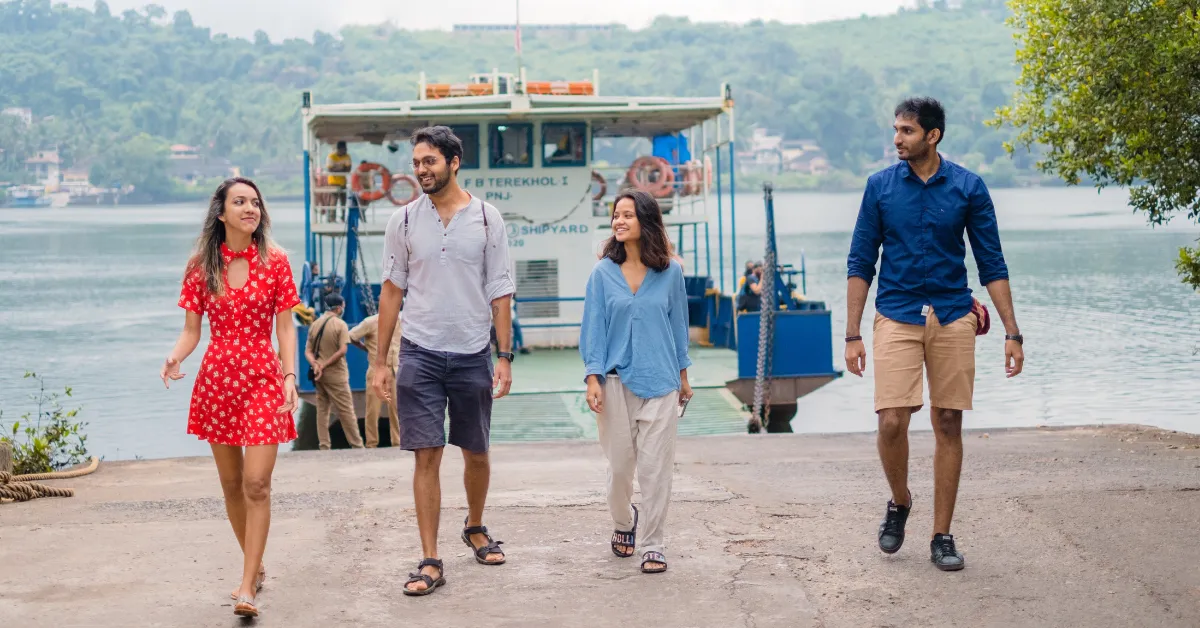
“I have always worked somewhere or the other, doing events, bartending, anything that came my way. Then the COVID-19 pandemic hit, and I found myself at a standstill, just trying to figure things out,” recalls Pawan Gorantla, pausing before adding, “At the time, I had no idea that this period of uncertainty would take me in an entirely new direction.”
For Maria Victor, that same sense of searching began much earlier, though it looked very different on the surface. During her early 30’s, she had already built what most would describe as a stable and successful corporate career.
A chartered management accountant trained with the Chartered Institute of Management Accounting in the United Kingdom, she spent close to eight years working across industries and geographies, from retail at Tesco to oil and gas with Schlumberger, and later with Accenture and HP.
Her work took her from Bengaluru to Mumbai, and even abroad to Dubai and the UK. On paper, it was everything she had worked towards. However, somewhere along the way, she began to feel a subtle disconnect.
“I had a comfortable life,” she says, reflecting on those years. “Everything was structured and predictable. But I kept asking myself what it all meant. Was I really doing something that fulfilled me? Did my daily work serve a meaningful reason?” That question hovered long enough to reshape her life.
From corporate comfort to intentional adventure
In 2011, she stepped away from her corporate role, initially as a pause rather than a permanent decision. She set out on a series of unhurried travels, each trip a chance to experience new places and perspectives.
“I started with small excursions, nature trails, and short treks. But even in those early trips, I realised how much travel opens you up. You begin to notice people, cultures, and ways of life that you would otherwise overlook,” she shares with The Better India.
More than the sights she saw, it was the inner awakening that stayed with her. “It was not just about seeing a new place. It was about how it made you feel, what it made you question, what it helped you realise about yourself,” she adds.
As she began organising trips for small groups, she noticed an understated pattern emerging. “There were people who did not just want to visit a destination,” she says.
“They wanted to know the people, the lives behind the places, and the stories that do not make it into guidebooks. They were seeking something that would stay with them, a connection that lingered long after the journey ended.”
This realisation led her to formally start ‘Make It Happen’ in September 2011 as a sole proprietorship. Her small hobby travel club soon began to take on a purposeful shape, hinting at something larger than herself.
“I would design itineraries and share them on social media,” she explains. “We kept the groups small, around ten people, because I wanted it to feel personal.”
These journeys took travellers to places such as Ladakh, Spiti, Nagaland, and Gujarat, with a focus on homestays and community interactions.
“Travel, for me, was never about ticking off places. It was about awakening, about stepping outside your comfort zone and genuinely engaging with the world,” she says.
Even as this grew, Maria briefly returned to the corporate world before making a decisive shift in April 2014.
“There comes a point where you realise you cannot do both,” she says. “If you want to build something meaningful, you have to give it your whole self.”
The village that shifted her path
A defining moment came during her travels in Nepal, in the village of Dhampus. “It is a small, beautiful village overlooking the Annapurna range,” she recalls.
“I met a shawl vendor there who insisted that I take his photograph.” What followed stayed with her long after she left. “He called up his wife and said, ‘Even if we cannot see the world, the world can see us,’” she adds.
“That one sentence changed everything for me. Until then, I had been thinking about what travellers gain. But in that moment, I understood what communities could gain,” she explains. It was here that the idea of travel as a two-way exchange began to materialise.
Between 2014 and 2015, she began reworking the Make It Happen model. “Traditional tourism often stops at the surface. It does not always create space for real connection,” she explains. At the same time, she observed the industry evolving with easier booking and access. “But what was missing was depth,” she says. “What was missing was experience.”
/filters:format(webp)/english-betterindia/media/media_files/2026/04/17/make-it-happen-2026-04-17-15-55-02.png)
“Setting up the company meant stepping into an undefined space and building something that did not yet have a name or a ready market in India,” she reflects.
“It was not a calculated move in the traditional sense. It came from a strong pull towards travel, culture, and the belief that there was something meaningful to be built there,” she adds, acknowledging that passion alone could not immediately sustain it.
Within a year, financial pressures forced her back into the corporate world in 2014. “That period tested me in ways I did not expect. I was trying to rebuild stability while still holding on to what I had started,” she says.
For nearly two years, she operated in two parallel worlds. “I was working full-time and still building Make It Happen at night and on weekends. The hardest part was not the exhaustion, but constantly switching mindsets,” she explains.
Eventually, the choice became unavoidable. “Quitting again was not impulsive. It was a conscious decision to commit, even without guarantees,” Maria says.
During this time, her travels across India began revealing deeper gaps. “I could see how much of our cultural richness was invisible in mainstream tourism. Communities were present, but not part of the narrative,” she reflects. This led to the creation of a collaborative model where experiences were co-created with locals, rooted in their lived stories.
When two journeys collided in the Himalayas
Around the same time, in a completely different setting, Murali Shankaran was undergoing his own shift. Having worked in the gaming industry for several years, he found himself increasingly drawn to travel.
“I used to take long breaks just to explore,” he says. “Not as a tourist, but as someone trying to understand a place.”
It was during a three-month journey across the Himalayas that he met Maria at a campsite in Chandra Taal, Lahaul Spiti. “We were both travelling independently. But the moment we started talking, there was an evident alignment in how we thought about travel and life,” he recalls.
/filters:format(webp)/english-betterindia/media/media_files/2026/04/17/make-it-happen-2026-04-17-16-03-08.png)
Maria describes it as an instant connection. “We spoke about purpose, and about what we wanted to build,” she says. “It did not feel like a casual conversation but felt like the beginning of something.”
Murali adds, “What I had been doing informally, she had already begun shaping into a structured idea. Make It Happen already existed, and it resonated with me completely.”
By July 2017, their shared passion for travel had grown from a personal hobby into a vision for experiential travel, leading to the company’s formal incorporation, with Murali joining as co-founder and Maria serving as CEO. Their partnership grew stronger when they married in 2019, further solidifying both their professional and personal journey together
From travel tales to real-life adventures
Even before the company was formally incorporated, in November 2015, Make It Happen launched its first curated experiences in Goa during the International Film Festival of India. These included the Fontainhas Heritage Walk, the Old Goa Heritage Walk, and the Divar Island experience.
“These were our first attempts at moving beyond itineraries into experiences,” Maria says. “We wanted people to feel a place, not just see it.”
Murali explains how the idea evolved further. “We realised that storytelling had to be at the centre of everything we do. Because it is what preserves heritage,” he says.
He elaborates, “Heritage is not just monuments. It is food, music, traditions, and everyday life. Storytelling brings all of that together in a way people can connect with.” The CEO adds, “It goes beyond facts and creates an emotional connection. It is perspective, not just information, like seeing a place through someone else’s eyes.”
Today, the organisation offers more than 50 experiences, ranging from heritage walks and food trails to art workshops and nature-based explorations. Each experience is designed around a theme and rooted in the local community.
“We break destinations into smaller stories, because every neighbourhood has something unique to offer,” the co-founder explains.
On average, a standard experience, such as a heritage walk, is priced between Rs 1,000 and Rs 1,500 per person, while food trails or longer immersive experiences can range between Rs 1,800 and Rs 3,500 per person.
The organisation earns revenue by designing and delivering story-led travel experiences across multiple channels. At its core, income is generated through direct bookings on its platform, www.makeithappen.co.in where travellers book curated experiences such as heritage walks, food trails, and cultural immersions.
This is complemented by private and customised experiences for small groups, priced at a premium. The organisation also undertakes destination development and consulting work, including creating heritage walks, training local communities, and shaping tourism narratives for regions. Together, these streams form a diversified model rooted in immersive, community-driven travel.
/filters:format(webp)/english-betterindia/media/media_files/2026/04/17/make-it-happen-2026-04-17-16-08-36.png)
‘It feels less like work and more like something I genuinely enjoy.’
Everyone who joins this journey experiences change from within. Pawan, an associate storyteller, reflects on his journey with warmth.
“The training here never really stops,” he says. “You learn by observing, by doing, and by interacting. At first, I was nervous because history was not my subject. But the way it is taught here brings it alive. Today, I lead multiple tours and meet people from all over the world, and it never feels like work; it is something I genuinely enjoy,” he explains.
He pauses, “What I love most is the connection. It feels like I am showing my home to friends.”
Rachana Pednekar, a senior storyteller, shares a similar sentiment. “I initially thought I would do this for a year,” she says. “But it changed me completely, and I have not looked back since July 2024. From public speaking to leadership, I have evolved in ways I never expected. I now train others, which is something I could not have imagined earlier.”
She smiles as she adds, “I feel like I have gained a superpower, which is the ability to make people feel at home.”
For community hosts, the experience goes beyond livelihood. Jorge Da Silva Pereira reflects, “It has added a meaningful dimension to our lives. We are doing something we thoroughly enjoy, welcoming people into our home. Every group brings a new energy; it keeps us active and connected.”
Aires Antonio Andrade expresses a similar thought. “It has improved my income,” he says. “But more importantly, it brings joy. People appreciate what we share, and that gives us a sense of pride.”
Rohan Nazareth, from Mulgao village, highlights the collective impact. “It has brought visibility and pride to our village,” he says. “When visitors show genuine interest, it validates traditions that people often overlook. It has turned our farm into a space of learning and connection.”
Travel that leaves a lasting impression
For travellers, the difference is immediately noticeable. Sumanth Vashist describes his experience as immensely engaging. “It felt more like a conversation than a tour. You are not just listening, but you are also participating. It made me realise that places like Panjim have layers that you often miss.”
Gul S Jain reflects on a more introspective experience, “It allowed me to pause and observe, to notice the small details, and the stories behind everyday things. It felt like I was not just seeing the city, but feeling it.”
Over the years, Make It Happen has worked with more than 100 community members, engaged 35 storytellers, and hosted over 65,000 travellers. Nearly 50 to 55 per cent of its revenue flows back into local communities, creating sustainable livelihoods and new career paths.
/filters:format(webp)/english-betterindia/media/media_files/2026/04/17/make-it-happen-2026-04-17-16-15-22.png)
“We are creating opportunities where people can stay where they are and still build meaningful lives,” Maria says. “They do not have to leave their homes to find work.”
Murali adds, “We are also redefining what a career can look like. You can turn your passion into something sustainable.”
With operations in Goa and Bengaluru, and projects in Diu, the organisation is now looking to expand to locations across India. “This is just the beginning. We want to build this into a larger movement,” the CEO says.
Make It Happen is now focused on scaling its model across India, with plans to expand to 20 locations over the next two to three years. This expansion is being driven through strong local partnerships, community-led experience design, and growing demand for immersive cultural travel.
Murali sums it up simply, “At its core, it is about making something meaningful happen, for travellers, for communities, and for everyone who becomes part of this journey.”
All pictures courtesy Maria Victor.
Disclaimer : This story is auto aggregated by a computer programme and has not been created or edited by DOWNTHENEWS. Publisher: thebetterindia.com



