
Updated ,first published
THEATRE
Before I Forget ★★★★
Melbourne Theatre Company, Fairfax Studio – Arts Centre Melbourne, until November 28
The debilitating creep of early-onset dementia is the focus of this new play, developed through MTC’s Next Stage writers’ program, a commissioning and residency initiative that seeks to foster emerging theatre-makers. Loosely based on lived experiences, Before I Forget is the work of Kamarra Bell-Wykes, whose capacity here is as both the playwright and the director.
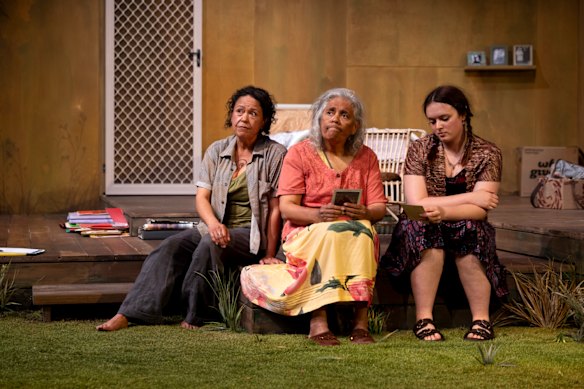
It paints a portrait of a woman, once vital and vibrant, who’s losing the contours of her days. Faith Wells (Roxanne McDonald), a renowned First Nations academic and linguist, once had a wicked tongue and a fierce intellect, but her language – and, indeed, her life skills – are now mired in forgetfulness and confusion.
While Faith is in the middle of giving a lecture, she becomes disoriented and hears voices. The play begins with her losing her keys and handbag, and as the disease takes a firmer grip, she fails to recognise her grandchild, Hope (Tyallah Bullock), and mistakes her son, Jet (Nathan Wright), for her own father.
But when plans are discussed to relocate her into an aged care home, Faith rages and refuses to go gently into that institution, much to the chagrin of her daughter, Karma (Melodie Reynolds-Diarra).
McDonald is brilliantly convincing as the erstwhile leader, activist and trailblazer who now needs round-the-clock care for basic daily tasks. There is a mischievousness and playfulness to her even as she battles both memory fog and her daughter’s and granddaughter’s ministrations, and it’s this humour that leavens the otherwise serious intent of the play.
Also funny in a feckless way is Wright, who makes a brief appearance as Jet, who loves but leaves, and is unable to do any actual caring for his mother. We’re reminded of how much caregiving is relegated to the domain of women.
To afford the fees for residential care, Faith’s home has been sold – its new owners are days away from moving in. The set features two beds on either side of a couch, with an ominous “For Sale” sign in the far corner. There are documents and folders in disarray on the floor as Karma and Hope try to pack away Faith’s research papers.
What’s particularly egregious is that for a linguist whose job and passion was to reclaim and restore Indigenous languages, Faith’s memory loss means aspects of her own life have disappeared, her cultural legacy compromised.
Before I Forget explores three generations of women grappling with change and transition. As the dutiful daughter trying to manage the household, Reynolds-Diarra is a tightly coiled ball of anger and frustration, while Bullock is sweetly earnest as she teases and plays with her grandmother, hoping for connection. Sometimes she’s rewarded by moments of lucidity.
Tonally, the play’s emotional arc moves back and forth from fear, hurt, outrage, and tenderness.
The play is all about loss – not just of identity, but of a home, independence, and dignity. But Bell-Wykes has a broader reach in her remit than just the interpersonal interactions of one family – one that reaches back into the annals. The living wake, a eulogy that the three women conduct to acknowledge each other’s strengths and to celebrate each other, is a balm to counter the fact that, as Faith points out, there were no burials for ancestors massacred by colonialists. Before I Forget is as much a story about remembrance and honouring the Indigenous matrilineal line as it is about ageing, illness and death.
The set opens up to reveal the luminous skyline and a scattering of stars, offering us a greater sense of spirituality and transcendence that goes beyond earthly mortality.
Reviewed by Thuy On
MUSIC
Night Music ★★★★
Melbourne Symphony Orchestra, Melbourne Recital Centre, October 31
Coincidentally presented on Halloween, this program, beginning with allusions to night but ending in a blaze of glory, delivered a few neat tricks as well as several treats.
Centred around the Melbourne premiere of The Vicious Circle, a flute concerto written for virtuoso Eliza Shephard by Joe Chindamo, the concert began with his Fantasie auf Nachtmusik (tipping its hat to Mozart’s Eine kleine Nachtmusik) and was counterbalanced by Mozart’s Symphony No. 36 “Linz”.
While Chindamo’s “poly-stylistic” reimagining of Mozart makes good use of elements from baroque and minimalist style, mid-20th century modernist influences seem predominant, whether in the opening Britten-esque gestures or later nods to the neoclassicism of Stravinsky. Even so, this amalgam remains uniquely Chindamo’s and was conceived and delivered with wit and a lightness of touch.
Taking musical influences from the other side of the Atlantic, the concerto was inspired by writer Dorothy Parker, member of the 1920s Algonquin Round Table (known as “the vicious circle”).
Traces of Gershwin and Copland pervade its deftly orchestrated three movements. City of Myths evokes New York with a slow blues feel, worthy of film noir. Tender is the Night projects interior melancholy through a slow waltz before a short preamble (Vertigo) leads into the fevered finale, The Brightest Hour, with its echoes of Hollywood.
Shephard is a dynamo of a performer, brimming over with irrepressible enthusiasm and astonishing technique, present not only in the concerto but two literally breathtaking encores.
Precociously written in under a week, the “Linz” symphony reflects the grand court for which it was written. From the imposing opening to the exultant finale, the Melbourne Symphony Orchestra, amiably and expertly directed by concertmaster Natalie Chee, brought effervescence and elegance to this finely crafted masterpiece. Revelling in their task, the players did indeed provide listeners with a final treat.
Reviewed by Tony Way
DANCE
Orbit Week 1: Charcoal and Agitato ★★★★
Dancehouse, Carlton, until October 31
It’s a familiar lament: contemporary dance rarely travels in Australia. We almost never get the chance to see the work of independent dance artists based in other cities. For that reason, a new national touring initiative called Orbit should be welcomed.
The program comprises two double bills, which tour through five venues across Victoria, South Australia and NSW.
The first program opens with Charcoal by emerging choreographer Keia McGrady, from south-east Queensland. This delicate, sensitively shaped duet responds to the regenerative power of cultural burning: the First Nations practice of using low fires to manage Country.
Crouched on a large sheet, the dancers crush sticks of charcoal and scrawl loose forms, suggesting a landscape viewed from above. As if rising from the ashes, they gradually stretch and unfold, then quicken, with fleeting animal imagery emerging as the work reaches its climax.
McGrady and Amelia Jean O’Leary give earnest, attentive performances, sustaining the duet’s gentle, nurturing atmosphere as its movement slowly gathers intensity.
The progression from quiet beginnings to fuller activity is straightforward but handled with assurance. McGrady focuses on developing her theme, allowing the simple image of regeneration to progress with clarity.
The second piece, Jo Lloyd’s Agitato, a standout work from last year, responds to a short, rackety piano piece by Fanny Mendelssohn, as remixed by Duane Morrison, with whirling, spasming figures.
Yet, it also opens chasms within the music. The four dancers seem to enter these fissures, discovering strange little scenes and fleeting, almost painterly arrangements amid the tumult.
With two new dancers in the quartet, Agitato seems an even greater achievement on second viewing: an epic of churning anxieties.
This is the sort of gripping theatre that I think vindicates Orbit’s ambitions. It’s fascinating to think what audiences elsewhere make of it.
Reviewed by Andrew Fuhrmann
The Booklist is a weekly newsletter for book lovers from Jason Steger. Get it delivered every Friday.
 Thuy On is an arts journalist, critic, editor and poet.
From our partners
Disclaimer : This story is auto aggregated by a computer programme and has not been created or edited by DOWNTHENEWS. Publisher: www.smh.com.au



