Updated ,first published
OPERA
Watershed: The Death of Dr Duncan ★★★
Playhouse, Arts Centre Melbourne, until November 28
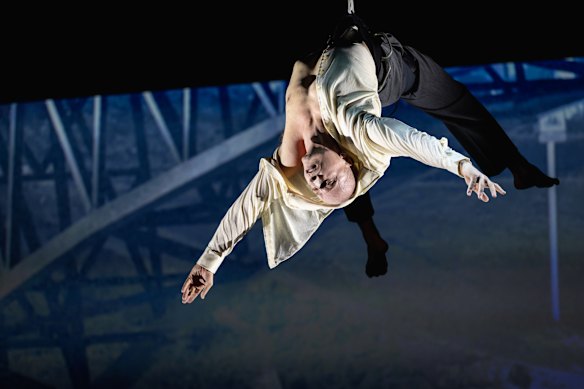
A man is suspended in mid-air above a body of water that stretches across the stage. He descends, drowning as he falls. It’s a visceral opening, the ensuing tale one that Australians may not know well, but the consequences of which are still felt today.
Watershed: The Death of Dr Duncan first premiered at the Adelaide Festival in 2022. It is a work by Brisbane composer Joseph Twist and librettists Alana Valentine and Christos Tsiolkas, the production devised by Neil Armfield. Opera Australia now brings Watershed to the Arts Centre.
We begin with the 1972 death of Dr George Duncan, who drowned in Adelaide’s River Torrens. Herein lies the “watershed”. It’s this tragic event that leads to the decriminalisation of homosexual acts in South Australia. We agonisingly watch as three police officers are tried and acquitted in relation to Dr Duncan’s death.
The crime remains unsolved.
The subject matter is deeply serious and is intended to be confronting. Anyone familiar with Tsiolkas – known for his colloquialisms and liberal use of profanity – might have known what was coming.
Coupled with the experience of Valentine, a doyenne of verbatim theatre (where transcripts of real people are taken and morphed into, usually, a play), the libretto is plainly, astonishingly blue.
Which is certainly what 1970s Adelaideans would have sounded like, but when language is so naturalistic yet sung operatically (the most unnaturalistic), an unintended side effect that can sneak in is caricature. At times, this plot, involving a real person’s life lost in devastating circumstances, felt trivialised.
Joseph Twist is known to those of us with young children as a composer on Bluey, but his music crosses all boundaries. With influences of Bach, Sondheim, Pink Floyd and others, this score feels closer to musical theatre than oratorio, as it is referred to in the program. What it isn’t, is opera. Whether anyone cares about that is in the eye of the beholder.
Musical theatre tenor Blake Appelqvist takes on the main role of the Lost Boy, and does so with deft sweetness, though their voice lacks resonance.
The chorus are the real stars; Twist gives them layers upon layers of harmonies, with various moments for individual choristers to shine. Sebastian Geilings, the aforementioned dangling dancer, is gut-wrenchingly stunning.
Though the period-ambiguous costumes did not aid the storytelling, Armfield’s direction is clever and undoubtedly powerful. After more than 50 years, this story deserves the spotlight, and many will be moved by it, no matter the manner in which it is told.
Reviewed by Bridget Davies
JAZZ
The Vampires ★★★★
Bennetts Lane Jazz Club, November 21
At a time when the Australian music industry is facing multiple challenges – rising costs, insecure conditions and the existential threat of AI – it’s heartening to see a queue snaking down the street outside a local jazz club.
It’s even more heartening to see a new venue open when so many are closing, and to see it filled to the rafters for a concert by a long-running Australian jazz quartet.
Sydney band The Vampires tour here regularly, but this was their first show in The JazzLab’s newly unveiled second room (named Bennetts Lane after owner Michael Tortoni’s previous club in the CBD), with excellent acoustics and twice the capacity of JazzLab.
Those acoustics served the band well on Saturday night at the Melbourne launch of their latest album, Skydancer. On the recording, all four players added extra layers and electronic effects in post-production. On stage, they layered and processed the sound in real time, enhancing the music’s textural depth without ever smothering its warmth.
That’s crucial for a band whose warmth is key to its sonic signature, along with memorable twin-horn themes and loping, dub-inflected grooves. Saxophonist Jeremy Rose and trumpeter Nick Garbett both used pedals to add reverb and delay to their instruments, but it was the creativity of their interactions – dancing in relaxed unison or taut harmonic lines, and engaging in energetic, improvised conversations – that made the music feel alive.
Noel Mason could alter the tone of his electric bass at will (fat and insistent, or light and guitaristic), but could also switch to acoustic bass for a brighter, breezier sound. And while drummer Alex Masso added an occasional touch of reverb to his snare, it was the invention of his touch that provided the music’s rhythmic vitality, via languid backbeats, polyrhythmic shuffles or a swift, heady propulsion.
Now in their 21st year, The Vampires are still finding new ways to expand their creative vision, without losing sight of the approachability – and humanity – that makes their music so appealing.
Reviewed by Jessica Nicholas
MUSIC
Beethoven’s Pastoral ★★★★
Australian Chamber Orchestra, Melbourne Recital Centre, November 21
It was a triple treat in more ways than one. For its final national tour of the year, the Australian Chamber Orchestra served up a winning trifecta of contrasting Beethoven works: the Coriolan Overture, the “Triple Concerto” and the “Pastoral” Symphony.
Another treat was hearing the trio of lead violinist Richard Tognetti, principal cellist Timo-Veikko Valve and pianist Konstantin Shamray perform together as soloists in the unjustly neglected concerto.
Forming a seamless prelude to the concerto’s quiet opening was the high drama of the Coriolan Overture. Thrumming with energy, the music was initially discharged in high-voltage chords before Tognetti ensured ongoing phrasing was flexible and well shaped.
There could have been no better way to celebrate Valve’s 20 years with the ACO than to collaborate with his friends in Beethoven’s charming amalgam of chamber and concerto styles. In all three movements, the cello has a starring role introducing the solo material and the golden, honeyed tone Valve’s Amati instrument made for unalloyed listening pleasure.
Shamray’s use of a modern concert grand made perfect sense against an augmented ACO. Joined with Tognetti’s brighter-toned Guarneri del Gesù and period wind and brass, the entire ensemble filled Elisabeth Murdoch Hall with an impressive heft, warmth and clarity that could only be totally appreciated in person.
Full of inventive detours, the concerto’s concluding Rondo alla Polacca made for an ebullient finale.
Tognetti and his players gave a distinctly evocative account of Beethoven’s idyllic symphony; the period wind and brass giving the familiar music added piquancy. Ernst Schlader’s clarinet was a constant joy while the valveless horns were almost always stirring.
Beethoven’s many contrasts were well pointed, not least the transition from the rustic country dancing into the ensuing thunderstorm and the eventual thanksgiving of the shepherds. What an uplifting end to another fruitful ACO season.
Reviewed by Tony Way
THEATRE
A Room with a View ★★★
Melbourne Theatre Company, Southbank Theatre, until December 19
The first question the trepidatious theatregoer who has read E.M. Forster’s 1908 novel and seen the 1985 Merchant Ivory movie adaptation will ask is: do we even need a stage version?
It’s certainly treacherous territory to approach a much-loved classic with the aim of revitalising it for a new audience, and this iteration is an uneven one – not quite a tribute to the original text nor a wholesale modernisation.
Adapted by Grace Chapple and directed by Hannah Goodwin, A Room with a View follows the convoluted getting-of-wisdom path of Lucy Honeychurch (Nathalie Morris) as she travels from England to Italy with her companion-chaperone cousin Charlotte (Hayley McElhinney).
Charlotte’s minder role seems to be a proprietary and protective one: to be in charge of Lucy’s moral education. After all, the Edwardian era dictates that a young, wealthy, unmarried woman of a certain class must conduct herself with decorum – which certainly does not extend to fraternising with men of questionable, socialist backgrounds.
When Lucy meets and finds herself attracted to George Emerson (Luke Wiltshire) in Florence, she slowly begins to unbutton herself to possibilities beyond those predetermined for her. In terms of social standing, and despite his pomposity, Cecil Vyse (Charles Wu), a family friend, is a far more appropriate partner, but George offers a sense of the unknown, of freedom.
Wu brings an energy to him that’s not present in Wiltshire until the later scenes; so too does Tomáš Kantor, who doubles as Lucy’s exuberant brother Freddy and as an Italian driver. The rest of the cast acquit themselves well, including McElhinney’s turn as the shrewish, gossipy Charlotte and Tom Conroy as the vicar with secrets of his own.
Chapple’s script moves from first-person dialogue to third-person narration, giving us both the individual and the omniscient perspective. Lucy’s sexual awakening is gradual and mired in confusion and self-deception.
Morris offers a spirited, open-eyed performance as she experiences the frisson of the new. But Wiltshire’s performance feels lacklustre next to her. Their budding relationship never feels genuinely lit up, and part of the problem lies with the disappointing, sparse set, which is primarily made up of a series of window frames upon which various scenes are projected – none memorable.
The novel and the film both credit the glamour and radiance of Italy as pivotal to Lucy’s ripening – her falling into the throes of romance, but here such golden-lit vistas are missing.
There are no costuming updates; the production sticks to Edwardian period-appropriate clothing. However, there are some innovations to this adaptation that playfully lend themselves to theatricality, with various set pieces (a tennis match and the infamous lakeside skinny-dipping) that are wordless but dynamic and fun.
While there are times when the momentum flags and it feels like there’s too much unnecessary exposition on the choices laid out for Lucy, one of the most poignant scenes is right towards the end, when McElhinney has her back to the audience and is looking out a window, her arms raised, leading us to wonder: will Charlotte ever have a possibility of choice like Lucy, a view of her choosing?
Reviewed by Thuy On
MUSIC
Aldous Harding ★★★★
Forum Melbourne, November 18
Tonight, New Zealand-born folk-pop songwriter Aldous Harding and her band spend most of the show sitting, meaning a lot of my view is the backs of people’s heads. If I angle it right, and the ocean of people sways in the right direction, I can see her, acoustic guitar in hand. But now what?
Seeing her isn’t important tonight, and neither is small talk. Harding is no showboat. Between songs, she and the band mill silently, changing instruments, tuning. The audience wait patiently. The music converges somewhere over our heads.
There’s plenty to fill the void left in place of sight lines and audience chatter. Harding’s songs are oblique. Much of tonight’s set is from her new album, Train on the Island.
Its songs are strange little machines, full of memorable images and unpredictable structures. She offers them with no context. “Mummy said my inception was like eating a pearl,” she sings on title track Train on the Island, over piano like knots in silk. Several tracks spin off into tangential outros, like on tonight’s highlight, If Lady Does It.
The lyrics might be very personal, but she keeps herself at a tantalising distance. “This one’s about me,” she says in the introduction to Coats, but the chorus goes “Big thick coats on the dogs of people just trying to help.” Happily, we learn nothing tangible.
“What is that accent?” my friend says during Leathery Whip. It’s no accent. It coils around Kiwi, American and something Germanic. These songs are from her subconscious, and she speaks her own language there.
The sold-out crowd is mostly reverent, but silence invites people to fill it. A man yelps something incomprehensible. “So funny,” Harding almost whispers, dismissively. One fan yells out a too-complicated, impassioned plea that the lighting balance is wrong. “I can’t hear you, mate,” says Harding, and launches into Worms (“I flew down to the brewery / All wool dead on my waist”).
“You’ll be all right,” she says later. “I know the quiet is hard.”
Harding closes her set with an encore of some older songs, Imagining My Man, with its twee little “Hey!” yelp, and the uncharacteristically sunny Designer (“Do not lose your young eyes / Laughing at good work with your ugly son”).
As we leave, I hear a few people saying it would have been a perfect show if she played The Barrel, and if they could have seen her.
I say embrace the obscured vision. There’s irreplicable joy in standing in silence with this many people, trying to get a glimpse at something you’ll never quite see and never quite understand.
Reviewed by Will Cox
MUSIC
Anne Sofie von Otter and Kristian Bezuidenhout ★★★★
Classical Music Australia, Melbourne Recital Centre, November 18
Swedish mezzo-soprano Anne Sofie von Otter has returned to Melbourne with the world-class stagecraft that has characterised her stellar career.
Presenting 16 Schubert songs with pianist Kristian Bezuidenhout, von Otter impressed an appreciative audience by bringing her compelling storytelling skills to the composer’s unique world where happiness and sadness, hope and disappointment are codependent.
Schubert’s famous trout featured early on, along with revelling impish spirits in The Ghost Dance.
Further evidence of von Otter’s chameleonic versatility came with a gentle Lullaby, D. 867, the lyrical solemnity of Mignon’s Let Me Appear So, D. 877 and the effective use of her rich lower register in the nocturnal rustlings of In the Forest, D. 708.
Bezuidenhout’s solo interludes included an engrossing account of Mozart’s bittersweet Rondo in A minor, K. 511, very aligned with the Schubertian mood, while later came a spiky reading of Schubert’s Hungarian Melody in B minor, D. 817 and the long melodic arcs of the second-movement allegretto from the Piano Sonata in A minor, D. 537.
In a lighter vein, four varied songs by von Otter’s 19th-century compatriot Adolf Lindblad proved a good foil for the final bracket of seven songs from Schwanengesang, D. 957, in which von Otter laid bare the stark anguish of unrequited love.
Among Schubert’s last utterances, these songs include the popular Ständchen and Abschied, in which von Otter put on the lover’s brave face, while with Die Stadt and Der Doppelgänger came a confronting rawness.
Supported by Bezuidenhout’s empathy and dexterity, von Otter’s highly developed musicianship kept the focus on musical communication rather than on any understandable mellowing of her famously lustrous instrument.
Two poignant encores, Schubert’s Lachen und Weinen and the ’60s hit Try to Remember, summed up the mood created by a memorable encounter with a great singer.
Reviewed by Tony Way
The Booklist is a weekly newsletter for book lovers from Jason Steger. Get it delivered every Friday.
 Jessica Nicholas is an arts and music writer, specialising in contemporary jazz and world music.
 Thuy On is an arts journalist, critic, editor and poet.
 Will Cox writes fiction and arts criticism. He’s based in Merri-bek.
From our partners
Disclaimer : This story is auto aggregated by a computer programme and has not been created or edited by DOWNTHENEWS. Publisher: www.smh.com.au