It’s two in the morning and already we’ve been walking for three hours. I’m bone-tired, filthy and freezing, despite multiple layers of insulation. We’re up above 5000 metres and every step is a Herculean effort. But the hardest part is yet to come.
In our Kilimanjaro summit night group there are three Australian climbers, plus guide Lucia Kivoi, and porters Aristide and Meshack. One of our party has already been forced to turn back with breathing difficulties. The objective is Uhuru Peak, at 5895 metres, the legendary “Roof of Africa”.
Between us and our goal lies the notorious climb to Gilman’s Point. It’s a brutally steep, rocky scramble over loose volcanic scree that seems to go on forever. We grind our way up the slope, one gruelling step after another at a pace so comically laboured it feels almost as if we’re in a slow-motion video sequence.
A couple of times I glance up to see pinpricks of light so impossibly high above us they could almost be stars. My heart sinks when I realise these are the head torches of climbers ahead of us. Unbelievably, that is where we need to get to, one painful step at a time – pole, pole (Swahili for “slowly, slowly”, the golden rule on Kilimanjaro).
A year earlier, two major life events set off the chain of occurrences that landed me here. The first was a medical emergency. I came within a hair’s breadth of a fatal heart attack and only by good luck was the problem discovered and then sorted with an apparently routine (to the doctors, at least) operation.
Nick Galvin
Sign up for the Traveller Deals newsletter
Get exclusive travel deals delivered straight to your inbox. Sign up now.
The other event, linked to my cardiac emergency, was the personal decision to lower the curtain on a 40-year love affair with alcohol. In short order, I went from being a morose, overweight, stressed-out journo who was determinedly drinking himself to death to being a sober, relatively fit and healthy 60-year-old enjoying a new lease on life and with an eye to my next challenge.
That opportunity arose when a colleague remarked on how well I was looking and casually suggested I was going to be one of “those sorts of people” who climb Mount Kilimanjaro. That was enough encouragement for me and with the help of our travel editor and World Expeditions, I had soon signed up for the expedition.
This abrupt decision was not entirely out of character. Looking back, I’ve made a lot of pretty big calls on a whim. There was the time in the early 1990s that I ended up riding a bike with a mate from Delhi to Mumbai. That came about largely as the result of a drunken challenge (we arrived in Delhi and the first order of business was to buy a map to see where Mumbai actually was).
Then there was the decision in my 20s to quit my job and move to Australia from England – just because I fancied a change. And let’s not forget the night of my ill-advised ascent of the Harbour Bridge (yes, we were arrested, and, no, we weren’t sober).
After the initial flurry of enthusiasm, I filed away the Kilimanjaro trip in a mental folder marked “Down The Track” and got on with enjoying my new life. Then, as deadlines have a habit of doing, the departure date came barrelling towards me. In no time at all the airy concept of flying to Africa to attempt a hugely ambitious climb flipped from the theoretical to very concrete reality and I was poring over a map with the other three team members and guide Lucia in the lounge of our hotel in Arusha, Tanzania.
Within minutes of meeting Lucia, I knew we were in safe hands. A Maasai woman nicknamed “Lioness”, she has summited Kilimanjaro too many times to count. She was one of the first ever female porters on the mountain before going on to become a highly respected senior guide. Everyone knows Lucia on Kilimanjaro. She calls the mountain her “office”.
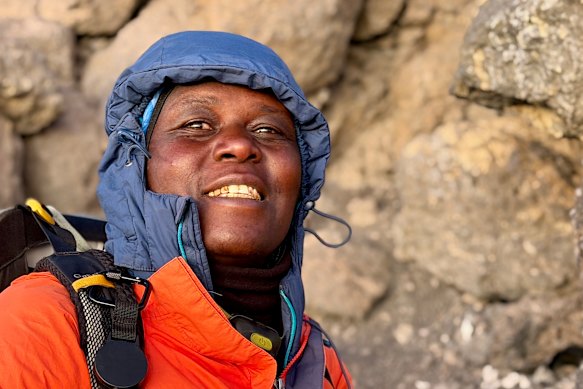
Lucia lays down her idiosyncratic terms from the get-go. “I am your Mama,” she tells us. “While you are here you must forget your families, your children, husbands, wives. I am here to look after you. Whatever you need, any problems you have, you come to me.”
She is as good as her word. Over the next nine days her extraordinary leadership abilities become apparent, from managing the team of 24 porters and dealing with all the logistical complexity of ensuring we are all fed, sheltered and safe, to giving canny psychological support each time one of us wavers in the face of a challenge that so often seems beyond us.
“You are eating an elephant,” she tells us. And, of course, the only way to eat an elephant is one mouthful – or in our case, one step – at a time.
We are climbing Kilimanjaro by the Remote Northern Circuit, which at nine days is the longest of the many different approaches. Starting on the western side of the mountain, it loops around to the north before the final summit push up the eastern flank. There are two main benefits to playing this long game. The first is that after the initial couple of days, climbers on the Northern Circuit leave the crowds behind – we have the desolate Shira Plateau just about to ourselves.
And the extra days walking also give us extra vital time to acclimatise to the extreme altitude, reflected in the fact the Northern Circuit has the highest summit success rate of all the routes. After a lively four-hour bus ride with our porters, stopping occasionally along the way to pick up extra team members, we arrive at Lemosho Gate, one of six departure points.
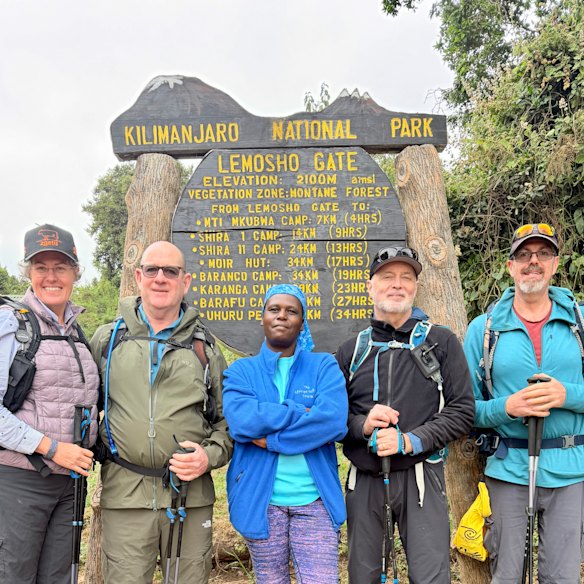
It’s a bustling scene full of febrile intensity as climbers make last-minute gear checks and teams of porters line up to have their loads weighed to ensure they come in under the 20-kilogram mandated maximum. Finally, with our gear checked and rechecked and after the obligatory group photo under the starting sign, there is nothing left to do but to start walking.
Within minutes we are plunged into dark, lush rainforest, surrounded by moss-covered trees dripping in old man’s beard. This is the first of the four distinct climatic zones we’ll pass through on our way to the top. The intensity and activity around the gate quickly gives way to near silence, broken only by the sound of our breathing (we’re already at 2100 metres), the occasional click of a walking pole on rock and the rustle of waterproof jackets and pants.
We swiftly fall into single file in an order that mostly remains unchanged for the whole trip with assistant guide Patrick taking the lead and “Mama” Lucia bringing up the rear, keeping a watchful eye on her charges. Frequently, we step to the side of the trail to allow past streams of porters hurrying ahead carrying everything for that night’s camp, from tents and cooking pots to gas bottles, chairs and even toilets.
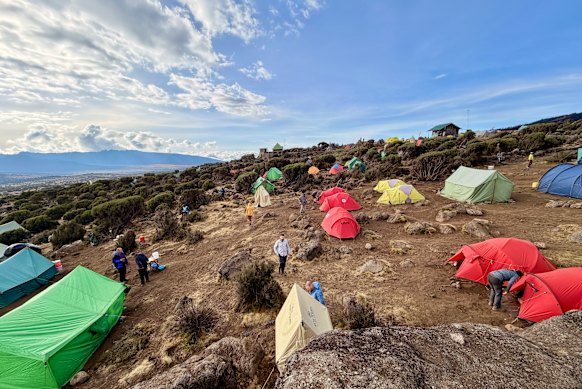
The first day’s walk turns out to be a relatively gentle introduction to our journey, and after about three hours in the rainforest we arrive at that night’s campsite. It’s a busy and noisy scene among the trees with hundreds of tents already pitched there: the porters have worked their magic and somehow erected an entire canvas village for us while we slowly laboured along the trail.
Our little corner of the site is made up of our individual tents plus accommodation for the crew, a kitchen and mess tent and the all-important toilet tent. Compared with the bigger, flashier tour groups with their logo tents and teardrop banners it’s a relatively modest set-up but quickly becomes a very welcome sight after each long day on the trail.
The days soon establish a unique rhythm that is as regimented as an army on the march. Wake-up is any time between 5.30am and 6.30am when kitchen porter Felix brings a welcome cup of tea to our tents, followed by a bowl of hot water for “washy-washy”. Duffel bags are packed and then, while the porters begin sorting their loads for the day, we have breakfast in the mess tent. Water bottles are filled, then by 8am we hit the trail in our slow crocodile.
The day’s walk mostly finishes by 3pm, then it’s time to rest in our tents, lulled into long naps by the sounds of our surroundings. Dinner is at 7pm, after which Lucia briefs us for the next day, then it’s bed and a night of fitful sleep before starting the whole process over again.
We have each been assigned our own personal porter, charged with carrying our duffel bags and keeping them secure. Part of their duties after we arrive in camp is to brush from our boots and pants the ubiquitous grey volcanic dust.
I find the whole process initially quite challenging. There is something very awkward about having a young porter cheerfully bend to this menial task while a wealthy white Westerner looks down. It carries an uncomfortable whiff of colonialism, further reinforced when I reflect that the Apple Watch on my wrist costs a lot more than the porters earn in a year.
It’s almost as if Lucia can sense my guilty ambivalence and more than once she goes out of her way to stress how vital the employment on the mountain is for the porters. It allows them to feed their families and educate their children and without climbers on Kilimanjaro there would be no work. As a former porter herself, she also goes out of her way to ensure the crew are kept happy and healthy, sharing an easy rapport with each of them.
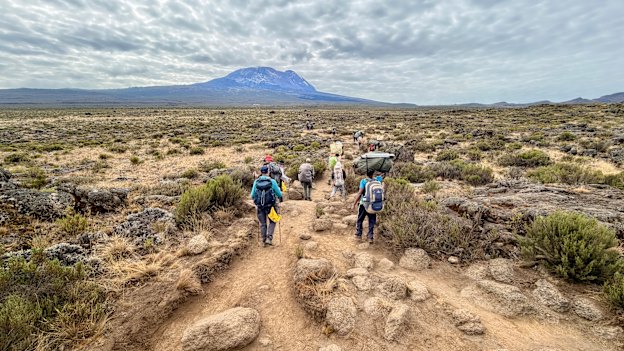
By day six we have left behind the crowds and entered a desolate moonscape of volcanic rock and dust. The sparse vegetation has dwindled almost to nothing and the only evidence of other living creatures is the occasional unidentified scat and, on one occasion, the bleached bones of a luckless buffalo.
We cross a series of shallow bowls, each separated by a narrow saddle. Everywhere underfoot are slate-like stones that give a pleasing musical clink when they come together. In the distance, the strange outline of Mawenzi, Kilimanjaro’s second volcanic cone, keeps us company. In some places its jagged peak resembles the torn edge of a piece of paper, while other parts look like palings on the top of a rotten fence.
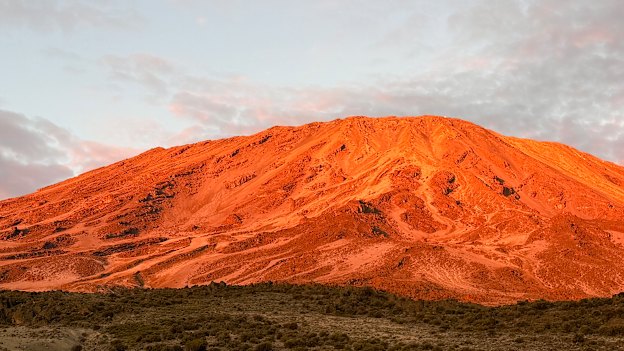
And above us all the while looms Kibo, the highest volcanic cone, dun brown and streaked with grey watercourses against a sky of cerulean blue, its intimidating summit lurking like an ever-present threat. I try quizzing Lucia about summit night. How hard is it? How long will it take? She brushes off my nervous questions like a winning football coach who will talk only about taking the season one game at a time. She knows how easy it is to get psyched out by the summit push. It’s tough enough, without sabotaging yourself by thinking of anything beyond that next step.
We arrive at School Hut, our base camp, by early afternoon on day seven. The whole trip has been building to this point and after dinner Lucia lays out the plan for the summit push. For the first time, supplementary oxygen and the availability of a stretcher is mentioned. Suddenly, things are getting very serious. At 11pm our small summit team gathers and Lucia beckons us into a circle. We hold hands and she says a brief prayer in Swahili for success, then we begin what will turn out to be one of the toughest nights of my life.
On the grinding climb to Gilman’s Point we are reduced to the circle of light from our head torches and one step, one breath at a time. There’s no room for anything else. We reach Gilman’s as first light begins to show. Aristide produces a flask of tea. I wash down a Snickers bar, watching the sunrise over Mawenzi, piercing the clouds away to our east. Far below us, lines of head torches snake slowly up the track.
Justin, one of the other climbers, asks, “Where would you rather be right now?”
Perhaps he was expecting me to reply tucked up in a warm bed or on a comfortable sofa in front of Netflix. But the answer – despite everything – is: “Nowhere else. Absolutely nowhere else.”
We’re at 5685 metres but getting to Uhuru Peak, just two kilometres away, will take another two hours or so. Walking in daylight now and with the peak visible, our spirits rise. What seemed impossible just a few hours previously is within our grasp as we make our way around the crater rim.
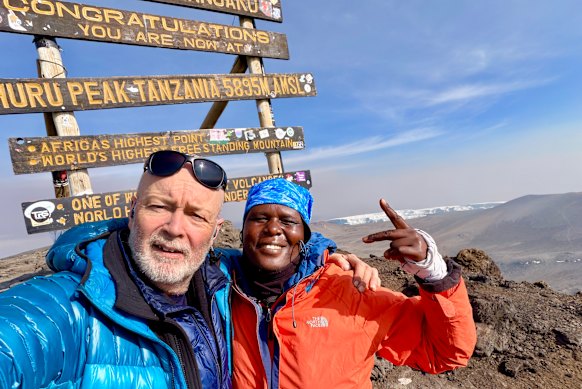
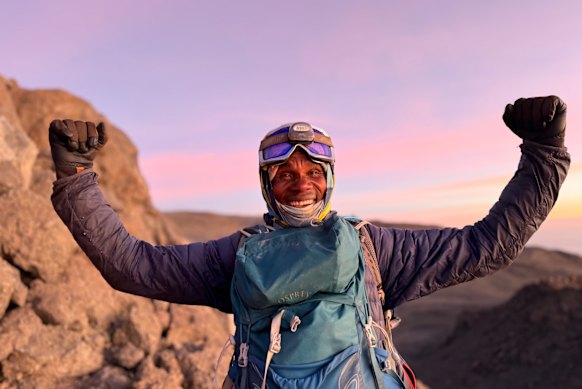
The summit is marked by a rough timber signboard, a little different from the others at each stop further down the mountain. After queueing for a picture I wander off from the gaggle of climbers for a moment alone. Suddenly, I’m overcome by the achievement of the past eight days and everything that has been demanded of me just to be able to stand at this point. I’m glad of my dark glacier glasses, which hide tears just as efficiently as they protect my eyes from the glare.
Getting down the mountain to the lower camp proves as tough – if not harder – than the ascent. After a two-hour descent on a treacherously steep shale field on exhausted legs followed by another three-hour downhill trek I’m as tired as I have ever been. My legs are screaming and my feet are brutally battered and bruised, making every step agony. Lucia wants the porters to support me for the last couple of kilometres, but I summon every last bit of Yorkshire bloody-mindedness and make it into camp under my own steam – just.
The following morning there is a last-day-of-school vibe about the camp as we pack for the last time and prepare for the trek out of the national park. Lucia leads our porters singing an impromptu concert and once again I’m grateful for my sunglasses as I look at the faces of this team who have given their all to help us get to the summit.
The language of mountaineering is so often full of the idea of conquest, but there is no way I had “conquered” Kilimanjaro as I limped away, battered and exhausted. The mountain remained exactly as it ever was – vast and indifferent to the efforts of the climbers swarming up and down her slopes.
At 60, I had stood on the roof of Africa. Kilimanjaro hadn’t changed, but somewhere along those endless, dusty kilometres, I had – one step at a time.
DETAILS
TOUR World Expeditions operates Kilimanjaro treks on five different routes with regular departures throughout the year. The Remote Northern Circuit is an 11-day trip, including two nights in Arusha. In 2027, tour costs will range between $7290 and $7650, depending on the date. See worldexpeditions.com
FLY The writer flew to Kilimanjaro International Airport from Sydney via Doha with Qatar Airways, returning via Nairobi and Doha with Precision Air and Qatar Airways. qatarairways.com
STAY The first and last night’s accommodation at Moivaro Coffee Plantation Lodge, Arusha, is included in the overall package (moivaro.com)
MORE Australians need a visa for Tanzania and should allow at least two weeks for it to be issued. The Tanzanian Government also requires all travellers to buy travel insurance from the National Insurance Corporation $US44 ($62). Intending climbers should check with their doctor about altitude and general travel health well before departure date.
FIVE ESSENTIAL KILIMANJARO PREPARATION TIPS
DEALING WITH ALTITUDE
Whether you will be affected is something of a lottery but keeping well hydrated, climbing as slowly as possible over as many days as possible and taking the prescription-only diuretic Diamox all help.
MENTAL STRENGTH
To summit successfully you have to live completely in the moment. Thinking too far ahead, beyond even the next step, can be disastrous.
PREPARATION
I probably didn’t train as hard as I should have but good general fitness and regular trail running got me through.
CREATURE COMFORTS
Small things like quality chocolate and clean socks make a big difference. One extra luxury I loved was a GPS device that allowed me to text my wife daily.
PRO TIP
Be prepared to give away most, if not all, of your gear to the porters. Many can’t afford decent kit and it makes a huge difference to them.
The writer travelled as a guest of World Expeditions
Disclaimer : This story is auto aggregated by a computer programme and has not been created or edited by DOWNTHENEWS. Publisher: www.smh.com.au