Updated ,first published
THEATRE
Eliza ★★★★★
Southbank Theatre, The Sumner until October 31
Prognoses of AI’s impact upon humanity has reached fever pitch, but in Tom Holloway’s play, we are catapulted into the past to grapple with the very same questions we’re seeking answers to 60 years later.
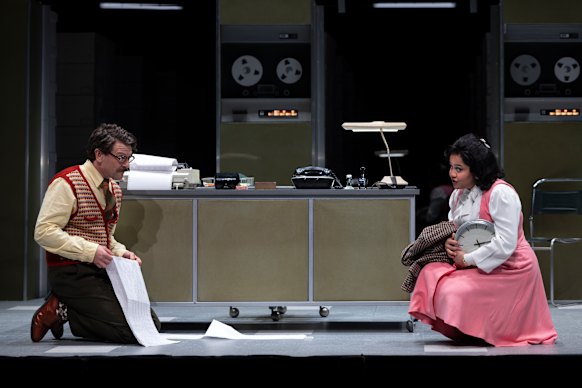
Dr Joseph Weizenbaum (Dan Spielman) is a mercurial visiting professor at the Massachusetts Institute of Technology, as intent on repressing the traumatic memories of his escape from Nazi Germany as he is on heralding the advent of digital computers. When his secretary, Becky (a bewitching Manali Datar) makes a seemingly inconsequential joke about the back-and-forth cadence of talk therapy, it opens the doors to the creation of the world’s first chatbot: Eliza.
The breathtaking scale of invention is mirrored in the expansiveness of Dale Ferguson’s vertiginous set. Rows upon rows of systematically aligned towers of working files and cascading sheets of glass lend an unexplainable depth and dimension to the stage, creating rabbit warrens for the characters to lose themselves in as their sense of reality and personhood begin to blur.
The play traces the ethical quandaries inherent in AI back to its genesis. Weizenbaum is shown to be well-meaning, but his disavowal of personal disclosure, refusal to listen until it’s too late and his betrayal of Becky, in particular, is a recurring theme that can be extrapolated to AI’s routine, large-scale copyright thefts in the present day.
The famed sycophancy of AI that is leading to current crises of consciousness is shown to have had very much the same effect when it was conceived in the 1960s, as people yearned to unburden themselves to what they perceived to be a neutral entity.
Under Paige Rattray’s direction, the rapid-fire play unfurls at the brisk pace of a psychological thriller as a collective psychosis and breakdown of legibility takes hold of the characters in different ways, as they around one another without truly understanding each other. This strange incomprehension finds its expression in the motif of starlings, which is, incidentally, the namesake of a company spying on Weizenbaum’s exploits.
Through spectacular audiovisual mastery and a stunning Hitchcockian reckoning, the forward march of progress is disturbingly realised in increasingly absurd and surreal ways as Weizenbaum figuratively and literally chokes on the irreversible weight of what he has set in motion.
Spielman excels as the fulcrum, superbly marrying the constant whirring of a beautiful mind with an inexplicable childlike naivete. Datar’s transition from unknowing to seemingly all-knowing in a role that Holloway resurrected from the annals of history is chilling, and there isn’t a role that Hamish Michael can’t play, as he dovetails seamlessly between aggrieved research assistant, enthused journalist and lofty powers that be.
The philosophical and ethical concerns that Eliza raises are by no means new to anyone engaged in the broader debate around AI, but in this undidactic, morally nuanced play, the inextricability of latent humanity and technological advancement is laid bare once more.
Reviewed by Sonia Nair
THEATRE
Koreaboo ★★★
Malthouse, until October 10
Inspired by playwright Michelle Lim Davidson’s own experiences and directed by Jessica Arthur, Koreaboo is a two-hander that surveys contentious issues of race, diaspora and belonging, with a light touch.
Davidson herself plays Hannah, a young Australian who travels to Seoul in an attempt to reconnect with her estranged birth mother, Umma (Heather Jeong). It’s only their second meeting. We learn that although she was born in South Korea, Hannah was adopted as a baby and grew up in Newcastle, NSW.
At the start, the two women fail and flail in communication. Hannah was expecting a summer-long stay – a long enough period, perhaps, for meaningful reconnection; Umma (mother in Korean), however, believed it was just going to be a short vacation.
Umma’s behaviour toward her daughter thrums with wariness, as though one were greeting a stranger. Maybe, she suggests, Hannah should be visiting Seoul’s touristy spots instead.
The entire performance is staged in a small convenience store run by Umma, lovingly decked out in all manner of brightly coloured snacks, and with harsh fluorescent lighting thanks to designer Mel Page. The two women move within the space as they interrogate, parry and deflect.
Davidson explores a raft of issues, including the question of identity. Hannah’s hyphenated background (Korean-Australian) means she’s part of both cultures and wholly of neither, and at first, Umma’s brusque criticism of Hannah’s language skills feels like a wholesale rejection of her daughter’s “Koreanness”. Seeking both maternal and cultural acceptance, Hannah feels crushed to receive neither.
Their common language – and one that helps them move toward connection and bridge distance, it turns out – is K-pop. The title actually refers to someone who’s not of Korean heritage but who is obsessed with Korean pop culture.
Koreaboo swerves to the unexpected and surreal when both performers begin to sing and dance. There is a talent show in the offing to prepare for, and a chance for Hannah to become more Korean. It’s all surface-level cultural appropriation, though, much in the same way that Umma learnt English by watching TV, becoming so familiar with the lives of the characters in Sex and the City that she can quote from them.
After a shaky start, Jeong and Davidson become good sparring partners and friends as they navigate the tricky mother-daughter relationship anew after years apart. Umma’s backstory is revealed: the reasons behind Hannah’s adoption and how her yearnings for a singing career were quashed because of filial obedience to her own mother. Korean culture is not just skincare and pop music, but, like a lot of Asian countries, there’s an expectation to conform to parental demands.
Koreaboo packs in a lot during its 90-minute stage time – maybe too much, as there is a lot of jumping about trying to cover a lot of ground. The beginning set-up takes a while to develop and can be tightened, and the ending feels rushed.
And although the singing and dance sequences are overextended and as distracting as they are humorous, the play’s value is drawn from highlighting the possible consequences of adopting a child, removing them from their motherland, and raising them in an entirely foreign environment. Even if they embrace the riches of a new life in their host country, there are always losses to be reckoned with.
Reviewed by Thuy On
OPERA
The Turn of the Screw ★★★
Palais Theatre, until October 1
Operatic takes on the supernatural span the centuries, but no modern work is more revered and feared than Benjamin Britten’s The Turn of the Screw. The 1954 opera follows a governess who takes up residence at an English country house, only to find the spirits of two dead servants are haunting the children now in her care.
Finally, an opera where the muffled screams drifting in from Luna Park next door actually add to the drama, rather than detract!
This is a piece that has potential to be The Shining-level unnerving. When staged up close and creepy, the eerie singing and sinister spectacle can captivate like a demonic spirit itself. Here, the huge set and vast stage dwarf the drama – in pivotal moments, the singers are far away from each other; we are far away from them. Detachment creates a disconnect that does not serve some excellent performances.
It is, after all, a chamber opera. Britten scored it for just 13 instruments. Perhaps no Australian conductor knows more about the English composer than Paul Kildea, and the reduced Orchestra Victoria was guided superbly by him.
Rachelle Durkin (Governess) was more maternal than hysterical, with a self-assured, impressive vocal performance to match. Kanen Breen’s voice is sharp and cold and uses his lithe physicality to intensify Peter Quint’s menace, despite donning the most unflattering wig anyone’s ever been cursed to wear (it’s a confusing choice, when it’s clearly mentioned how handsome Quint is).
One exceptional discovery to come from this production is soprano Genevieve Gray (currently a university student), who sings the older child, Flora. Gray possesses a vocal evenness and an array of colour that belies her youth.
Neither a spook nor a snore, though with moments of satisfaction, this production feels like a missed opportunity to bewitch more people with the mystery and magic of operatic storytelling.
Reviewed by Bridget Davies
MUSIC
Lady Blackbird ★★★★
Melbourne Recital Centre, September 30
It’s been decades since Lady Blackbird – raised in an evangelical Christian household in New Mexico – abandoned her church-music roots, along with the religious doctrines that no longer defined her.
These days, the message underpinning her music is much more personal, but no less spiritually charged. The American singer (born Marley Munroe) has a voice to rival any gospel queen, but it’s now self-empowerment and self-acceptance she champions, rather than submission to an external force.
In Melbourne on Wednesday, as part of her debut Australian tour, Lady Blackbird cut a striking figure as she arrived on stage: floor-sweeping black dress, elegant cane and signature platinum afro. Her three-piece band (guitarist Chris Seefried, bassist Jonathan Flaugher and Melbourne drummer Felix Bloxsom) stoked a gritty, distortion-flecked fire around the singer for Pink Floyd’s Mother, then retreated to the shadows for Blackbird, the haunting Nina Simone song that inspired the singer’s stage moniker.
On Collage, the amped-up fuzz of electric bass and guitar magnified the drama but almost submerged Blackbird’s glorious vocals. Then the mood softened – first with the addition of acoustic bass, then acoustic guitar. This was Blackbird in heartfelt confessional mode, her gorgeously grainy voice brimming with emotion on a clutch of originals: the soulfully swaying Lost and Looking, the jazz-tinted Five Feet Tall and the lilting, folky Man on a Boat.
Seefried switched to piano for the wistful If I Told You before ushering in another cloud of psychedelia on a heady rendition of The Beatles’ Come Together. Blackbird’s musical world is unconstrained by genre, and her emotional commitment and authenticity allow her to make each song her own, whether it was written by her or others.
Imaginative arrangements and reharmonisations also allow the audience to hear old songs with fresh ears. In Blackbird’s hands, Knockin’ on Heaven’s Door became a hushed torch song, exquisitely understated. Her spellbinding encore – I Am What I Am – was equally unadorned, stripped of its Broadway sequins to become a quietly defiant affirmation of identity.
Reviewed by Jessica Nicholas
The Booklist is a weekly newsletter for book lovers from Jason Steger. Get it delivered every Friday.
 Sonia Nair is a contributor to The Age and Good Food.
 Thuy On is an arts journalist, critic, editor and poet.
 Jessica Nicholas is an arts and music writer, specialising in contemporary jazz and world music.
From our partners
Disclaimer : This story is auto aggregated by a computer programme and has not been created or edited by DOWNTHENEWS. Publisher: www.smh.com.au