THEATRE
Losing Face ★★
Melbourne Theatre Company, Southbank Theatre, until July 25
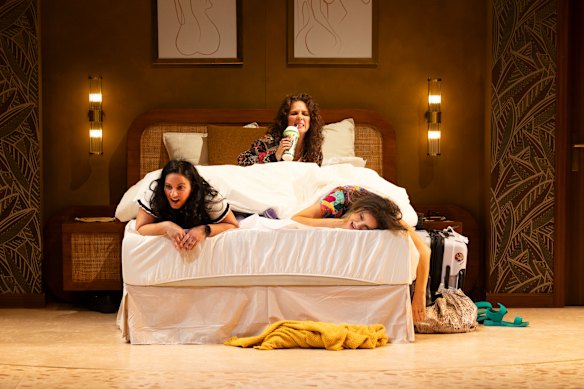
Billed as “a perimenopausal Weekend at Bernie’s”, Marieke Hardy’s Losing Face should be funnier and more edifying than it is. And with Hardy’s well-known gift for spiky banter, smart production design and a wealth of comedic talent in the cast, that’s a disappointment.
The initial scenario resembles a subplot from The White Lotus more than Weekend at Bernie’s.
Travel writer Jo (Michala Banas) is turning 50. To celebrate, she books a junket at an exclusive wellness resort with her two oldest friends – harried mum Lauren (Christie Whelan Browne) and knockabout lesbian Simone (Madeleine Sami) – and it isn’t long before they’re lobbing Gen X nostalgia bombs, regaling each other with the debaucheries and adventures of their misspent youth.
Regaling soon turns into reliving: the women will abandon relaxation treatments and collagen injections for a wild, drug-fuelled night on the town.
Before that happens, though, the creepiness of the resort makes itself felt. It’s run by a biohacking guru with a silly accent (Wil King), alongside his judgy nurse sidekick (Genevieve Morris), and the three women are pressured to have gravity-defying cosmetic surgery.
When disaster strikes and extended and escalating grotesquerie unfolds, a secret Jo has been hiding is revealed, and the play attempts to flick a switch from Weekend at Bernie’s to authentic tearjerker, in a way that feels completely unearned.
Scenes establishing female friendship through intimate chat do provide some of the better acting. Banas, Sami and Whelan Browne all bring chemistry to the mix, but there’s not much they can do about the shallowness of the characterisation, or the glib handling of the gender politics – from issues of body image to inequities in ageing – that the play raises.
King choreographs a clownish narcissism into the pantomime male villain, and Morris has amusing moments. Neither character does much to advance the plot, or to create genuine dramatic conflict, and while the hokum of the wellness industry is loosely mocked, it isn’t sharply satirised.
Losing Face also sniffs in the direction of (unbelievably tacky) comedy horror, before pulling back into sentiment. That last shift jars terribly with Hardy’s essentially nihilistic comic vision, and the titillation that the play’s more outrageous and puerile extrusions of humour seem designed to provoke.
I think Losing Face might best be enjoyed by Gen X audiences as a guilty pleasure. We get all the cultural touchstones and references, and might be more forgiving of a play that, often enough, looks more like a live-action midlife crisis than a work of dramatic art.
Overall, though, this is a missed opportunity, given the fact that feminist comedy lies behind some of our finest contemporary theatre.
Reviewed by Cameron Woodhead
THEATRE
MR BIG aka Tatay, a Transwoman and That Tiring Tune! ★★★★
fortyfivedownstairs, until July 5
If MR BIG’s complete title is a mouthful, it’s at least a succinct encapsulation of everything you need to know about this theatre work.
The discordant refrains of Mr Big’s 1991 hit To Be with You chime in haphazardly throughout as two people are haunted by its stanzas: Tatay (Trevor Santos), a traditional patriarch attempting to make sense of his place in his nuclear family and the changes his son Dion (Ken Paolo) is undergoing in 1990s Manilla, and Diana (Dax Carnay-Hanrahan), a trans Filipina woman in the throes of planning her father’s funeral and her engagement party in present-day Melbourne.
MR BIG reaches across time and space to braid an undeniable link between these two people, each trapped in their inability to confront the source of their deepest pain and move forward. A freeloading philanderer, Tatay is the site of the original sin; his weaknesses, foibles and failures are inherited by Diana in a swirl of intergenerational trauma and unresolved pain that transcends continents, estrangement and, finally, death.
Simultaneously the playwright and lead actor, Carnay-Hanrahan, has crafted an expansive, elegiac play that eschews linearity to explore the inheritance of loss, the “Sisyphean debt” shouldered by migrants, and the toll of survival. Which is to say nothing of how funny it is.
Joyously bilingual as it toggles between English and Tagalog – cries of the expletive putangina are manifold – the play oscillates seamlessly between moments of immense pathos and sidesplittingly funny gallows humour. The play abounds with memorable one-liners, brought to the fore most notably by comedic force of nature Ayril Borce, who plays both Tito (Tatay’s best friend) and Alfie (Diana’s best friend) with the utmost pageantry and mirth.
The all-Filipino cast is unfaultable. Santos brings an endearing vulnerability to the maligned character of Tatay, preventing him from devolving into a villainous caricature. Paolo is affecting as a young queer man foisted with a responsibility that far outstrips his years, and Anna Buenaseda shines as the maternal Nanay across two timelines. Aiden Gale Miranda leans into the comedy of being Diana’s diminutive fiance Jerry while fully leaning into the dramatic moments, while Carnay-Hanrahan perfects the juggling act of a woman on the precipice of her forever-happy-after ending if the tentacles of past trauma don’t topple her.
Under Beng Oh’s direction, the strictures of time and space are collapsed as the characters inhabit the same plain, proving that the life lived in our heads is as real as the one that occurs outside of us. In one particularly thrilling scene that sees Diana recreating the mistakes of Tatay’s past, we witness two timelines unfurling at once as the characters echo, project and channel one another across decades.
All is revealed around a simple dining table. Christina Logan-Bell’s minimalistic set is backdropped by a gauzy curtain that both mimics the confines of conformity through a projected image of suburbia and acts as the thin veneer separating the alive from the dead.
If certain momentous reveals afforded little airtime beyond their divulgence feel superfluous against the main unfolding story, it’s but a minor quibble. That MR BIG wades into familiar territory while remaining mired in the hyper-specificities of the Filipina migrant trans experience and remaining true to this highly particular story is testament to its singularity as a piece of theatre.
Reviewed by Sonia Nair
The Booklist is a weekly newsletter for book lovers from Jason Steger. Get it delivered every Friday.
 Sonia Nair is a contributor to The Age and Good Food.
From our partners
Disclaimer : This story is auto aggregated by a computer programme and has not been created or edited by DOWNTHENEWS. Publisher: www.smh.com.au