
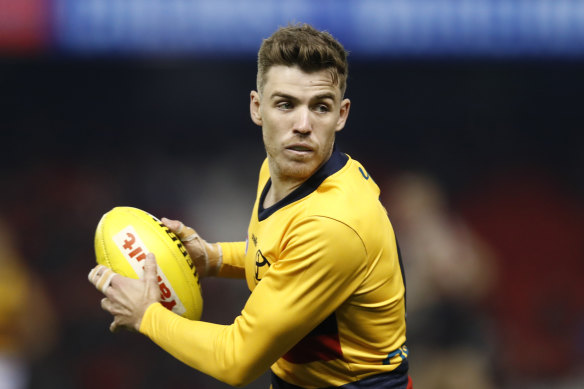

Ex-AFL player Paul Seedsman has had more hands on his head than he can recall.
After suffering a head knock that ended his career four years ago and left him with debilitating migraines, insomnia and memory loss, the former Crows midfielder has sought treatments that have ranged from the traditional to the eccentric.
“One guy did a lot of clicking, he was trying to clear all these things from my head, almost like a spiritual sort of thing. So I did that,” Seedsman said.
“Extreme massage, pressure point relief, things like craniosacral [therapy] … I’ve had acupuncture all over. I’ve tried a lot of different medications, supplements … I’m open to most things these days.”
When the 34-year-old heard of a new clinical trial in the works at Monash University involving psychedelics, he had no hesitation in putting his hand up to be considered.
While Seedsman now lives in South Australia, he is contemplating coming to Victoria, where he is originally from, and staying with a relative for the duration of the trial so he can participate.
“I have a wife and kids … and I’ve got things that I want to do in life that just are on hold at the moment … so if there’s something that can help me, I’d absolutely love that,” he said.
“But also, if I can be a part of something in any way, shape or form to help people, the next generations, not have to go through this, then I’m really keen.”
Researchers are exploring whether psilocybin – the psychedelic compound found in magic mushrooms – could hold the key to helping people like Seedsman recover from the long-term effects of concussion, also known as mild traumatic brain injury.
Someone is hospitalised for concussion roughly every 18 minutes in Australia, based on 2021-22 health data, and as many as one in two sufferers experience persistent symptoms.
Currently, there are no clinically proven effective treatments. But Monash is hopeful it can change that after a pre-clinical trial found trauma-affected rats who were given a single dose of psilocybin showed evidence of recovery both inside the brain and behaviourally.
The university has just received approval for the trial, and a $1.5 million federal grant to see whether similar results can be achieved in humans.
It is now calling for about 60 people who have experienced post-concussion symptoms for at least six months to take part in a first-of-its-kind randomised double-blind clinical trial of psilocybin-assisted therapy.
After completing an eligibility survey and going through the screening process, approved candidates will be guided through a six-week course, involving just a single dose of psilocybin, followed by therapy and self-guided exercises.
Dr Paul Liknaitzky, who heads up Monash University’s Clinical Psychedelic Lab, said the drug had two useful qualities that had been proven in other cases – its capacity to treat psychiatric conditions like depression and anxiety, and its ability to increase brain plasticity for several weeks, enabling enhanced learning and behaviour change.
If successful, Liknaitzky said the trial would be expanded to other states, though he reiterated the research was still in its very early stages, and it was important not to be “over-confident”.
While prescriptions for psychedelics are on the rise in Australia, some experts have raised concerns about the inability to control for placebo in clinical trials due to the fact people usually know if they have taken the drug. Monash is planning for this by giving participants different strengths – either a high micro-dose of 5mg, or a standard macro-dose of 25mg.
It comes as the global conversation around concussion reaches fever pitch, thanks in large part to the public battles of athletes like Seedsman and some former players taking the leagues and clubs for which they played to court.
And as demand for a solution has grown, so, too, has the interest from private pharmaceutical companies and investors.
Neurologist Professor Terence O’Brien – who is the lead researcher for the Monash University trial – said this made legitimate research in the space all the more important.
“There’s lots of people waving around saying, ‘we’ve got the magic treatment’, and they’ll trot out a whole bunch of patients who say, ‘yeah, we took this treatment and I feel so much better now’ … but there’s just not the evidence base,” he said.
O’Brien said any publicly available treatment worth its salt should have gone through double-blind randomised controlled trials at a large enough scale, and have peer-reviewed research and TGA approvals.
He said it was also important to remember prevention was always better than treatment.
While Seedsman would love to go back in time and avoid the head knock that led him here, he said he was trying to move forward.
“I took it for granted … having a brain that just worked,” he said.
“Now any time I’m headache-free, I’m like, ‘Oh God, how good does this feel?’. You know, it doesn’t last very long, but those moments are nice.
“I’ve just got to try and stay positive … For a long period of time, I was feeling like I was just sort of existing, where [now] I want to get back to living.”
Start the day with a summary of the day’s most important and interesting stories, analysis and insights. Sign up for our Morning Edition newsletter.
 Bridget McArthur is a sports affairs reporter at The Age, covering the intersection of sports and politics/business/economy/society.Connect via X or email.
From our partners
Disclaimer : This story is auto aggregated by a computer programme and has not been created or edited by DOWNTHENEWS. Publisher: www.smh.com.au


