Thousands of Beirut residents have fled their homes after Benjamin Netanyahu instructed the Israeli military to bomb the city’s southern suburbs, a move that threatens to derail Iran-US peace talks.
The Israeli prime minister and his defence minister, Israel Katz, said they had given instructions to strike “terrorist targets” in the southern suburbs for what they described as “repeated and ongoing violations of the ceasefire by Hezbollah”.
The bombing order marks the most serious escalation of Israel’s war in Lebanon since a supposed ceasefire was announced on 17 April.
Iran’s political leadership called off all further negotiations over the threatened attacks on Beirut, maintaining that a ceasefire in Lebanon was a precondition for a broader truce with the US. Its central military command also warned that if Israel carried out attacks on Beirut, residents of northern Israel should leave their homes if they “don’t want to be harmed”.
Fighting between Israel and Hezbollah has not stopped despite the 17 April ceasefire, and Israeli strikes have killed more than 800 people in Lebanon since its announcement. Hezbollah has targeted Israeli troops in southern Lebanon, and in recent days launched rockets towards northern Israel.
The ceasefire was previously understood to exempt Beirut from Israeli strikes, largely at Washington’s request, though Israel has struck the southern suburbs twice in what is still a reduction from the daily bombing of the capital before 17 April.
Iran ended its negotiations with the US over the planned strikes, with Iranian state TV reporting that the country’s negotiating team would stop exchanging messages with the US. The Iranian foreign minister, Abbas Araghchi, said the ceasefire applied to Lebanon as well and that a violation on one front was a “violation on all fronts.”
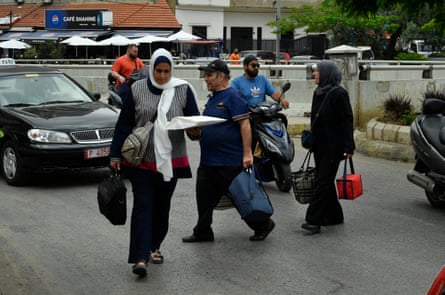
People began to leave the southern suburbs minutes after Netanyahu’s statement on Monday, with roads leading out of the area choked with cars. The displacement was a familiar one; residents there have been forced out of their homes several times over the last three months.
More than a million people have been displaced because of Israeli bombing in southern Lebanon and the Bekaa valley, as well as the dozens of forced evacuation orders the Israeli military has placed on towns and villages across Lebanon.
On Sunday, the Israeli military captured the medieval Beaufort castle in southern Lebanon, the deepest it has reached since its 18-year occupation of the region ended in 2000. It also bombarded Tyre, levelling entire buildings in some of the most violent airstrikes yet on the southern city.
An Israeli airstrike on Tyre severely damaged the city’s Jabal Amel hospital, blowing in windows and collapsing sections of its ceiling, leaving patients and staff in disarray.
Netanyahu vowed on Sunday to push even further into the country.
“Now my directive is to deepen and expand our hold in places that were under Hezbollah’s control,” Netanyahu said in a statement released after the capture of the castle. “We have returned united, determined and stronger than ever.”
Hezbollah remained defiant, announcing operations on Sunday against what it said were Israeli soldiers stationed outside Beaufort Castle. The Hezbollah MP Hassan Fadlallah blamed the Lebanese government for the escalation on Sunday, saying it “has proven the failure of the direct negotiation option”.

European leaders have condemned Israel’s expansion into Lebanon. The French president, Emmanuel Macron, called for an end to the fighting, saying “nothing justifies the major escalation under way in south Lebanon”. His foreign minister, Jean-Noël Barrot, requested a meeting of the UN security council for Monday.
The foreign ministers of the UK and Germany joined France in condemning the new operation. Britain’s Yvette Cooper called for the US-brokered ceasefire to be respected.
Israeli media reported that Netanyahu’s government had been lobbying Washington in recent days for a green light to strike Beirut, with Washington agreeing over the weekend to expanded strikes as tensions between Washington and Tehran grew.
Sources cited by Israeli media said Netanyahu convened high-level security consultations over the weekend and spoke by phone with the US secretary of state, Marco Rubio, arguing that Israel could not allow Hezbollah to enjoy what it viewed as de facto immunity in Beirut.
The Israeli military subsequently presented political leaders with a range of operational plans, including options that would require civilian evacuation orders. Reports said Netanyahu acknowledged in private discussions that US restrictions continued to limit Israel’s freedom of action.
The current conflict began in March, after Hezbollah fired rockets towards Israel in retaliation for the US-Israeli killing of Iran’s supreme leader. Since then, more than 3,300 people, including children and first responders, have been killed in Lebanon. Hezbollah strikes since 2 March have killed two people in Israel and more than 20 soldiers and one contractor in southern Lebanon.
Lebanon’s prime minister, Nawaf Salam, on Saturday accused Israel of “implementing a policy of total destruction of cities and towns”.
Netanyahu has called the capture of Beaufort Castle a “dramatic shift” in the campaign against Hezbollah. Israeli forces used the castle, also known as Qalaat al-Shaqif, as a base during their occupation of southern Lebanon that ended in 2000.
The castle offers views across Lebanon and into northern Israel. It was built as a crusader castle around the 12th century and later occupied by Saladin’s Jerusalem army, the Ottomans, the French and the Palestine Liberation Organisation.
Some experts have questioned the strategic significance of the capture, and said it amounted to little more than a public relations coup.
The military’s presence there would not solve the issue with Hezbollah, Orna Mizrahi, a former deputy director in Israel’s national security council, told the Associated Press. “We are damaging them in the operations, but in parallel we need to pursue a political and diplomatic solution,” Mizrahi said.
Talks between senior officials from Israel and Lebanon began in April in Washington, the first in more than three decades between the countries, which have no formal diplomatic relations. Those discussions were scheduled to continue this week. Hezbollah is not taking part and has said it will not accept any results.
Israel’s latest advance and the continuing violence in Lebanon present a challenge in efforts to secure a lasting peace agreement between the US and Iran. Tehran has continued to insist that any agreement to extend the current ceasefire with Washington and return shipping to the strait of Hormuz must include an end to fighting in Lebanon.
Observers have suggested Israeli officials and military commanders want to inflict as much damage as possible on Hezbollah before a potential deal imposes new limits or stops the current offensive.
Agence France-Presse contributed to this report
Disclaimer : This story is auto aggregated by a computer programme and has not been created or edited by DOWNTHENEWS. Publisher: theguardian.com