
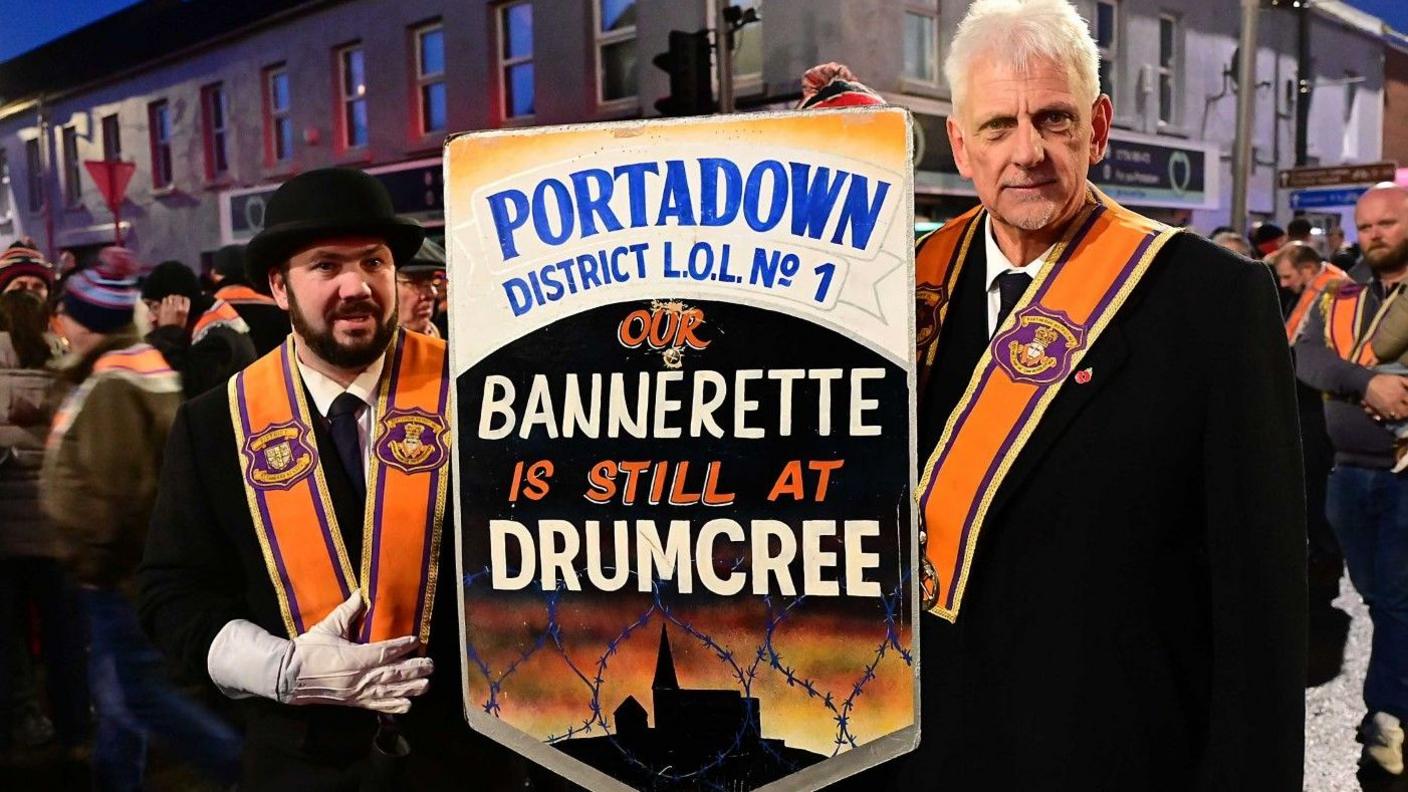
Thousands of people gather in support of Drumcree Orangemen
-
Published
Thousands of people have gathered in Portadown to show support for the Orange Order in the wake of the Drumcree dispute.
Hundreds of Orangemen paraded through the town centre, joined by bands and a crowd of supporters who were not deterred by the stormy weather.
The parade comes amid continuing tensions surrounding the long-running Drumcree dispute, whereby the Orange Order has been banned from walking down the mainly nationalist Garvaghy Road in the County Armagh town.
Northern Ireland Secretary Sir Chris Bryant has held talks with representatives from both sides in recent weeks.
Democratic Unionist Party (DUP) MP Carla Lockhart was there, while her party colleagues and assembly members Jonathan Buckley and Brian Kingston paraded with their lodges.
The Drumcree dispute has led to divisions within the unionist party, with Lockhart standing down as party officer on Thursday. She said the DUP had it “within its gift to remove” Michelle O’Neill as Northern Ireland’s first minister.
This would mean removing DUP Deputy First Minister Emma Little-Pengelly from her role, as the two ministers share an office and cannot function without one another.
O’Neill had taken part in the Garvaghy Road protests which blocked the parade from taking place and earlier this week, the Sinn Féin politician attended police interviews over her involvement.

The first part of the parade was followed by a series of speeches, mainly from members of the Orange Order.
Lockhart was the only politician to take to the stage, where she repeated her challenge to the DUP leadership: “Profound consequences must mean profound consequences. Michelle O’Neill must go.
“That’s where I stand, and this lady is not for turning.”
Portadown District Master Nigel Dawson warned politicians that they could face consequences at the next election over the Drumcree dispute.
“Politicians need to remember that we put them into office and we can take them out of office,” he said.
He added that the Orange Order had won the right “to return home via our traditional route and Portadown District intends to exercise that right on a date and time of our choosing, and if necessary, without further recourse”.
Orange Order Deputy District Master Alistair Power said Drumcree must not be allowed to divide unionism.
“It should not be used by parties to attack each other publicly over differences of opinion,” he added. “We need to stand united.”

 Image source, Pacemaker
What is the Drumcree dispute?
The Drumcree parade dispute began in the mid-1990s and it almost derailed the peace process at the time.
Violence related to the dispute resulted in riots, roadblocks and murders.
When the Orange Order was prevented by police from walking down the route in July 1995 there was a tense stand-off. It was the same for the next three years.
The Parades Commission began operating in 1998 to regulate parades and try to defuse tension around marches.
Its decision not to allow a march down the Garvaghy Road that summer has been challenged by the order for the past three decades.
Last month, the Parades Commission decided that the march could go ahead on 27 September with restrictions in place after its original decision to stop the march was overturned in court.
That morning, up to 1,000 people – including nationalist politicians – blocked the road, preventing Orangemen marching from Drumcree Church a mile to the west.

Since then there were repeated attempts by the Orange Order to walk the route, but they were stopped by police.
Residents maintained a constant presence on the Garvaghy Road, but that ended on 9 October when the NI Secretary Sir Chris Bryant banned the parade following advice from the PSNI chief constable.
On 12 October, the Garvaghy Road residents failed in a bid to challenge the Parades Commission’s decision to allow the Drumcree parade to walk down the predominantly nationalist road.
The Court of Appeal judges said their decision was confined to the lawfulness of the decision – it was not deciding whether or not the march should occur.
Lady Chief Justice Dame Siobhan Keegan said the ruling was decided before Sir Chris banned the parade.
-
-
Published12 October

-
-
-
Published12 October

-
-
-
Published12 October

-
Disclaimer : This story is auto aggregated by a computer programme and has not been created or edited by DOWNTHENEWS. Publisher: BBC




