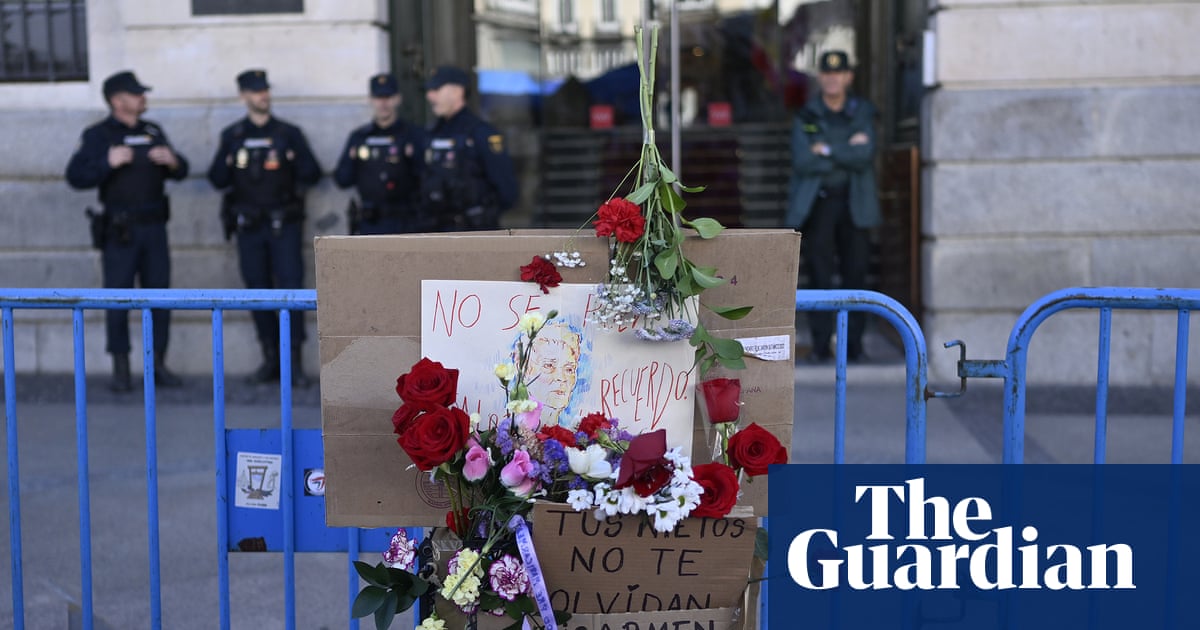
Thousands of people are expected to march through the centre of Madrid on Thursday evening in memory of María del Carmen Abascal, the 87-year-old woman whose eviction from her flat in the capital a fortnight before her death triggered mass protests over Spain’s housing crisis.
The pensioner, whose flat had been bought by an investment firm that sought to increase her rent by 230%, had become the public face of the crisis before her death in hospital on Wednesday night.
Abascal’s eviction unleashed waves of demonstrations across Spain, led to the setting up of a protest camp in the centre of the capital, and prompted the socialist-led government to propose emergency measures to try to make the rental market more equitable. When those measures were voted down by rightwing and far-right parties last week, the prime minister, Pedro Sánchez, announced a snap general election, to be held on 29 November.
Anger over the plight of the woman who had become known around the country as Maricarmen remained undimmed a few hours after her death. On the pavement across from the apartment building where she had lived for seven decades, a steady stream of people visited a small, steadily growing memorial. Some came to light candles or leave flowers, while others left handwritten messages such as, “You made history Maricarmen,” and “Thank you for changing Spain”.
Sara, 41, who had come with her young son and a sign that read, “Maricarmen, we’ll fight for you”, said: “We’re here because I think Maricarmen’s death shows how institutions can kill a person by failing to care for them.”
For many, the site was a reminder of all that Maricarmen had gone through as she tried to stay in her home, fending off three eviction attempts before the investment firm succeeded in forcing her out. “When people are protected less than investors, that leads to these kinds of things happening,” Sara added. “This woman could have died – if she had died of natural causes – she could have died peacefully in her home.”
Jaime, 34, pointed to all that Maricarmen had come to represent, particularly in a country like Spain, where social rights are supposedly guaranteed. “She had become a symbol, albeit one she never wanted to be, of the fight for decent housing,” he said. “So I came here because I think it’s important to restore some of the respect that Spanish society took away from Maricarmen.”
Visitors included some of the housing campaigners who had helped Maricarmen fight off previous eviction attempts. “This is really hard to take,” said Miguel, 59, fighting back tears as he added a red rose to the memorial. “When money is more powerful than people’s lives, it’s unbelievable.”
He said he hoped Maricarmen’s death would mark a turning point in Spain. “At least now we’re talking about this and putting names to those who are being evicted,” he said. “Because until now, there were 44 people a day being forced out of their homes. To the people in power, those are just numbers – now at least we’ve started putting names to those going through this.”
The Madrid tenants’ union announced a commemorative march at 8pm on Wednesday from the camp in the Puerta del Sol square to Abascal’s flat.
“Farewell, Maricarmen!” the union said in a post on social media. “Tonight we’ll honour you with a march … to the place that was your home for 70 years, and where you just wanted to stay until the end.”
Abascal’s ordeal has made housing a key issue in the forthcoming election, with Sánchez’s government seeking to push a redrafted package of measures through the council that operates when parliament has been dissolved. Meanwhile, the rightwing and far-right parties that opposed the legislation in congress last week have accused the prime minister of failing to act to address the housing crisis over the course of his eight years in office.
Sánchez offered his condolences to Abascal’s family and friends on Wednesday night. “A hug also to everyone who’s feeling this loss today as their own,” he wrote on social media. “Rest in peace.”
Alberto Núñez Feijóo, the leader of the conservative People’s party (PP), which voted against last week’s emergency measures, also offered his condolences.
“No campaigning, no political parties, no partisan ends, no more bricks in the wall,” he wrote on social media. “When a person dies, there should be nothing but respect.”
The following day, however, Feijóo accused the government of trying to “manipulate the emotions of the Spanish people” by focusing on one particular eviction when there had been countless others during Sánchez’s time in office.
PP politicians also joined forces with the far right on Thursday to veto attempts to hold a minute’s silence for Maricarmen in Madrid’s regional parliament and the country’s senate. In Madrid’s municipal council, meanwhile, a rightwing attempt to block a minute’s silence was thwarted by opposition parties.
Abascal’s death has prompted reflection on how she had been treated by politicians and the media. The far-right Vox party, which also voted down the new decrees, had falsely suggested that Maricarmen would have had a home had she been an immigrant from North Africa, while one commentator had opined that “Maricarmen was chosen during a casting call for people facing eviction” to become a leftwing saint.
At least two far-right figures, including one of Vox’s MEPs, sought to sow doubt over the cause of Abascal’s death, with one even suggesting an autopsy should be carried out to determine whether the government had been involved. Another wrote: “Maricarmen was probably already made to send in her postal vote before they did her in. I expect anything from this scum.”
Disclaimer : This story is auto aggregated by a computer programme and has not been created or edited by DOWNTHENEWS. Publisher: theguardian.com