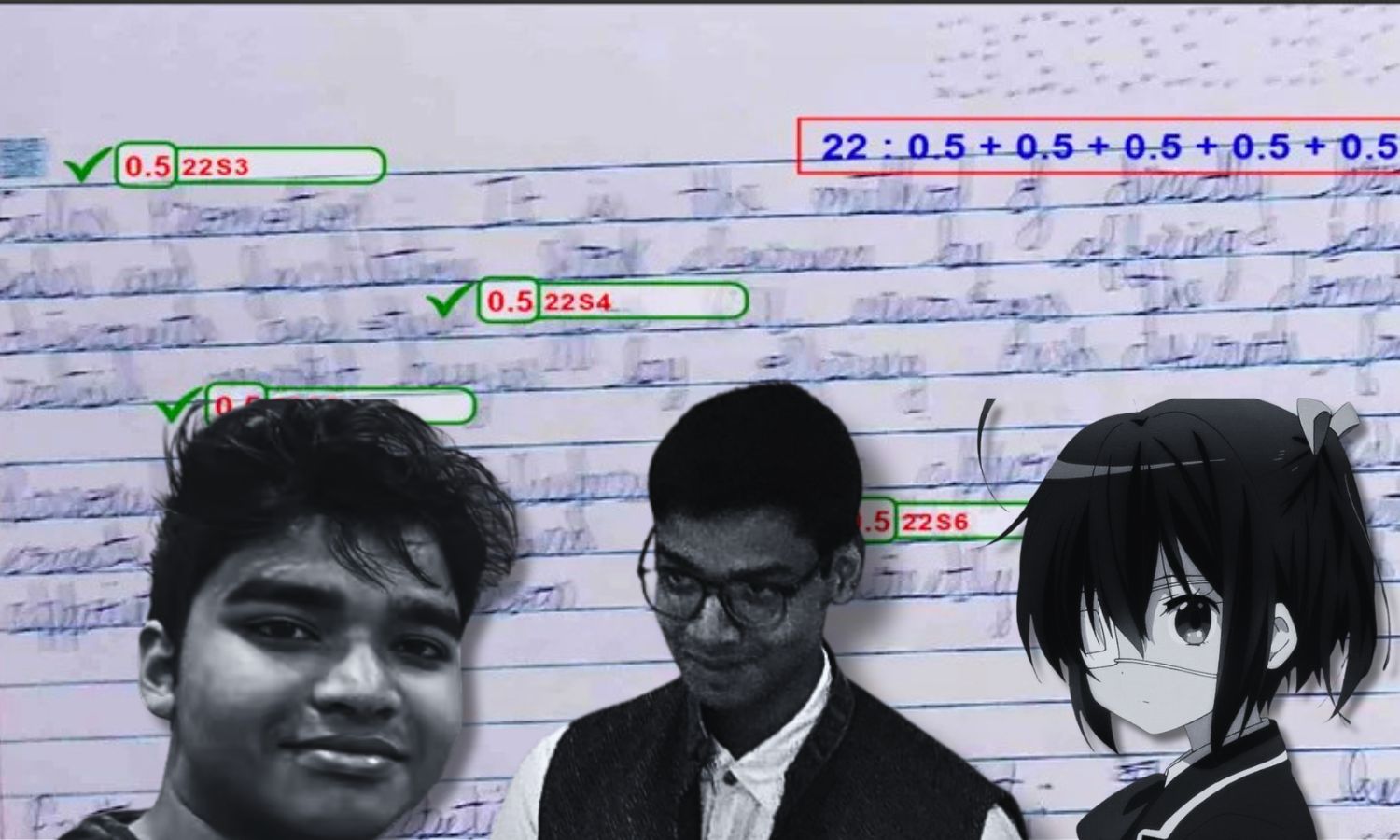
What began as isolated complaints about the Central Board of Secondary Education’s (CBSE) newly launched On-Screen Marking (OSM) system snowballed into one of the biggest public controversies surrounding school examinations in recent memory. At the centre of it were not political parties, activist groups or educational institutions, but three teenagers, Vedant Shrivastava, Sarthak Sidhant and Nisarga Adhikary.
Their interventions took different forms, but each stemmed from a determination to probe beyond the explanations offered by authorities.
“Pakistani” Vedant Shrivastava calls out errors
Vedant Shrivastava’s story was the most personal. After receiving unexpectedly low marks in Physics, the Delhi student requested a copy of his answer sheet, only to discover that the handwriting did not appear to be his own. His social media post quickly went viral, drawing millions of views and forcing CBSE to respond publicly. Initially, CBSE defended the integrity of its evaluation process. There were attempts to label the 17-year-old student getting subjected to online abuse for calling out the error in the system, and was even labelled “Pakistani’ trying to tarnish the image of CBSE.
However, as the issue gained public attention and media scrutiny intensified, the board reviewed the case and acknowledged that an error had indeed occurred. Vedant was subsequently provided with what CBSE said was his actual answer script, and corrective action was initiated regarding his marks. CBSE had to apologize to the teenager for the inconvenience caused to him, but the same ‘inconvenience’ was caused to lakhs of Indian students who wrote their 12th exams under the CBSE.
For thousands of students across the country, Vedant’s experience prompted a closer examination of their own answer sheets and evaluation records.
Jharkhand’s Sarthak Sidhant Flags Coempt EduTeck
If Vedant’s story captured public attention, 17-year-old Jharkhand student Sarthak Sidhant examined the documents that raised broader questions that sustained the public scrutiny on the organization.
According to Sarthak Sidhant’s analysis of CBSE’s publicly available tender documents and bidding records, the board floated three separate tenders for the On-Screen Marking (OSM) project in 2025. He alleged that eligibility, technical and accountability requirements were progressively relaxed before the contract was awarded to Hyderabad-based Coempt EduTeck. Among the changes he identified were the removal of disqualification clauses related to murky performance in the past, a narrowing of blacklisting criteria, and revisions to technical evaluation metrics. CBSE strongly rejected suggestions of favoritism or irregularity.
The board argued that modifications became necessary because earlier tender rounds had failed to produce a suitable vendor. Officials maintained that the procurement process complied with established norms and that the contract was awarded to the highest technically qualified bidder. According to CBSE’s explanation, both Coempt EduTeck and Tata Consultancy Services qualified in the final round, but Coempt submitted the lower financial bid, with them bagging the contract. Surprisingly, the same company had allegedly managed Telangana’s Intermediate examinations in 2019, a major administrative crisis which reportedly led to nearly 3.8 lakh students being marked as failed, amid concerns linked to more than 20 student suicides.
Hacker Teen Exposes Flaws in CBSE’s OSM Portal
The third figure, 19-year-old cyber security enthusiast Nisarga Adhikary, shifted attention to digital infrastructure itself. Months before the controversy reached national headlines, Nisarga said he had identified vulnerabilities associated with the OSM ecosystem and had reported them to authorities, including CERT-In. He claimed to have discovered a master password embedded in the portal’s frontend code that bypassed the OTP verification step, allowing direct access to the OSM evaluation dashboard and the ability to modify marks. His findings suggested weaknesses in authentication and access controls that, if exploited, could potentially allow unauthorised access to parts of the system, and raised major signs of concern among the student population.
Initially, CBSE rejected suggestions of any breach, maintaining that the site in question was only a testing environment, and not the live system used for evaluating board examination answer sheets. He raised a major question in response to the claim by CBSE, stating that if he could access the personal details of the evaluator’s account he logged into through a downloadable file with a password as predictable as “123456”, why was such sensitive information even uploaded in the test website. Days later, however, the board acknowledged that certain vulnerabilities had been identified and addressed, while thanking ethical hackers who had reported weaknesses. In another post on X on May 31, Adhikary claimed that the answer sheets stored on an Amazon Web Services (AWS) bucket, a cloud storage for digital files, were publicly accessible online.
Faulty OSM System Deployed
The OSM system represented one of the most significant technological shifts in CBSE’s evaluation process. Introduced for Class 12 examinations this year, the On-Screen Marking (OSM) system replaced the physical evaluation of answer scripts, where these physical copies needed to travel the country, with digital assessment of scanned copies. CBSE argued that the system would improve efficiency, reduce clerical errors and enhance transparency.
Yet after the Class 12 results were declared in mid May, students and teachers across the country began reporting blurred scans, missing pages, unevaluated answers and difficulties accessing post-result services. Defending the system as “fair, transparent and equitable”, the CBSE noted that re-evaluation remained available, but its data showed that of the 98.6 lakh answer books assessed, 68,018 required rescanning due to poor image quality, while 13,583 had to be manually verified after scanning failures. Meanwhile, with the latest CBSE notice released on Tuesday, the students will be charged Rs 100 per answer book, while re-evaluation of answers will be charged at Rs 25 per question. This amounts to crores of Rupees in extra financial burden for students and their parents, at the hands of CBSE.
A recurring pattern has been noticeable with India’s recent examination controversies: initial official assurances, followed by acknowledgements of failure only after getting overwhelmed by mounting public pressure. During the NEET paper leak row, authorities repeatedly downplayed concerns before investigations confirmed irregularities. A similar trajectory emerged in the CBSE’s On-Screen Marking (OSM) controversy, where the board initially defended the system as ‘transparent and secure’, even as students reported blurred answer sheets, missing pages and evaluation anomalies.
This controversy with the extensive media coverage that it garnered, along with arising legal challenges, led to a Public Interest Litigation (PIL) before the Allahabad High Court. The PIL questioned the implementation of the OSM system and alleged widespread evaluation failures.
CBSE, Education Ministry Acknowledge failures
After initially rebuking the allegations and exposes of the OSM system, Union Education Minister Dharmendra Pradhan eventually acknowledged that discrepancies had emerged during the implementation of the OSM system, confirming the raised concerns that involved nearly 40 crore scanned pages and assured students that genuine grievances would be addressed.
He defended the OMS system, calling it “a progressive instrument”, and “student-centric”, while assuring that “no student will suffer injustice”, as he stated that experts from IIT Kanpur and IIT Madras had been brought in to review the software and strengthen the evaluation process.
CBSE also reported undertaking corrective measures, including rescanning answer books where image-quality problems had been detected and reviewing complaints submitted by affected students.
The OSM controversy was about more than errors in a new evaluation system. It showed how ordinary citizens can hold powerful institutions accountable using little more than curiosity, technical knowledge and access to information.
Vedant questioned an answer sheet. Sarthak scrutinized tender documents. Nisarga examined the technology behind the system. Together, their efforts compelled CBSE to address questions about evaluation, procurement and cyber security that might otherwise have remained unanswered.
Whether the episode will lead to lasting reforms remains uncertain. What is clear, however, is that three teenagers succeeded in turning individual concerns into a national conversation about transparency and accountability.
(This article is written by Rocheta Chakraborty, a student of the English and Foreign Languages University, currently interning at Deccan Chronicle.)
Disclaimer : This story is auto aggregated by a computer programme and has not been created or edited by DOWNTHENEWS. Publisher: deccanchronicle.com