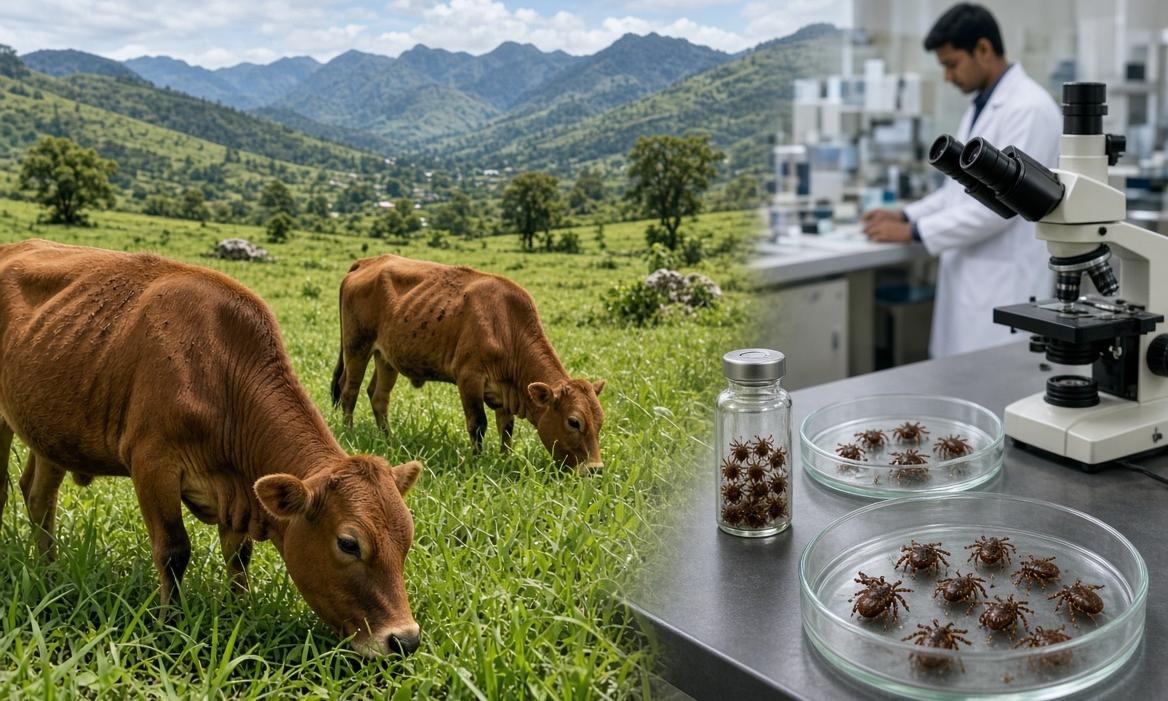
Coimbatore: Dr. S. Yaswanthkumar, the glowing young scientist in invertebrate studies at Kongunadu Arts and Science College, Coimbatore, said in India, tick‑borne diseases (TBDs) are a growing concern for veterinary and human health, with Tamil Nadu recognised as one of the important endemic regions.
In Tamil Nadu, tick species such as Haemaphysalis intermedia, Haemaphysalis bispinosa and Rhipicephalus sanguineus are common and they act as vectors for zoonotic infections like Kyasanur Forest Disease (KFD), Indian tick typhus and Lyme disease reported from the Nilgiris also.
These zoonotic diseases are particularly significant because they cross the animal-human barrier, affecting farmers, forest workers and rural communities who are frequently exposed to tick bites.
“Nationally, India records more than 125 tick species across diverse agro‑climatic zones, and several of them transmit zoonotic pathogens. The most notable zoonotic tick‑borne diseases include Crimean‑Congo haemorrhagic fever (CCHF), Kyasanur Forest Disease (KFD), Indian tick typhus, Lyme disease and Q fever. These infections have been documented in states such as Karnataka, Gujarat, Rajasthan, Himachal Pradesh and Tamil Nadu, with outbreaks leading to significant morbidity and mortality. Surveillance data show that seroprevalence of Borrelia burgdorferi (Lyme disease agent) can be as high as 19.9% in parts of Karnataka and 18% in Arunachal Pradesh, while CCHF outbreaks in Gujarat and Rajasthan have caused human fatalities,” he explained.
Dr S Yaswanth kumar
Experts argue that India urgently needs a ‘Centre for One Health Approaches’ to integrate surveillance across human, animal and environmental domains. Current monitoring is fragmented as veterinary institutes track livestock infestations, medical colleges study human outbreaks and wildlife agencies monitor forest ticks but rarely do these systems communicate. A unified One Health surveillance platform could bridge these silos, enable early warning systems and coordinate responses to tick‑borne threats.
Ironically, much of the tick burden originates not in forests but within cattle sheds themselves. Farmers often lack knowledge about the tick lifecycle, unaware that cracks in walls, damp bedding and poorly cleaned shelters serve as ideal breeding grounds. Without routine cleaning and acaricide rotation, sheds become reservoirs of infestation, perpetuating cycles of reinfection in livestock and increasing the risk of zoonotic spillover.
Chemical acaricides (chemical substances fashioned to kill / paralyse / stop reproduction of ticks) have long been the frontline defence against ticks. But misuse and over‑application have triggered widespread acaricide resistance development. In India, resistance rates in Rhipicephalus microplus and Hyalomma anatolicum species are alarmingly high with pooled estimates ranging from 68 to 78 per cent. This means that the very compounds meant to protect cattle are losing efficacy, leaving farmers with fewer options and escalating costs. Moreover, residues from indiscriminate use contaminate milk, meat and the environment, compounding the problem.
The silent surge of ticks is not just a veterinary issue; it is a national health concern. Tackling it requires region‑specific surveillance to track species distribution and pathogen prevalence, farmer education on tick lifecycles and shed management, integrated One Health Centres initiative to unify human, animal and environmental monitoring and research investment in vaccines and sustainable tick control strategies.
Ticks may be small, but their impact is vast. As India grapples with climate change, expanding livestock trade and shrinking wildlife habitats, ignoring this creeping crisis could prove costly.
The time to plan for a coordinated, science-driven response is now, Dr. Yaswanthkumar stressed.
Disclaimer : This story is auto aggregated by a computer programme and has not been created or edited by DOWNTHENEWS. Publisher: deccanchronicle.com