Robert Jackman
Political types like to blame the iPhone – the ubiquitous conduit for social media – for upending America’s politics, ushering in the era of Donald Trump. By my reckoning, though, there’s a second handheld digital device that has left an indelible mark on the United States: the humble EPOS terminal.
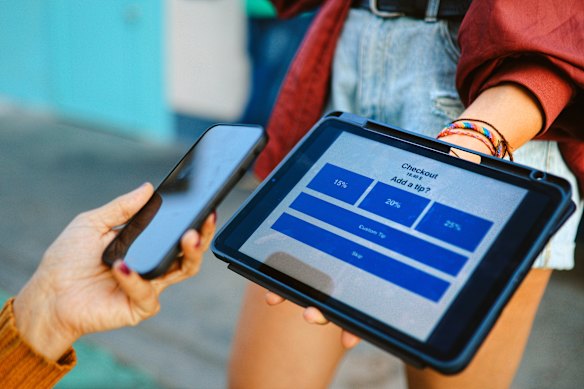
Admittedly, you aren’t going to be seeing anyone adding an EPOS terminal to their Christmas list. But that doesn’t mean that these ubiquitous items haven’t made their mark on the American economy, in particular when it comes to tipping. They ensure that every time you tap your card to pay for the simplest of services, you’re asked to add a tip.
And these machines aren’t just in bars and restaurants. You can find them everywhere from museums to convenience stores, and even in tiny independent retailers. On my last trip to the States, I visited an artisan moonshine distillery in rural Missouri. Sure enough, the EPOS terminal insisted that I consider tipping 20 per cent with my purchase.
If you’ve travelled in the US recently, you’ve almost certainly had the same experience. The terminals that are designed as a cheaper way for small businesses to process digital payments have had the inadvertent effect of ensuring that no purchase can occur without the vendor having the chance to request an extra gratuity.
Paying for entry to a roadside attraction in rural Florida? You’ll likely be prompted to tip. Picking up a snack from the airport newsagent before your flight? More than likely. Buying a beer from one of those cheerful vendors you get at sports games? Almost certainly. Thanks to the EPOS terminal, there’s the hope or expectation of a tip on every purchase in America. Consumer experts have a term for this practice. They call it “tipping creep”.
Sign up for the Traveller newsletter
The latest travel news, tips and inspiration delivered to your inbox. Sign up now.
For decades, Americans have defended the practice, insisting that it leads to better service and more customer choice.
Tipping point
Then there’s “tipflation”, another term that you might have heard recently. It’s a separate phenomenon that refers to the heightened expectation as to what constitutes a generous tip.
Take restaurants, for example. If you haven’t been to the States recently, you might still be labouring under the misapprehension that a 10 per cent tip means good service. I’m afraid not. These days, it’s 20 per cent – minimum. Some servers would probably consider 10 per cent to be a borderline insult.
Why have tipping expectations been rising? Like much of the American economy, it’s hard to pinpoint a precise cause. But most experts seem to lay the blame on the general inflationary spike and cost-of-living squeeze that has taken hold in recent years.
If we were being logical about the whole thing, you might expect that Donald Trump’s big gambit to make tips tax free might have eased the situation somewhat. After all, if employees are taking home all of the tips, surely that relieves the pressure to ask for more? Yet the opposite seems to have happened.
No wonder, then, that you can’t move for arguments about tipping online. On the unofficial Facebook group for British tourists visiting Orlando – which has nearly 200,000 members – the topic has been banned entirely. “Please don’t post about tipping as it causes too many arguments,” reads the group’s official rules that are upheld by strict moderators.
To be fair, they may have made the right decision. Look at the bitter arguments that tipping has already caused on social media. Last year, a post in which a New York waitress complained that her customers had only tipped a paltry 7 per cent – on a bill of $US3000 ($4243) – led to incendiary rows on X, with the post attracting 26 million views.
That was far from the only crazy tipping story to go viral online. How about the Illinois restaurateur who was caught on video chasing down a customer who had failed to leave a tip? When the video made the news, some Americans even took the angry chef’s side, suggesting that he was right to berate the customer who had the audacity to pay the advertised price.
Could all this madness have some upside in persuading the Americans to rethink their obsession with tipping? For decades, Americans have defended the practice, insisting that it leads to better service and more customer choice. Now, surveys suggest they might be having a rethink, with more than three in four saying that tipping has gone too far in one recent poll.
In the meantime, the tipping menace shows no signs of slowing down just yet, as the standard demand for a 20 per cent gratuity appears on every EPOS terminal across America. Good luck, then, to fans heading to the World Cup, where stadiums are already charging the best part of $US20 ($28) for a beer, and around one third of that for a bottle of water.
In the current climate, perhaps we should just be glad that FIFA isn’t demanding a 20 per cent tip on ticket prices – at least not yet anyway.
The Telegraph, London
From our partners
Disclaimer : This story is auto aggregated by a computer programme and has not been created or edited by DOWNTHENEWS. Publisher: www.smh.com.au