
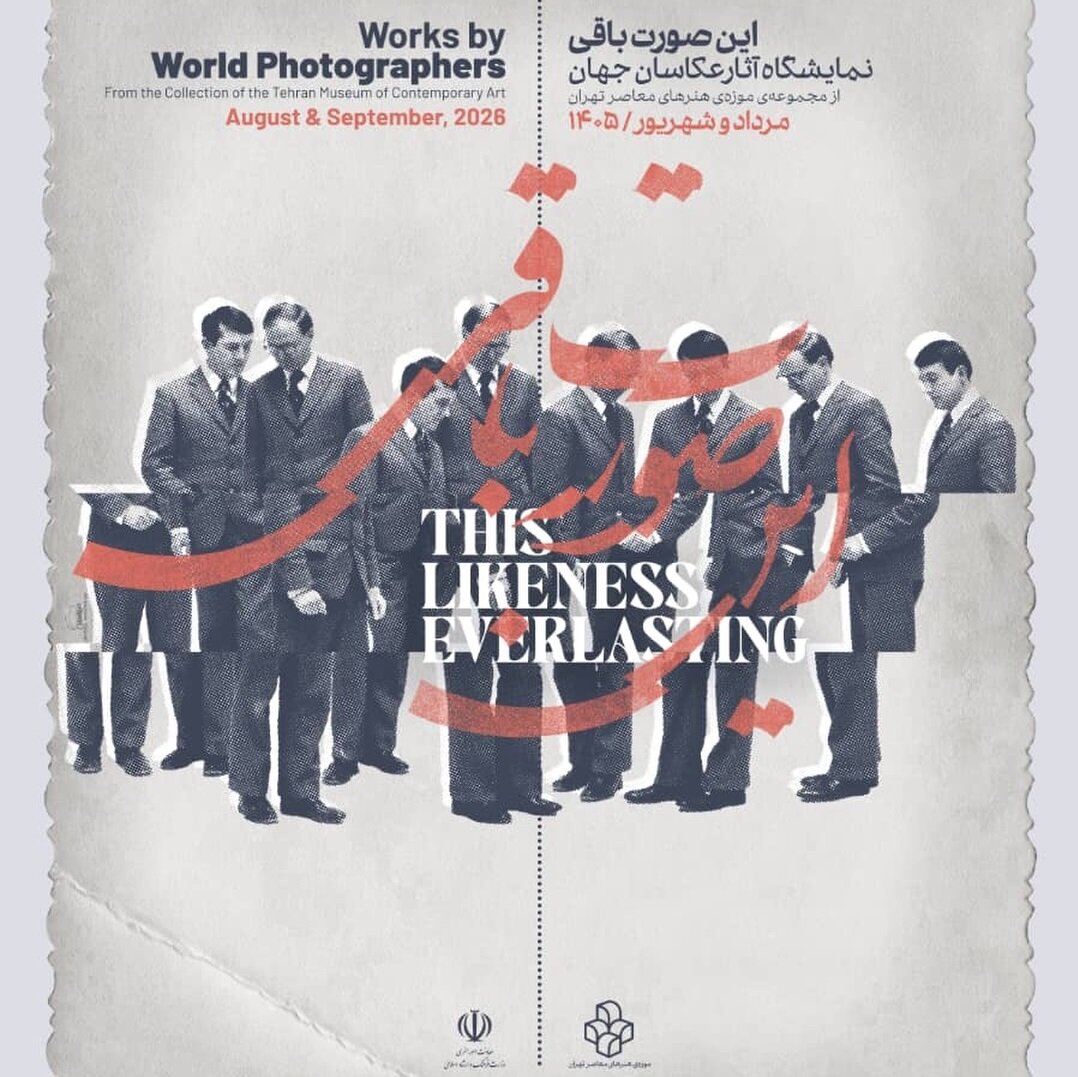
TEHRAN – Director of the Tehran Museum of Contemporary Art, Reza Dabirinejad, has announced that a unique photography exhibition from the museum’s treasured collection, titled “This Likeness Everlasting,” will open on August 15 at the museum.
“In the exhibition, we will display works that belong to the museum’s collection of foreign photographs, meaning it does not include works by Iranian artists,” Dabirinejad was quoted as saying by IRNA.
“We can claim that the oldest photograph in Iran is kept in the museum’s collection. On display, there will be the oldest photograph in Iran taken by English photography pioneer Henry Fox Talbot in 1838. The collection also preserves works from later periods, up to the expansion of photography and its various forms,” he added.
“Another captivating part of this event is the display of six photo albums being shown for the first time. These albums come from Russia, the Ottomans, Japan, and France. They were catalogued roughly during the Naseri era (1848–1896) and before, photographed outside Iran, and contain photographs of people of Iranian descent,” Dabirinejad noted.
“We can also claim that some of the first photographs ever taken of Iranians in the world are preserved in these albums. The research on this section was carried out by three curators,” he asserted.
According to Dabirinejad, this year also marks, per recorded narratives, the 200th anniversary of the invention of photography, and the exhibition will coincide with this anniversary.
The exhibition “This Likeness Everlasting,” focusing on the history of photography and its developments, will run for a month at the Tehran Museum of Contemporary Art.
It presents a collection of existing works and rarely seen documents from the museum’s collection — from the oldest photographs in the history of Iran to photograph-based works of contemporary art.
The exhibition features works by pioneers of art photography from French photographer Nadar, English photographers Julia Margaret Cameron and Henry Peach Robinson, and American photographers Alfred Stieglitz, Edward Weston, and Ansel Adams, through to contemporary artists including German artist Hans Bellmer and American artists Lee Friedlander, John Baldessar, Ed Ruscha, Robert Rauschenberg, William Wegman, and British artist David Hockney.
Also on display will be issues of Camera Work magazine as well as some photographs and preparatory sketches related to American artist Dennis Oppenheim’s 1977 project — a project designed to be realized in the natural landscape around Tehran but which never came to fruition due to the upheavals of that period.
The exhibition will also present, for the first time to the public, six valuable historical albums containing portraits of political, cultural, and artistic figures of Europe and the Ottoman Empire, as well as depictions of everyday life in 19th-century Japan. These albums feature portraits of the first groups of Iranian students in Europe — among the oldest portrait photographs of Iranians in existence.
“This Likeness Everlasting” offers a look at the history of photography, from the earliest experiments in image capture to photography’s status as an independent medium in modern and contemporary art, and brings a part of the Tehran Museum of Contemporary Art’s less-visible photo collection before audiences after a decade, with a new narrative.
Established in 1977, the museum has more than 4,000 items that include 19th- and 20th-century world-class Iranian, European, and American paintings, prints, drawings, and sculptures. Being the biggest collection of Western art in the Eastern world, it includes works from almost all artistic periods and movements.
The museum was designed by Iranian architect Kamran Diba, who employed elements from traditional Persian architecture. The building itself can be regarded as an example of contemporary art, in the style of an underground Guggenheim Museum.
Most of the museum area is located underground, with a circular walkway that spirals downwards, with galleries branching outwards. Western sculptures by artists such as Ernst, Giacometti, Magritte, and Moore can be found in the museum’s gardens.
SS/SAB
Disclaimer : This story is auto aggregated by a computer programme and has not been created or edited by DOWNTHENEWS. Publisher: tehrantimes.com




