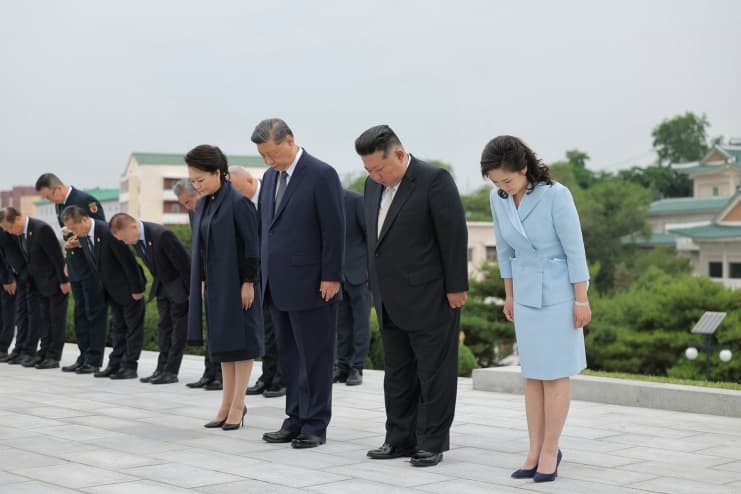
Following his recent meetings with President Donald Trump and President Vladimir Putin, Chinese President Xi Jinping traveled to Pyongyang on 8-9 June, his first visit in nearly seven years. During the summit, Xi and Kim pledged to “open a new chapter” in bilateral relations, while Xi reaffirmed China’s “unwavering” support for Pyongyang.
These commitments raise an important question. If Xi is serious about opening a new chapter in China-DPRK relations, can he also achieve what decades of denuclearization efforts have failed to deliver?
To succeed, Xi must understand why earlier denuclearization efforts failed.
Trump’s diplomacy failed not because of inapt personal diplomacy, nor because Kim was inherently unwilling to negotiate. Limited sanctions relief, temporary aid packages and vague security assurances were insufficient because they did not address the central issue: nuclear weapons remain the DPRK’s ultimate guarantee of regime survival. The United States was unable to devise a viable proposal in which the benefits clearly outweighed the strategic value of nuclear weapons to the DPRK.
For Pyongyang, nuclear weapons serve five strategic functions. First, they provide a credible deterrent against perceived U.S. military aggression. Second, they offer a cost-effective means of offsetting South Korea’s conventional military superiority. Third, they form a central pillar of the byungjin policy, linking military strength with economic development. Fourth, they reinforce the domestic legitimacy of Kim’s leadership by symbolizing a major national achievement. Finally, they enable North Korea to pursue a belligerent foreign policy posture despite its broader economic and structural weaknesses.
Any proposal aiming at denuclearization without more than making up for these functions with something stronger is doomed to fail. Ultimately, past diplomacy failed because no leader was able to contrive a viable framework in which the benefits of denuclearization outweighed the costs for the DPRK.
The Pyongyang summit demonstrated that relations between Beijing and Pyongyang are entering a new phase of closer political and economic cooperation. Yet stronger bilateral ties alone will not resolve the nuclear issue. If China wishes to translate its renewed influence into historic diplomatic achievement, it must come up with an offer Kim cannot refuse.
With its leverage over Pyongyang, China is the only country capable of devising a viable comprehensive package deal involving every major stakeholder.
If Beijing decides to pursue denuclearization as the next stage of its engagement with Pyongyang, the essential attribute of any such deal must be the permanent lifting of sanctions on the DPRK. Security guarantees must also be institutionalized. This would include diplomatic recognition by the U.S. and Japan, a permanent peace treaty with South Korea, and the reconfirmation of security treaties with both China and Russia.
However, the deeper political and economic cooperation discussed during the summit also highlights a broader reality – security guarantees alone will not suffice. To survive, the DPRK must achieve robust and dynamic economic development capable of fundamentally restructuring the country’s future. Credible development funds must be mobilized collectively, particularly by South Korea, which would benefit most directly from lasting peace and stability on the peninsula. Only through spectacular economic development can the regime substitute the legitimacy that it currently derives from nuclear weapons, extending from the elite to the mass population, by delivering visible, sustained improvements in living standards and durable domestic support.
Denuclearization would be explicitly linked to market-oriented economic reforms in the DPRK. The objective would not be limited growth, but a robust and dynamic economic transformation on a historic scale. The DPRK would need to achieve levels of development surpassing even the peak growth periods experienced by South Korea, Taiwan and China during their own developmental miracles. A realistic framework could entail approximately $30 billion in development funding over ten years, combined with economic reforms capable of generating annual growth rates exceeding 10 percent per annum, establishing the foundations for economic modernization.
Only development on this scale could plausibly replace the strategic, political and ideological functions that nuclear weapons currently provide. Nuclear weapons currently provide the regime with external security, internal legitimacy, elite cohesion, diplomatic leverage and psychological prestige. Removing them without replacing these functions would destabilize the system itself. The regime’s legitimacy is also anchored in the juche ideology established by Kim Il-sung. Abandoning both nuclear weapons and these foundations would therefore only be conceivable if spectacular economic transformation created a credible alternative source of legitimacy. Economic transformation is therefore not supplementary to denuclearization – it is the only realistic substitute for the survival guarantees that nuclear weapons currently provide.
In addition, any viable settlement must promote lasting peace and prosperity on the Korean Peninsula, preserve the DPRK’s role as a geopolitical buffer, remove both nuclear weapons and U.S. ground troops from the peninsula, and prevent further regional nuclear proliferation.
This is why neither China nor the U.S. can solve the issue alone. Only a collective framework involving all major regional actors can provide sufficient guarantees, incentives and resources to make denuclearization viable.
Such a framework would create strategic benefits for every major participant.
For China, a stable and economically developing DPRK would reduce the risk of conflict on its border, weaken the rationale for expanded U.S. military deployments in Northeast Asia, and diminish pressures for regional nuclear proliferation.
For South Korea, it would remove the constant threat of war while opening possibilities for long-term economic integration and permanent stability on the peninsula.
For Japan, it would reduce existential security threats and decrease pressure for military expansion.
For the US, the removal of American ground troops from South Korea would serve as a credible bargaining chip, enabling its long-sought objective of denuclearization.
And for the DPRK itself, denuclearization would cease to represent surrender. Instead, it would become a rational exchange: trading nuclear weapons for economic growth, international integration, regime continuity and a more durable foundation for long-term prosperity.
The Pyongyang summit created a unique opportunity for China to shape the future of the Korean Peninsula. If Xi wishes to seize it, the next step must be denuclearization.
Disclaimer : This story is auto aggregated by a computer programme and has not been created or edited by DOWNTHENEWS. Publisher: dailynk.com