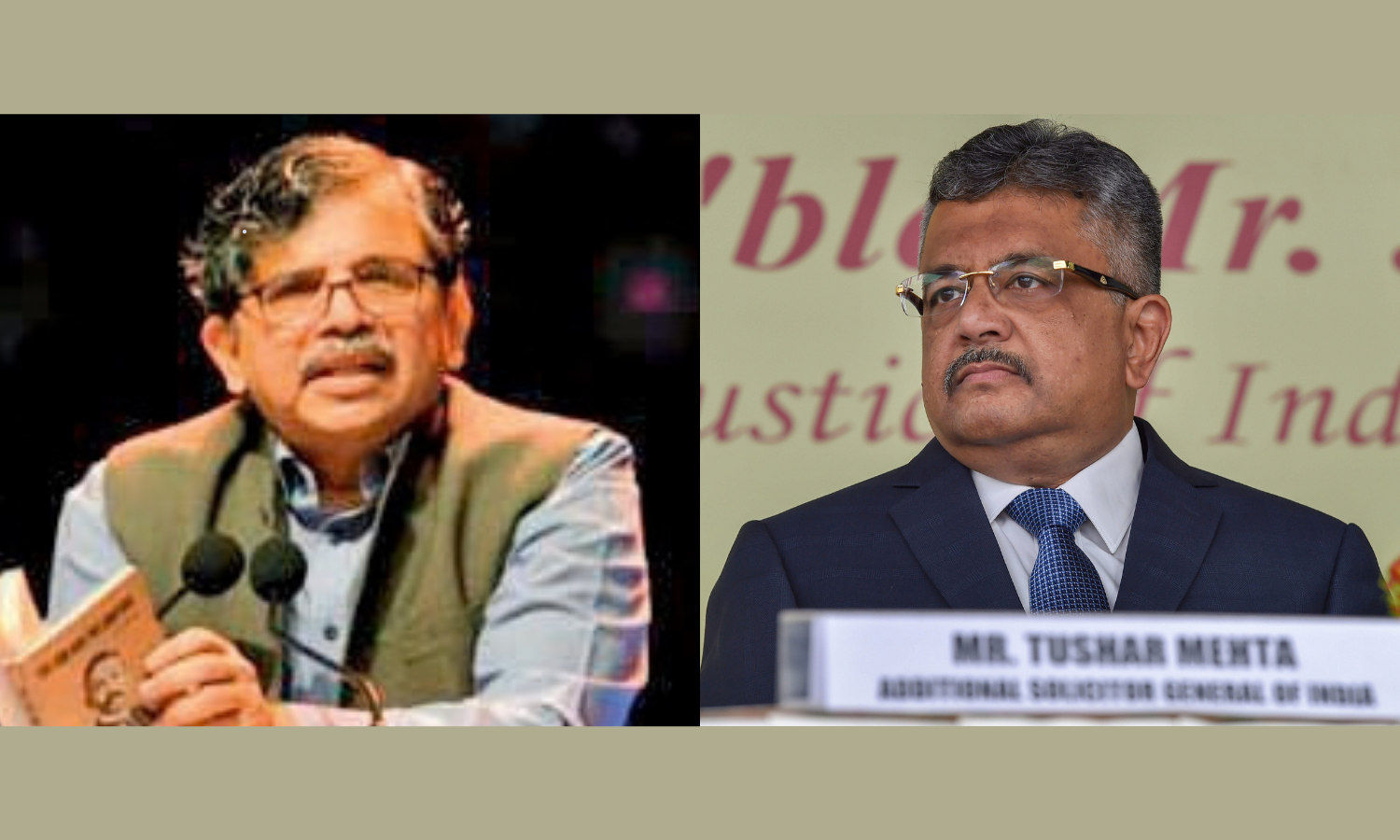
Solicitor General Tushar Mehta and Senior Advocate Dr S Muralidhar traded barbs and got into a heated exchange during the Supreme Court hearing of Carnatic musician and author TM Krishna’s plea challenging the constitutional validity of the 2026 amendment to the Prevention of Insults to National Honour Act, 1971, which extends penal protection to the National Song, Vande Mataram, as well as the Ministry of Home Affairs’ directions mandating the singing of the complete six stanzas of the song at official functions.
The plea argued that the last four stanzas violate the secular character of the nation.
President Droupadi Murmu had granted assent to the Prevention of Insults to National Honour (Amendment) Act, 2026, expanding the scope of penal provisions under the Prevention of Insults to National Honour Act, 1971 to cover the National Song (Vande Mataram) alongside the National Anthem.
Senior advocate S Muralidhar, appearing for Krishna, said the amendment does not define the expression “national song”, leaving scope for uncertainty and possible misuse.
He also said that the MHA directions were issued through an Office Memorandum which had not been gazetted and contended that the government had altered the earlier understanding of Vande Mataram through executive instructions.
Muralidhar said the amendment had been enacted without defining which version or stanzas constituted the National Song.
When Justice Bagchi observed that Vande Mataram was customarily understood as the national song, Muralidhar said the established understanding related to its first two stanzas.
The senior lawyer further submitted that the amendment had been enacted hastily and without what he described as a process of national consensus.
During the exchanges, Solicitor General Tushar Mehta opposed the petitioner’s submissions and submitted that “secularism cannot be this narrow”.
At another stage, the solicitor general said that “law making cannot be as per Naxalites idea”.
Muralidhar strongly objected to the submissions and sought withdrawal of the remark, saying such a comment did not “befit” a law officer. “Withdraw the expression you used just now. This is going live… I strongly object,” he said.
Mehta said his reference was to those who, according to him, did not respect the law-making process. After the hearing, Muralidhar again sought a retraction, but the Solicitor General declined to withdraw the remark.
“I can repeat what I said. One has to go by law. I am not sorry about what I said. I said that is the constitutional way, not what the Naxalite wants. And I am not sorry about it,” the solicitor general said.
Muralidhar later accused the solicitor general of “playing to the gallery”. “He is again repeating it. I am now going to register my strongest protest… To think is not to be a Naxalite.”
Justice Joymalya Bagchi intervened, stressing the role of constitutional institutions and observing that even a person alleged to be a terrorist has equal rights under the Constitution.
Vande Mataram Row
The Supreme Court has asked the Centre to respond to the plea and cited its 1986 judgment protecting children who refused to sing the national anthem on grounds of conscience.
The court said it would expect the principle laid down by the Supreme Court in its 1986 judgment in Bijoe Emmanuel vs State of Kerala to govern the amended law. In that case, the court had protected schoolchildren who respectfully declined to sing the national anthem on grounds of conscience.
The bench indicated that it was not for the court to determine what constitutes the national song, but said it would examine whether the rights of a “conscientious objector”, particularly one who declines to sing on religious grounds, are protected under the law.
The bench said determining the national song was a matter for the democratic state and the court would not second-guess the national sentiment or aspiration associated with Vande Mataram.
At the same time, it indicated that a conscientious objector should not be subjected to criminal consequences merely for declining to sing one or more stanzas.
“Nobody who feels an infraction of Article 25, 26 rights (freedom to practice religion under the Constitution) or a conscientious objector would be subjected to (penal consequences),” Justice Bagchi said.
Disclaimer : This story is auto aggregated by a computer programme and has not been created or edited by DOWNTHENEWS. Publisher: deccanchronicle.com